AI Hyperscaler Cooling for Real Heat Loads
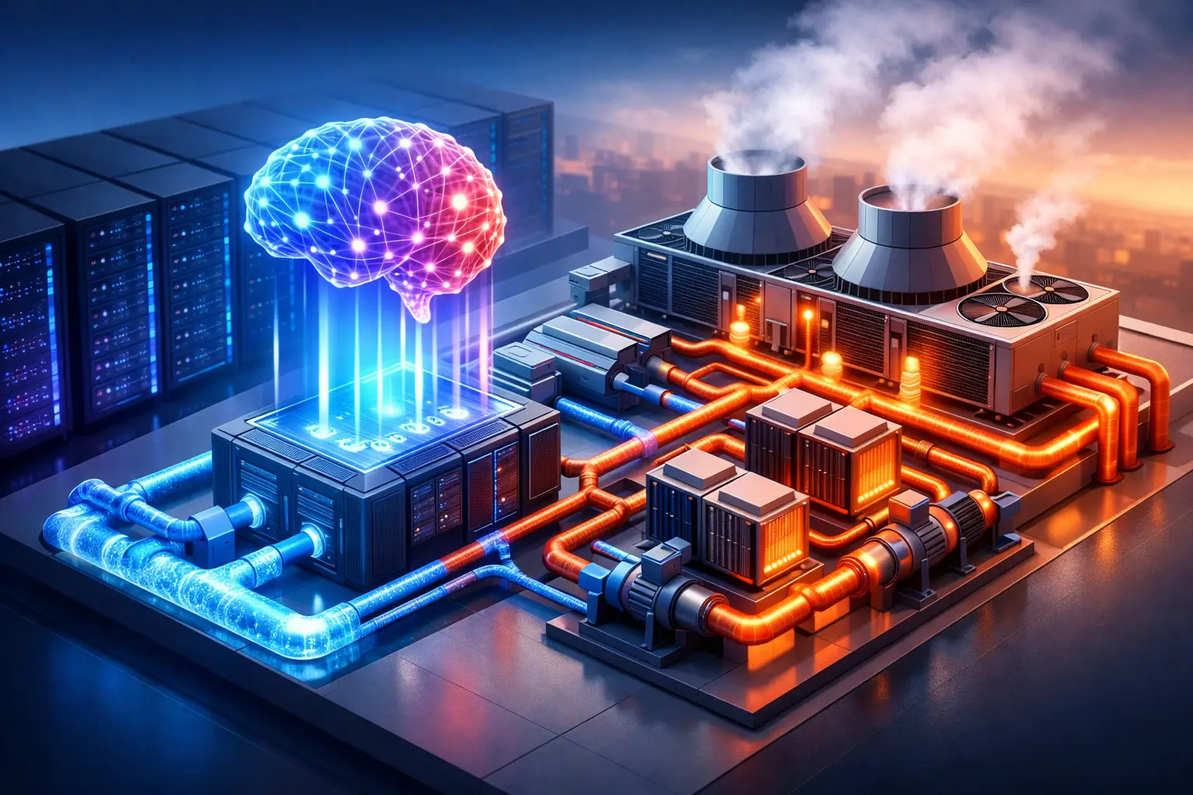
An AI hyperscaler does not have a traditional data center heat problem. It has a rapidly changing, extremely concentrated heat-rejection problem. A single high-density AI rack can impose thermal loads that would have once been spread across an entire row of conventional servers. When that heat is not removed predictably, the result is not merely a warm room. It can mean processor throttling, equipment faults, shortened component life, lost capacity, and a facility that cannot add the next generation of hardware.
For operators, engineers, and developers, cooling design has to begin before equipment is ordered. The required airflow, static pressure capability, exhaust path, make-up air volume, filtration approach, and control strategy must match the actual compute load and the selected cooling architecture. Oversizing a few wall fans is not a heat-management plan.
Why AI Hyperscaler Heat Loads Change the Design
AI training and inference environments use GPU and accelerator platforms that draw substantially more power per rack than general-purpose server deployments. That electrical power becomes heat. The basic conversion is straightforward: one kilowatt of electrical load produces approximately 3,412 BTU per hour of heat.
The difficult part is that the load is not always stable. GPU utilization can rise sharply during training cycles, workloads may be redistributed between rooms, and new hardware can change the thermal profile of a rack without changing the footprint. A building designed around average demand can fail during peak operation, which is exactly when uptime matters most.
An AI hyperscaler facility also cannot treat room temperature as the only measurement that matters. Intake air temperature, exhaust air temperature, rack inlet conditions, differential pressure, hot-aisle containment performance, coolant supply temperature, and fan power all affect real operating capacity. If hot exhaust air recirculates into server inlets, the cooling plant may appear to be operating while the IT equipment sees unacceptable temperatures.
Air Cooling Still Has a Role, but It Has Limits
Air cooling remains practical for lower-density racks, electrical rooms, network areas, and facility spaces that support an AI deployment. Properly selected axial, centrifugal, or mixed-flow equipment can remove large volumes of sensible heat when there is a clear supply-air and exhaust-air path.
The design question is not simply, “How many CFM do we need?” CFM must be evaluated with the allowable temperature rise and the resistance created by louvers, dampers, filters, ductwork, plenums, sound attenuation, and discharge conditions. A fan rated at a high free-air CFM may deliver far less air once it is installed against real system static pressure.
For preliminary planning, sensible heat removed by air can be estimated using the familiar relationship:
BTU/hr = 1.08 x CFM x temperature difference
If a room must reject 341,200 BTU/hr, equivalent to about 100 kW of continuous electrical load, and the design allows a 20°F air temperature rise, the theoretical requirement is roughly 15,800 CFM. That calculation is only a starting point. It does not account for fan derating, leakage, recirculation, altitude, outdoor temperature, or redundancy requirements.
At higher rack densities, air volume becomes difficult and expensive to manage. Large air quantities require larger openings, bigger ducts, higher fan energy, and more careful pressure control. The heat may also be too concentrated for air to capture efficiently at the rack level. That is where liquid cooling moves from an option to a design requirement.
Direct-to-Chip, Immersion, and Facility Heat Rejection
Direct-to-chip liquid cooling captures heat at the processors through cold plates and moves it through a coolant distribution unit. It can substantially reduce the air-side burden in the white space, although power supplies, memory, networking equipment, and other components may still release heat into the room.
Immersion cooling places compatible hardware in dielectric fluid, allowing heat to be transferred from the fluid loop to a facility water loop or dry cooler system. It can support very high heat density, but it introduces operational considerations: hardware compatibility, service procedures, fluid management, leak detection, maintenance access, and the ability to expand without disrupting production equipment.
Neither approach eliminates the need for facility ventilation. Electrical switchgear rooms, UPS rooms, transformer areas, battery systems, generator enclosures, pump rooms, and occupied work areas all have their own heat and air-quality requirements. In some locations, code-required smoke control, battery ventilation, combustible-gas detection, or emergency purge provisions must be coordinated with the mechanical design.
The practical goal is to separate heat streams. Use liquid systems to carry concentrated IT heat where they are most effective. Use engineered air systems to ventilate support spaces and remove residual heat without pulling hot discharge air back into critical intake locations.
Do Not Design Exhaust Without Make-Up Air
High-capacity exhaust fans create negative pressure unless replacement air can enter the building in a controlled manner. This is a frequent failure point in containerized mining, retrofitted warehouses, and fast-track compute expansions. The fans may run, but actual airflow falls because the building cannot supply enough replacement air.
Negative pressure can pull dust through cracks, interfere with door operation, draw in hot air from mechanical yards, and reduce fan performance. In cold climates, it can create freeze risks around piping and cause uncomfortable or unsafe conditions for personnel. In hot or humid regions, unconditioned make-up air may add more sensible and latent load than the cooling system can absorb.
Make-up air selection depends on climate, contamination exposure, room pressurization targets, and operating mode. A filtered supply fan system may be appropriate where outside air quality is acceptable and the heat load is largely sensible. In other applications, packaged cooling, air handlers, indirect evaporative cooling, or a closed-loop liquid system may be more suitable. The correct answer depends on the annual weather profile and the facility's tolerance for outdoor-air variability.
Static Pressure, Recirculation, and Fan Selection Matter
A ventilation design should identify every restriction between the fan inlet and discharge point. Bird screens, motorized dampers, intake louvers, MERV filters, light traps, elbows, roof curbs, weather hoods, and long discharge ducts each add resistance. Selecting equipment from a free-air rating instead of a fan curve can leave a critical room thousands of CFM short.
Fan placement is equally important. Exhaust discharge needs adequate separation from outdoor-air intakes, condenser coils, generator combustion-air openings, and neighboring buildings. A roof fan that sends hot discharge into a nearby intake can create a self-inflicted heat loop. The same concern applies to ground-mounted dry coolers and cooling towers, where plume and airflow interactions must be reviewed.
Variable frequency drives provide valuable control when loads change, but they are not a substitute for correct fan sizing. A VFD can reduce fan speed during low load, maintain differential pressure, and stage multiple fans. It cannot make an undersized fan overcome more static pressure than its curve permits. Controls should be based on meaningful inputs such as rack inlet temperature, room pressure, coolant temperature, and fan status - not a single thermostat mounted in the wrong location.
Build Redundancy Around Failure Modes
AI infrastructure is often designed with N+1 or greater redundancy for power and cooling. The ventilation system should be evaluated with the same discipline. If one exhaust fan, VFD, control panel, pump, or motor fails during peak load, can the remaining equipment maintain safe operation until service is completed?
Redundancy also requires independent electrical feeds where appropriate, alarm notification, manual override capability, and maintenance access. Two fans on the same failed branch circuit are not meaningful redundancy. Likewise, a backup fan that cannot operate because its damper is closed or its discharge path is blocked does not protect the load.
Commissioning should include more than verifying fan rotation. Measure airflow, room pressure, temperature rise, motor amperage, VFD operation, alarm response, and recovery after a staged equipment failure. Baseline readings give operations teams a way to identify declining performance caused by dirty filters, belt wear, bearing issues, damaged louvers, or unexpected changes in IT load.
Start With the Heat Load, Then Engineer the Air Path
A credible AI hyperscaler cooling plan starts with utility demand, rack density, cooling method, site climate, available floor area, and planned expansion. From there, the engineering team can calculate heat rejection and identify whether the solution requires high-static exhaust, filtered make-up air, roof-mounted ventilation, containment modifications, liquid cooling support, or a hybrid approach.
Factory Fans Direct provides project evaluation for data center and crypto mining cooling applications where CFM, static pressure, motor selection, duty cycle, and equipment matching cannot be guessed from a catalog page. A few accurate inputs at the beginning can prevent expensive rework after racks are energized.
The best time to validate airflow and heat rejection is before the next megawatt of compute goes online.
Factory Fans Direct - Crypto Mining & Data Center Cooling Experts Contact Mike Miller VP Engineering at Factory Fans Direct for a FREE Project Evaluation 888-849-1233 | Mike@FactoryFansDirect.com
Recent Posts
-

Smart Buildings Architects Recommend Edmonds ecoPOWER Hybrid Ventilation
A rooftop ventilator should not force an all-or-nothing energy decision. Smart Buildings Architects …7th Sep 2026 -
Smart Industrial Buildings Use Edmonds ecoPOWER Hybrid Ventilation
A roof exhaust system can be the difference between a plant that controls heat at the source and one …7th Sep 2026 -
Smart Commercial Buildings Use Edmonds Hybrid Ventilation
A rooftop exhaust fan that only performs when the wind blows is not a complete ventilation strategy. …7th Sep 2026