AI Data Center Design That Addresses Community Concerns
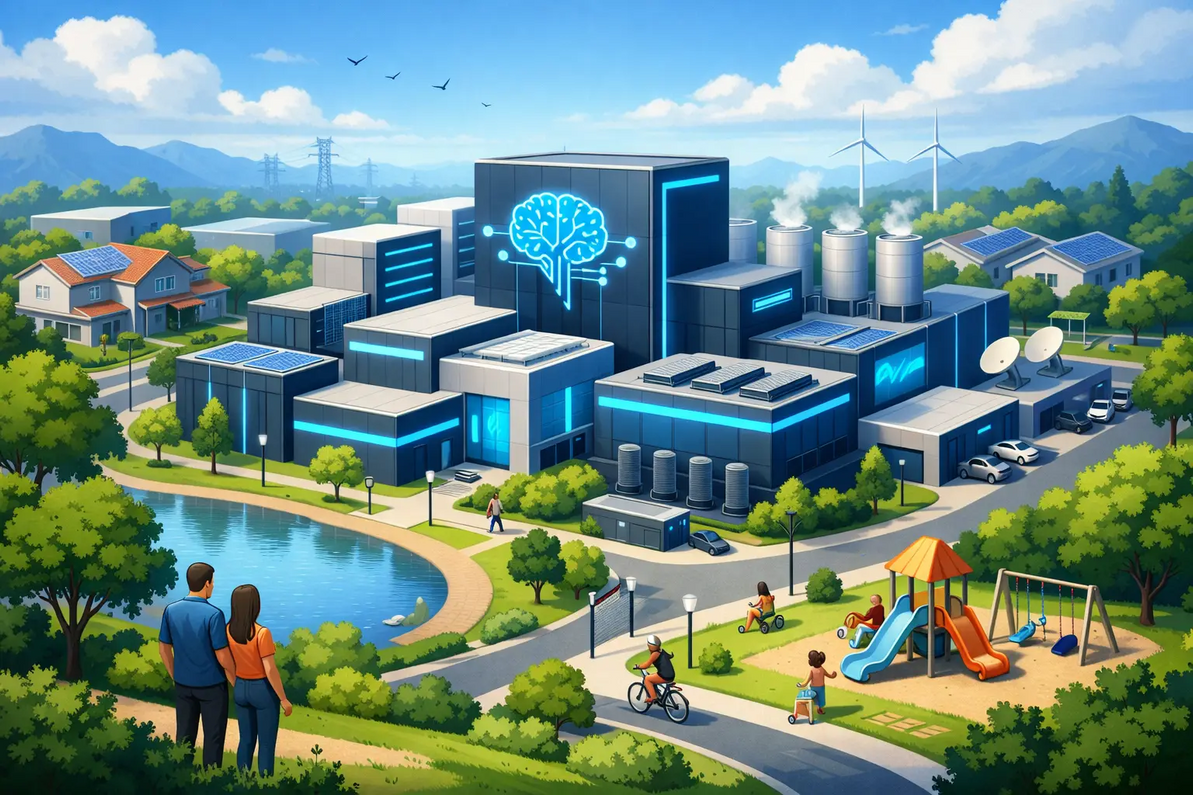
A data center can meet its IT load, uptime target, and budget and still fail the community test. Neighbors do not experience megawatts, PUE, or rack density. They experience transformer noise at night, diesel generator testing, water restrictions, construction traffic, and a facility that appears to consume local resources without providing a clear benefit. AI Data Center Design that can coexist with Communities Concerns has to engineer those real-world impacts into the project before the first equipment pad is poured.
For AI operators, the pressure is obvious. GPU clusters are driving higher rack densities, higher heat rejection requirements, and faster deployment schedules. For communities, the pressure is just as real: electricity capacity, water availability, land use, noise limits, air quality, and trust. The strongest projects do not treat these as public-relations obstacles. They treat them as design inputs with measurable performance requirements.
Start With the Thermal Architecture, Not the Equipment Catalog
AI loads are not traditional enterprise loads. A conventional air-cooled white space may have been designed around relatively modest rack densities. AI deployments can place far more heat in a smaller footprint, with rapid load changes and equipment that may require direct-to-chip liquid cooling, rear-door heat exchangers, immersion cooling, or a carefully engineered hybrid approach.
The first decision is where heat will be collected and where it will be rejected. That sounds basic, but it determines the project’s water demand, outdoor sound profile, electrical demand, redundancy plan, and physical footprint. A poor early decision can leave a facility dependent on loud rooftop equipment, oversized evaporative systems, or emergency ventilation added after the building shell is complete.
Air cooling remains practical for certain halls, lower-density zones, network rooms, and support spaces. It can also support AI environments when airflow containment, supply temperatures, and heat loads are honestly calculated. However, specifying fans by free-air CFM alone is not engineering. Fan selection must account for actual static pressure across louvers, filters, dampers, heat exchangers, duct transitions, and discharge conditions. The operating point matters more than the nameplate.
For high-density halls, liquid cooling often reduces the amount of air that must move through the white space. That can reduce fan energy and make containment more manageable. It does not eliminate heat rejection. The design still needs to answer where that heat goes, how much water is required, how equipment performs during peak ambient conditions, and what happens if a cooling loop, pump, controller, or utility feed is unavailable.
AI Data Center Design Must Make Noise a Core Load Case
Noise complaints often emerge after commissioning because noise was evaluated as a compliance calculation rather than an operating condition. A facility may pass a daytime property-line measurement yet become disruptive during low-background nighttime conditions, especially when multiple fans, cooling units, transformers, and generators operate together.
Sound planning should begin with a complete source inventory. Include cooling towers or fluid coolers, condenser fans, air-cooled chillers, dry coolers, make-up air systems, exhaust fans, standby generators, transformers, and periodic testing. Then evaluate sound at sensitive receptors, not only at the property line. Nearby homes, schools, hospitals, parks, and future residential development may have different expectations and local requirements.
Fan speed is particularly important. Variable frequency drives can reduce energy use and sound when the system has capacity margin. But a VFD is not a cure for an undersized or poorly located system. If cooling equipment must run at maximum speed during warm evenings, the sound benefit disappears precisely when neighbors are most likely to notice it.
Low-sone fan selection, discharge orientation, acoustical screening, intake and discharge silencers, vibration isolation, and equipment placement all have a role. The trade-off is static pressure. Every sound attenuator, louver, screen, and restrictive architectural enclosure adds resistance. The ventilation design must recheck fan curves, brake horsepower, motor capacity, and delivered CFM after the acoustic features are included. Quiet equipment that cannot move the required air is not a solution.
Water Strategy Must Be Specific to the Site
Water is where generic sustainability claims break down. The right cooling approach in a humid Southeast location may be the wrong approach in an arid Western market under drought restrictions. A project team needs an annual water balance, not a single design-day estimate.
Evaporative cooling can be highly effective under the right ambient conditions, but it introduces water consumption, treatment requirements, blowdown, plume considerations, and public scrutiny. Air-cooled and dry cooling approaches can sharply reduce site water use, but they may require more fan power, more outdoor equipment area, and potentially higher operating costs during extreme heat. Hybrid systems may offer a useful middle ground, using water only during the conditions where it produces a meaningful efficiency benefit.
The community-facing question is not simply, “Does the facility use water?” Nearly every industrial operation uses some water. The better question is whether the operator has matched its cooling strategy to local availability, disclosed its assumptions, and built a plan for drought response. That plan can include reclaimed water where available, leak detection, metering by cooling zone, seasonal operating limits, and the ability to shift from evaporative to dry operation when conditions require it.
Water Availability Is Not the Same as a Water Plan
Closed-loop direct-to-chip cooling does not necessarily consume large volumes of water at the server level. The critical question is how the facility rejects heat. Evaporative cooling towers can provide favorable energy performance, particularly in hot climates, but they require make-up water, blowdown management, chemical treatment, and a clear plan for seasonal or drought-related restrictions.
Dry coolers reduce dependence on water but may require more fan energy, larger outdoor equipment footprints, or supplemental mechanical cooling during high ambient temperatures. Hybrid systems can balance these constraints, but they add operating complexity. There is no universal best choice. The right decision depends on local wet-bulb and dry-bulb design conditions, water cost, discharge rules, water quality, noise limits, and the owner’s uptime target.
Water quality is an engineering requirement, not a maintenance afterthought. Poor chemistry can cause corrosion, scaling, biological growth, blocked strainers, reduced heat transfer, and premature failures in heat exchangers and valves. Specify filtration, side-stream treatment, monitoring points, leak detection, isolation valves, and service access from day one.
Plan Electrical Capacity Without Treating the Grid as Unlimited
AI data centers can be major electrical loads, and a project may require new substations, feeder upgrades, transmission work, or generation resources. Communities understandably want to know whether new demand will raise costs, reduce reliability, or delay housing and business development.
A credible design process coordinates early with the serving utility and models more than the initial phase. It considers the full build-out load, phased energization, backup generation, battery storage, demand-response capability, and the cooling system’s coincident peak demand. During hot weather, cooling equipment and computing load can peak together. That combined profile matters.
Load flexibility can improve both grid relationships and operating economics. Noncritical mechanical loads may be staged, thermal storage may shift some cooling demand, and controls may reduce selected loads during utility events. These options depend on the uptime tier, customer commitments, and process requirements. They should never be represented as available flexibility if the site cannot safely use them.
Backup power requires equal care. Generator exhaust, fuel storage, testing schedules, and runtime rules affect community acceptance. Weekly testing at an inconvenient hour may meet a narrow operating requirement while creating a recurring neighborhood nuisance. Coordinated test windows, cleaner fuel options where feasible, battery-supported ride-through, and well-designed exhaust discharge can reduce that burden.
Construction Impacts Need Their Own Engineering Plan
Residents often form their opinion of a data center long before it operates. Months of truck traffic, dust, night lighting, idling equipment, and blocked access can create opposition that no post-construction landscaping will fully erase.
Construction management should set defined haul routes, delivery hours, dust-control methods, staging areas, lighting limits, and a response process for complaints. The project should also identify heavy or oversized deliveries early so traffic control does not become an emergency exercise. This is not separate from facility planning. Equipment size, modularization strategy, cooling plant location, and electrical yard layout all influence construction impacts.
Measure What You Promise
Community coexistence improves when commitments can be verified. Publish meaningful operating targets where appropriate, then install the meters, sensors, controls, and maintenance access required to manage them. Useful measurements include water use by cooling system, cooling energy, fan speed, differential pressure, supply and return temperatures, generator test hours, and sound readings at selected locations.
Mechanical systems also need maintainability. A fan array that looks efficient on a schedule can become noisy and energy-intensive when filters load, belts wear, dampers stick, or controls drift. Specify service clearances, access doors, isolation, spare parts strategy, and controls alarms. Commission at realistic operating conditions, including high-load cooling operation and coordinated equipment sequences.
A community-compatible facility is not necessarily the one with the lowest first cost. It is the one that can prove its heat, sound, water, and power impacts are controlled over the life of the building. That requires practical airflow design, honest load calculations, and equipment selected for the actual static pressure and operating environment.
Factory Fans Direct - Crypto Mining & Data Center Cooling Experts Contact Mike Miller VP Engineering at Factory Fans Direct for a FREE Project Evaluation 888-849-1233 | Mike@FactoryFansDirect.com
Recent Posts
-

Smart Buildings Architects Recommend Edmonds ecoPOWER Hybrid Ventilation
A rooftop ventilator should not force an all-or-nothing energy decision. Smart Buildings Architects …7th Sep 2026 -
Smart Industrial Buildings Use Edmonds ecoPOWER Hybrid Ventilation
A roof exhaust system can be the difference between a plant that controls heat at the source and one …7th Sep 2026 -
Smart Commercial Buildings Use Edmonds Hybrid Ventilation
A rooftop exhaust fan that only performs when the wind blows is not a complete ventilation strategy. …7th Sep 2026