
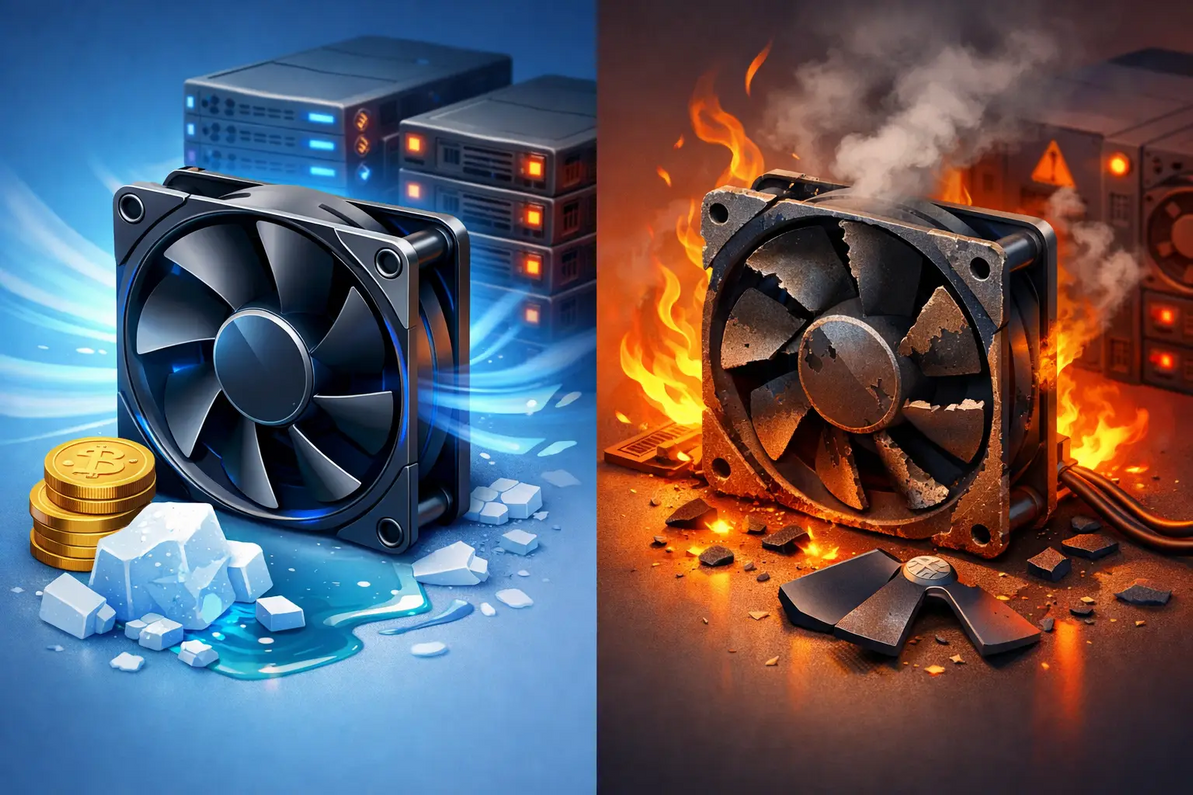
Why Low Temp & Low SP Crypto Mining Exhaust Fans Fail | Ask the Experts
If your mining room keeps getting hotter even though the exhaust fan is running nonstop, the problem usually is not "bad luck" or a weak motor. It is a design mismatch. Why Low Temp & Low SP Crypto Mining Exhaust Fans Fail | Ask the Experts comes down to one simple issue: these fans are often selected for free-air performance, then installed into systems with real restriction, real heat load, and no margin for static pressure.
In crypto mining, fan failure is not always a burned motor or broken blade. More often, it is performance failure. The fan still spins, but it no longer moves the CFM required to remove ASIC heat. That is when inlet temperatures rise, miner throttling starts, and power efficiency drops.
Why low temp and low SP crypto mining exhaust fans fail
Low temperature and low static pressure fans are built for lighter-duty environments. They can work in clean air, short duct runs, and low-resistance applications. A mining facility is usually the opposite. You are dealing with concentrated BTU loads, filter resistance, louvers, weather hoods, shutters, light traps in some applications, and long air paths that create pressure the fan has to overcome.
A fan might look great on paper at 0.0 static pressure. That number can be misleading. The moment you add intake restriction, discharge accessories, dirty filters, or poorly designed openings, airflow drops. In many mining projects, that drop is severe enough to make the fan effectively undersized on day one.
This is where many buyers get trapped by nominal CFM ratings. They buy based on catalog airflow without checking the fan curve. If the system operates at 0.5, 0.75, or 1.0 inches of static pressure and the selected fan was really intended for very low SP conditions, actual delivered airflow may be nowhere near the requirement.
Static pressure is where the real trouble starts
Crypto mining ventilation is rarely a free-air application. Even container mining and retrofitted warehouse setups develop resistance from intake wall design, dampers, silencers, bird screen, and exhaust transitions. Add dust loading over time, and static pressure rises further.
When a low SP fan is forced into a higher-pressure system, three things happen. Airflow falls off, motor loading can move outside the intended range, and the fan operates farther from its peak efficiency point. That creates higher operating stress and poorer heat removal at the exact time you need stable performance.
A second issue is temperature class. Low temp fans may not be built for the continuous elevated airstream temperatures seen in mining exhaust. The air leaving a dense ASIC room is not mild ventilation air. If the fan wheel, bearings, motor insulation, or drive components are not selected for that duty, service life shrinks fast.
Common sizing mistakes in mining exhaust design
The most common mistake is sizing to room volume instead of equipment heat load. Mining rooms are not comfort-cooling spaces. They are process-cooling environments. The fan must be selected around total BTUs, allowable temperature rise, intake conditions, and system resistance.
Another mistake is using too little intake area. Even a properly selected exhaust fan will struggle if the make-up air path is undersized. That creates negative pressure, starves airflow, and raises fan workload. Operators then blame the exhaust fan when the real problem is system balance.
There is also the issue of future scaling. A fan package that works for today's miner count may fail after additional racks are installed. If you do not design for growth, seasonal temperature swings, and dirty operating conditions, you leave no safety factor.
What experts look at before specifying a fan
A proper mining ventilation evaluation starts with miner model, quantity, wattage, room layout, intake path, exhaust path, and target temperature delta. From there, the fan selection has to match the required CFM at actual static pressure, not at ideal lab conditions.
Engineers also look at motor type, insulation class, ambient rating, bearing design, drive method, and serviceability. In mining, uptime matters more than bargain pricing. A lower-cost fan that cannot hold airflow against pressure or survive elevated exhaust temperatures is expensive the moment miners begin to derate.
That is why high temp and higher static pressure exhaust fans are often the right answer for serious mining applications. Not in every case, but in many of them. The correct choice depends on the full system, not just the fan nameplate.
The better question is not "What fan fits?"
The better question is, "What fan delivers required airflow at my real operating conditions?" That includes dirty filters, summer ambient temperatures, intake restriction, and expansion plans. Once you ask that question, many low temp and low SP products drop out of consideration quickly.
For mining operators, facility managers, engineers, and installers, this is where expert fan curve review and ventilation design support pay for themselves. Proper fan selection protects miner performance, electrical efficiency, and equipment life. It also prevents the common and costly cycle of replacing one underperforming fan with another.
Factory Fans Direct works with crypto mining and data center applications where static pressure, heat rejection, and equipment matching cannot be guessed. If your current fan package is falling short, a free project evaluation can usually identify whether the issue is fan class, pressure loss, intake design, or total heat-load mismatch.
Factory Fans Direct - Crypto Mining & Data Center Cooling Experts Contact Mike Miller VP Engineering at Factory Fans Direct for a FREE Project Evaluation 888-849-1233 | Mike@FactoryFansDirect.com
Recent Posts
-

AI Smart Buildings Incorporate Edmonds ecoPOWER Hybrid Turbine Ventilation
A building automation system can report rising rooftop temperatures, increasing indoor contaminants, …12th Sep 2026 -
Smart Buildings Architects Recommend Edmonds ecoPOWER Hybrid Ventilation
A rooftop ventilator should not force an all-or-nothing energy decision. Smart Buildings Architects …7th Sep 2026 -
Smart Industrial Buildings Use Edmonds ecoPOWER Hybrid Ventilation
A roof exhaust system can be the difference between a plant that controls heat at the source and one …7th Sep 2026