Cooling Guide for Crypto Mining & Data Centers
A mining container or data hall can reach shutdown temperatures fast when cooling is treated as a fan purchase rather than an engineered air-management system. This Cooling Guide for Crypto Mining & Data Centers starts with the number that matters most: nearly every watt consumed by servers, ASIC miners, power supplies, and network equipment becomes heat that must be removed.
Start With the Actual Heat Load
Electrical input is the foundation of cooling design. Convert the measured or planned equipment load to heat using 3.412 BTU per hour for every watt. A 1 MW mining operation, for example, produces approximately 3.412 million BTU per hour before accounting for lighting, transformers, occupancy, and heat transfer through the building envelope.
Do not size from nameplate assumptions alone. ASIC fleets can have different power draw by model, firmware, hash rate setting, and ambient conditions. Data center loads also vary with utilization. Use the highest credible operating load, then include a practical margin for growth and seasonal exposure.
For air-cooled operations, required airflow can be estimated with this formula:
CFM = BTU per hour ÷ (1.08 × allowable temperature rise)
If a facility must remove 341,200 BTU per hour with a 20°F rise from intake to exhaust, the starting point is roughly 15,800 CFM. That is only a starting point. Real performance changes with elevation, filter loading, louvers, duct losses, equipment restrictions, and the static pressure capability of the selected exhaust fan.
Airflow Must Follow a Controlled Path
High CFM without a defined air path can create recirculation, hot aisles, and wasted fan energy. The goal is simple: bring the coolest practical air to equipment intakes, move it through the heat-producing equipment once, and remove it before it can migrate back to the intake side.
In a mining building, this commonly means filtered intake openings on one side and high-temperature exhaust fans on the opposite wall or roof line. In containers, fan placement and louver free area must support the miner layout without starving end rows. In data centers, hot-aisle or cold-aisle containment may be necessary when rack density is high or supply-air temperature margins are narrow.
Intake area is frequently undersized. A small louver opening may look adequate on a plan but impose substantial pressure loss after screens, bird mesh, filters, and blades are considered. Restrictive intake conditions force fans farther out on their performance curve, reducing delivered CFM and raising motor load. Design around net free area, not rough opening dimensions.
Select Fans by Static Pressure, Not Catalog CFM
A fan advertised at 30,000 CFM may not deliver 30,000 CFM in your facility. That rating is often measured at little or no static pressure. Once air moves through louvers, filters, ductwork, dampers, sound attenuators, or evaporative media, system resistance rises.
Specify fan performance at the calculated static pressure and verify the fan curve. For high-heat crypto mining, heavy-duty exhaust fans with suitable motors, bearings, guards, and temperature ratings are typically required. Corrosive environments, dusty locations, and outdoor installations may also require specific coatings, weather protection, or motor enclosures.
Variable frequency drives provide useful control when load, outdoor temperature, or utility pricing changes. However, a VFD cannot correct an undersized intake, poor containment, or an improperly selected fan. Use controls to trim a sound mechanical design, not compensate for one.
Choose Air, Evaporative, or Liquid Cooling Based on the Site
Direct outside-air ventilation can be the lowest-cost cooling approach in dry or moderate climates, particularly for mining applications that can tolerate wider inlet temperature ranges. Its trade-off is exposure to dust, humidity swings, smoke events, and seasonal extremes. Filtration and maintenance become operational requirements, not optional accessories.
Evaporative cooling can reduce inlet temperatures substantially in hot, dry regions. It becomes less effective as outdoor wet-bulb temperature rises, and it adds water treatment, media maintenance, and humidity management to the facility plan. The pressure drop across cooling media must be included in fan selection.
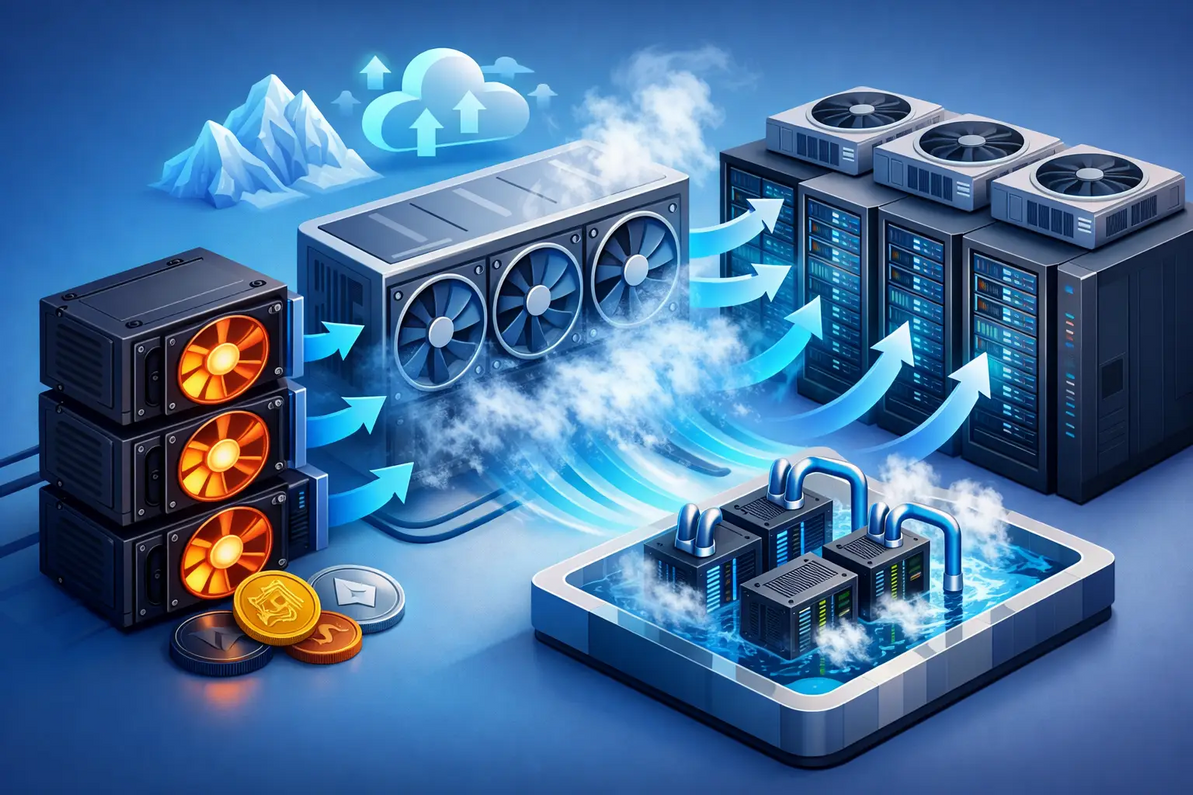
Immersion cooling and hydro cooling can support very high compute density and reduce dependence on massive air movement at the equipment level. They also change the project scope. Heat still must leave the fluid loop through dry coolers, cooling towers, chillers, or heat-recovery equipment. Pumping energy, fluid compatibility, leak management, redundancy, and service access all need engineering review.
Protect Uptime With Monitoring and Redundancy
Temperature alone is not enough. Monitor intake temperature, exhaust temperature, differential pressure across filters, fan status, motor current, and room or container pressure. A rising intake-to-exhaust differential can signal falling airflow, blocked filters, failed fans, or recirculation before miners begin throttling or servers alarm.
For critical facilities, divide fans and electrical feeds into independent zones. Avoid placing all cooling capacity on one controller, one breaker, or one roof section. N+1 capacity is valuable when downtime costs exceed the cost of an additional fan, drive, or standby cooling module.
Factory Fans Direct provides free project evaluation support for crypto mining and data center cooling applications, which is where practical engineering guidance saves time and prevents expensive installation mistakes. The earlier that review happens, the easier it is to avoid overspending on the wrong hardware.
Factory Fans Direct - Crypto Mining & Data Center Cooling Experts Contact Mike Miller VP Engineering at Factory Fans Direct for a FREE Project Evaluation 888-849-1233 | Mike@FactoryFansDirect.com
Recent Posts
-

Smart Buildings Architects Recommend Edmonds ecoPOWER Hybrid Ventilation
A rooftop ventilator should not force an all-or-nothing energy decision. Smart Buildings Architects …7th Sep 2026 -
Smart Industrial Buildings Use Edmonds ecoPOWER Hybrid Ventilation
A roof exhaust system can be the difference between a plant that controls heat at the source and one …7th Sep 2026 -
Smart Commercial Buildings Use Edmonds Hybrid Ventilation
A rooftop exhaust fan that only performs when the wind blows is not a complete ventilation strategy. …7th Sep 2026