Warehouse Ventilation Trends 2026
A warehouse that runs hot by 2 p.m., traps forklift exhaust near loading zones, or leaves stagnant air over picking lines is not dealing with a comfort problem. It is dealing with a production, safety, and equipment-life problem. That is why warehouse ventilation trends 2026 are moving well beyond basic exhaust and toward engineered airflow strategies built around heat load, occupancy, door cycles, product sensitivity, and energy costs.
For facility managers, design engineers, and warehouse owners, the shift is practical. Air movement is no longer being treated as a standalone fan purchase. It is being evaluated as a system - roof exhaust, make-up air, destratification, controls, filtration where needed, and airflow paths that actually match how the building operates.
What is driving warehouse ventilation trends 2026
The biggest driver is operating density. Warehouses are carrying more racking, more automation, more charging equipment, and more packaged goods in the same cubic volume. That raises sensible heat loads and creates more localized hot zones, especially near mezzanines, battery charging stations, conveyor runs, and upper rack levels.
Energy pressure is the second factor. Facilities are under pressure to reduce electrical demand without sacrificing indoor air quality or worker conditions. That is pushing interest toward high-efficiency fan motors, variable frequency drives, hybrid rooftop ventilators, and control packages that modulate airflow instead of running full output all day.
The third driver is compliance and risk management. In many buildings, ventilation design must now account for indoor air quality expectations, smoke migration concerns, process heat, and in some cases corrosive or particulate-laden air. A generic fan schedule rarely covers those realities.
Smarter controls are replacing simple on-off ventilation
One of the clearest changes in warehouse ventilation trends 2026 is the move toward control-based ventilation. Older warehouse systems often ran at a fixed speed or were switched manually based on complaints. That approach wastes power and usually responds too late.
Now, more projects are pairing exhaust fans, HVLS fans, and make-up air systems with temperature sensors, humidity sensors, pressure monitoring, and programmable logic. In practical terms, that means the building can respond differently on a 55-degree morning than on a 98-degree afternoon with all dock doors active.
This does not mean every warehouse needs a complicated building automation platform. In many cases, a variable frequency drive with staged control solves the problem. But the direction is clear: facilities want airflow that tracks actual conditions, not assumptions made at startup.
Why controls matter in real warehouse conditions
The value of controls shows up fastest in buildings with fluctuating occupancy and process loads. A distribution center with peak afternoon forklift traffic needs a different ventilation profile than a storage warehouse with limited personnel movement. If both are run with the same fixed-speed strategy, one will be over-ventilated and the other under-ventilated.
Controls also help maintain pressure balance. That matters when large exhaust volumes are installed. Without enough make-up air, the building can pull in dust, create door issues, and reduce fan performance. Good engineering still starts with CFM calculations and static pressure, but controls make the system usable day to day.
HVLS fans are being used more strategically
HVLS fans are not new, but the application is getting sharper. In 2026, the trend is less about installing oversized fans because they are popular and more about using them where destratification and floor-level air movement actually improve conditions.
In high-bay warehouses, heat stratification can create a major temperature split between the occupied zone and the roof deck. That trapped heat raises cooling costs in summer and creates uneven conditions year-round. Properly selected HVLS fans reduce that stratification and improve perceived cooling without requiring the same energy draw as additional mechanical cooling.
There is a trade-off, though. HVLS fans are not a substitute for required exhaust or fresh air. They recirculate and mix air. If the warehouse has combustion byproducts, process fumes, or battery charging off-gassing, you still need proper exhaust and make-up air design. The best projects use HVLS as part of the airflow strategy, not as a shortcut.
Roof ventilation is shifting toward low-energy and hybrid designs
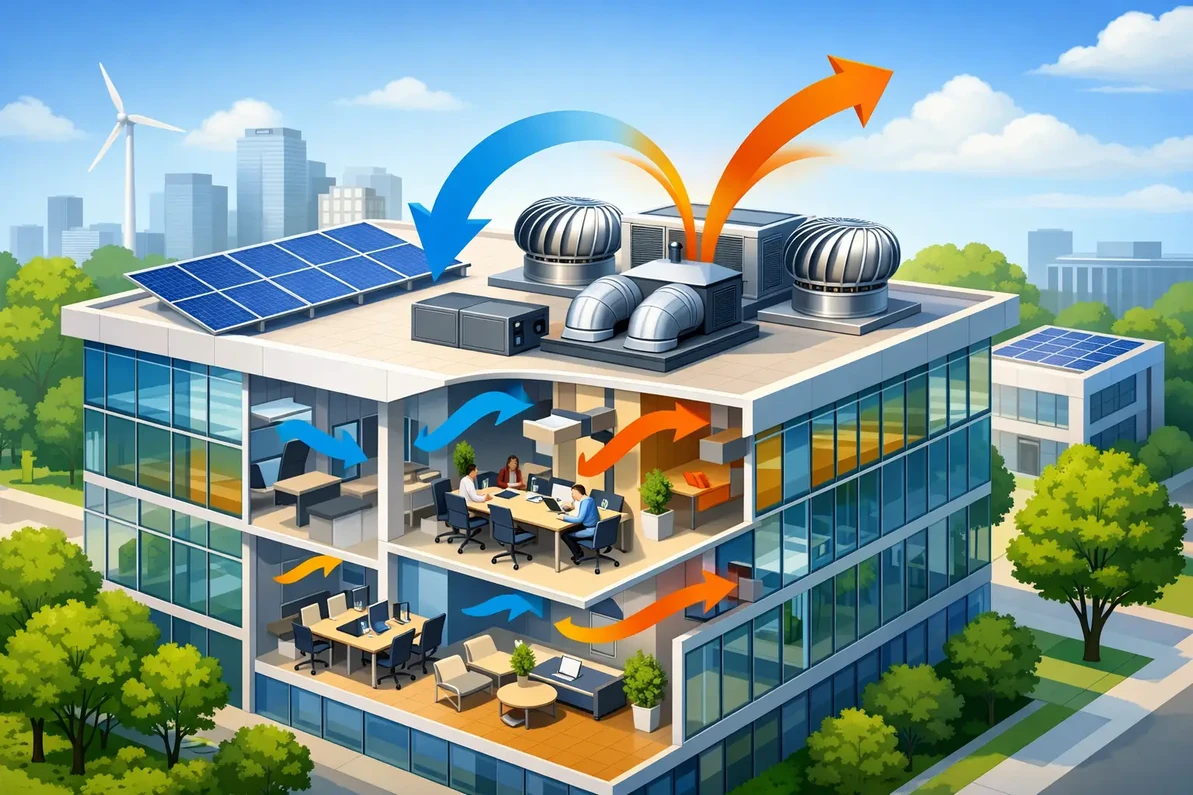
Another major development in warehouse ventilation trends 2026 is increased interest in hybrid rooftop ventilation. Facilities want to reduce fan energy where possible, especially in large buildings with long operating hours. Hybrid systems that combine wind-driven and low-watt assist operation are getting more attention because they can reduce electrical consumption while still supporting measurable air exchange.
This is especially relevant in warehouses with persistent heat buildup near the ceiling, but where full-time powered exhaust may not be necessary at maximum output around the clock. The right roof-mounted approach depends on building geometry, local climate, roof layout, and internal heat gain. In some applications, traditional powered roof exhaust is still the right answer. In others, hybrid ventilation can improve economics over the life of the building.
For engineers and owners, the key point is not the product category. It is performance under actual static conditions, weather exposure, and operating schedules.
Make-up air is getting the attention it should have had all along
A surprising number of warehouse ventilation problems are not caused by weak exhaust fans. They are caused by poor make-up air planning. When a facility exhausts large CFM volumes without bringing replacement air into the building in a controlled way, fan performance drops and comfort complaints rise.
That is why more warehouse projects in 2026 are budgeting make-up air as a core part of the design. This is especially true for buildings with multiple dock doors, enclosed work cells, or dedicated exhaust from charging rooms and process areas. Controlled make-up air improves pressure stability, supports fan performance, and reduces the random infiltration that carries in humidity, dust, and unconditioned air.
In colder regions, tempered make-up air becomes a bigger design issue. In hot climates, the question is often how much outside air can be introduced without creating a larger cooling burden. There is no universal answer. It depends on climate zone, occupancy, and what the building is trying to remove.
Zoning is replacing one-size-fits-all warehouse airflow
Warehouses rarely behave like a single room anymore. Picking zones, returns areas, battery charging stations, automated storage sections, loading docks, packaging lines, and employee workstations all create different ventilation demands.
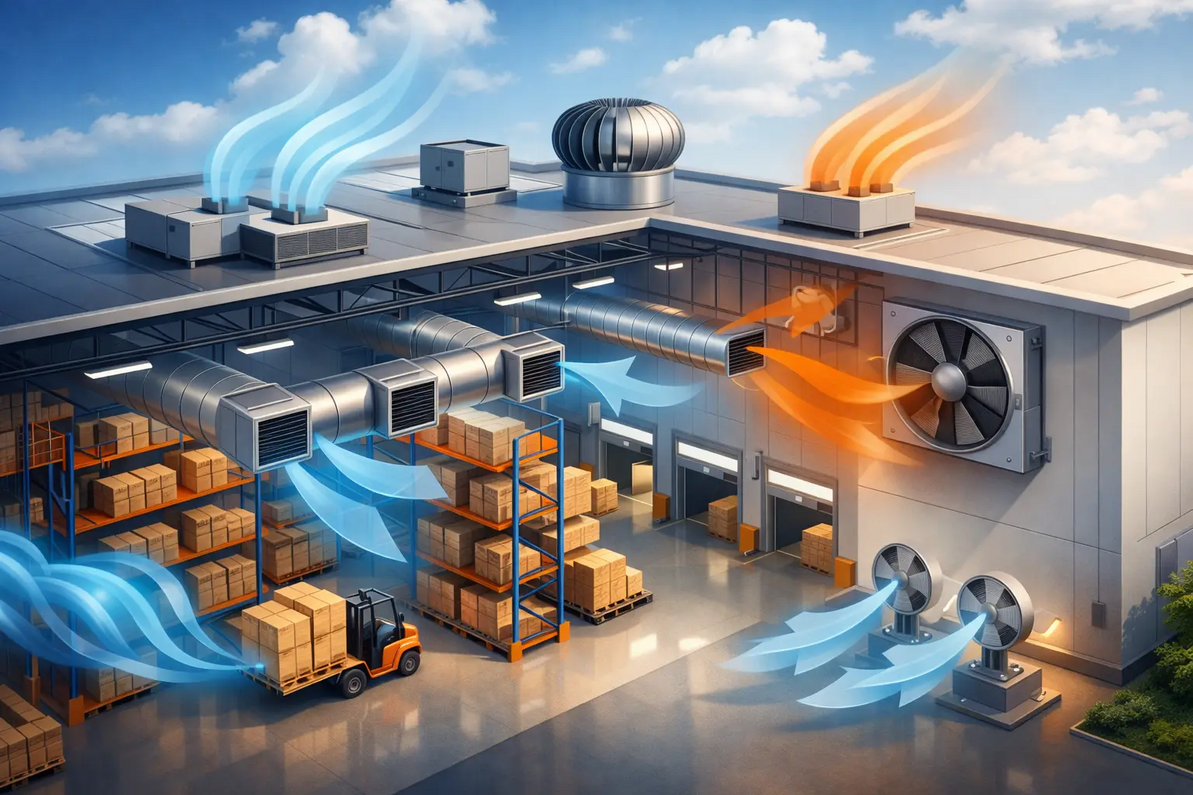
As a result, one of the stronger trends for 2026 is zoned ventilation. Instead of treating the full warehouse as a uniform air volume, more facilities are targeting airflow by use area. That may include spot exhaust over high-heat equipment, added circulation near loading docks, dedicated exhaust for enclosed charging rooms, or different fan schedules for occupied versus unoccupied zones.
This approach usually improves performance and lowers operating cost, but it requires better planning up front. Air has to move where intended. That means fan placement, discharge direction, intake paths, and interference with racking or process equipment all need to be considered.
Better ventilation design now starts with data, not guesswork
More owners are asking for actual ventilation calculations before equipment is selected. That is a healthy trend. Warehouse ventilation should be based on heat load, cubic volume, required air changes, contaminant source strength, and building leakage characteristics. If those variables are unknown, the fan schedule is mostly a guess.
That is also why technically complex facilities are moving toward consultative design support instead of buying by thumbnail specifications alone. CFM still matters, but so do motor type, curb compatibility, weather resistance, control integration, sound, and service access. A fan that looks right on paper may underperform if the system resistance was underestimated.
For many warehouse operators, the best next step is not ordering equipment immediately. It is getting the building evaluated correctly. A free project review from an experienced ventilation design team can identify whether the real problem is exhaust volume, air distribution, make-up air deficiency, or heat stratification.
What warehouse owners should watch in 2026
Expect more projects to center on efficiency per delivered airflow, not just nameplate fan size. Expect more demand for VFD-ready systems, better roof ventilation packages, and warehouse layouts that separate general airflow from source capture needs. Also expect more scrutiny on how ventilation interacts with labor retention and uptime. If workers avoid certain zones because they are too hot or stale, that is an operations issue, not just a maintenance issue.
The strongest ventilation projects in 2026 will not be the ones with the most equipment. They will be the ones where exhaust, make-up air, circulation, and controls are matched to the building’s actual load profile and operating schedule.
If your warehouse airflow still depends on open doors, wall-mounted fans, and trial-and-error adjustments, 2026 is a good year to replace assumptions with engineering.
Factory Fans Direct - Commercial & Industrial Ventilation & Cooling Experts | Contact Mike Miller VP Engineering at Factory Fans Direct for a FREE Project Evaluation 888-849-1233 | Mike@FactoryFansDirect.com
Recent Posts
-

AI Smart Buildings Incorporate Edmonds ecoPOWER Hybrid Turbine Ventilation
A building automation system can report rising rooftop temperatures, increasing indoor contaminants, …12th Sep 2026 -
Smart Buildings Architects Recommend Edmonds ecoPOWER Hybrid Ventilation
A rooftop ventilator should not force an all-or-nothing energy decision. Smart Buildings Architects …7th Sep 2026 -
Smart Industrial Buildings Use Edmonds ecoPOWER Hybrid Ventilation
A roof exhaust system can be the difference between a plant that controls heat at the source and one …7th Sep 2026