
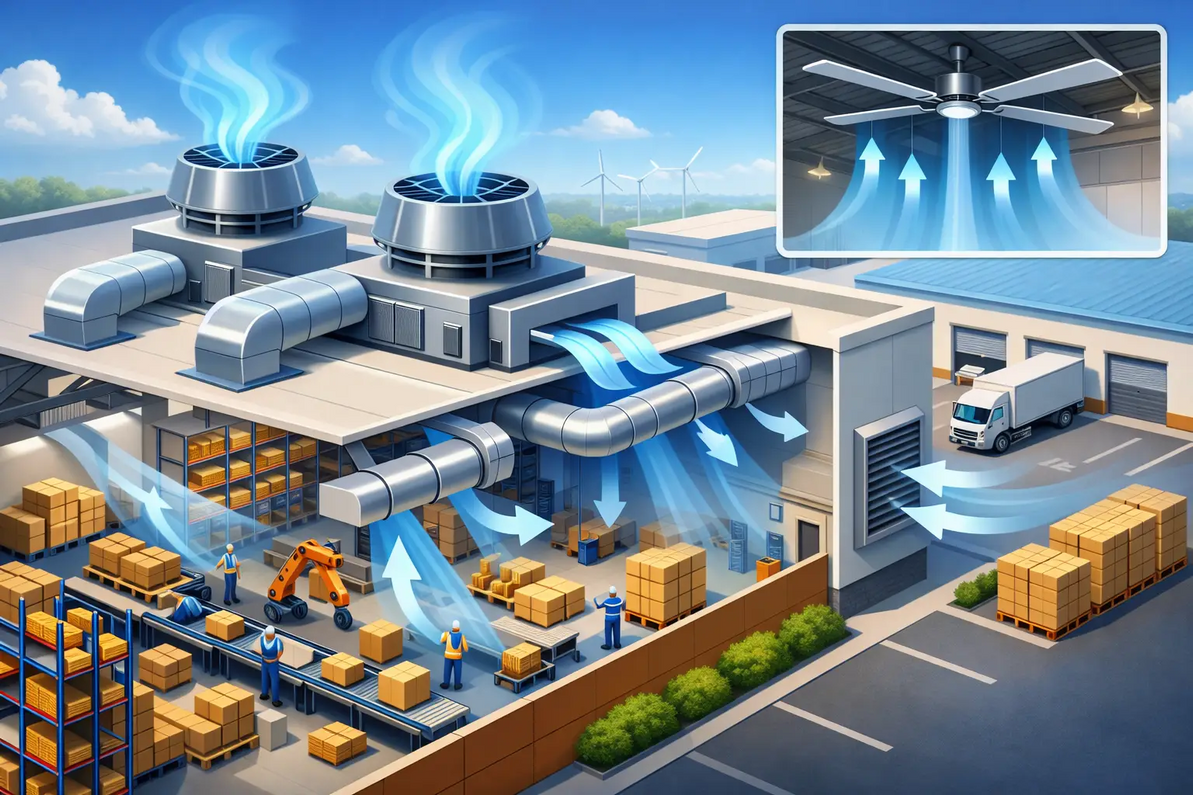
Ventilation Guide for Warehouse & Mfg Facilities
A warehouse can feel acceptable at the loading dock while the production floor runs 15 to 25 degrees hotter. That difference is not a comfort complaint. It can affect worker productivity, product quality, equipment reliability, and safety. This Ventilation Guide for Warehouse & Mfg Facilities focuses on the engineering inputs that determine whether an airflow system actually performs.
Start With the Heat and Air Contaminant Load
Ventilation design begins with what the building must remove. In a warehouse, that may be trapped roof heat, forklift exhaust, dust, or fumes from charging stations. In manufacturing, process heat and contaminants often drive the design: welding smoke, oil mist, grinding dust, solvents, combustion byproducts, humidity, or heat from ovens, compressors, and machinery.
Do not size exhaust fans from square footage alone. Building volume, ceiling height, roof profile, insulation, internal heat gain, occupancy, and the required operating temperature all matter. A high-bay facility with a large roof volume may need significant airflow just to prevent heat stratification, while a machine shop may need targeted source capture before general exhaust can be effective.
Air changes per hour can provide an early planning estimate, but CFM requirements should be verified against the actual heat load and contaminant source. A fan with high published free-air CFM may deliver substantially less airflow once it is connected to shutters, louvers, guards, ductwork, filters, or wind-loaded roof openings.
Match the Exhaust Strategy to the Facility
General ventilation removes accumulated heat and stale air from the building. It is often accomplished with wall exhaust fans, roof-mounted upblast or downblast ventilators, powered supply fans, and circulation fans. The correct arrangement depends on the building layout and where heat collects.
Wall-mounted exhaust works well when there is a clear path for replacement air through opposite wall louvers, dock doors, or engineered intake openings. Roof exhaust is frequently the better choice when heat rises into a high ceiling or when wall space is limited. In either case, fan placement should pull air across the occupied or process zone, not simply short-circuit fresh air from a nearby opening directly into the fan.
Source capture is a separate requirement. Welding, chemical mixing, laser cutting, and solvent-based operations can require hoods, ducted exhaust, filtration, and carefully calculated static pressure. General warehouse fans are not a substitute for local exhaust where hazardous or nuisance contaminants are generated at the source.
Do Not Forget Make-Up Air
Every exhausted CFM must be replaced. When a facility exhausts 30,000 CFM but provides only a few open doors as intake, the building can become negatively pressurized. Symptoms include difficult-to-open doors, drafts, backdrafting from combustion equipment, reduced fan performance, and uncontrolled air infiltration.
A properly designed make-up air system provides a low-resistance path for incoming air. Depending on climate and process requirements, that may include gravity louvers, motorized intake dampers, filtered supply fans, or tempered make-up air units. In cold climates, untempered outside air can create worker discomfort and freeze-risk concerns. In hot, humid regions, it can add substantial cooling and moisture load. The lowest first-cost intake method is not always the lowest operating-cost solution.
Use Circulation Fans to Solve Stratification
Exhaust fans exchange air. HVLS fans and directional circulation fans move air within the space. Most large facilities need both.
In warehouses, HVLS fans can destratify warm air at ceiling level, improve air movement in occupied zones, and help reduce perceived temperature during warm weather. In heated buildings, controlled destratification can reduce the amount of heat stranded at the roof. However, an HVLS fan does not remove process fumes, moisture, or combustion gases. It must be part of an overall ventilation plan, not the entire plan.
Fan spacing, mounting height, aisle racking, cranes, lighting, and sprinkler clearance all affect performance. A layout that looks adequate on a floor plan can leave dead zones around storage racks or equipment lines. Confirm clearances and operating controls before selecting fan diameter and quantity.
Evaluate Static Pressure, Controls, and Duty Cycle
Industrial fan selection should be based on the required CFM at the required static pressure. Static pressure is resistance created by louvers, ducts, hoods, filters, dampers, and discharge accessories. If the fan curve is not reviewed, the installed system may deliver far less airflow than expected.
Motor type and controls also matter. Variable frequency drives can adjust airflow as production loads change, reduce energy use during partial-load conditions, and provide smoother startup for larger motors. Thermostats, humidistats, CO sensors, and building automation controls can sequence exhaust, supply, and circulation equipment without relying on manual intervention.
Specify equipment for its actual duty cycle and environment. Grease, corrosive chemicals, washdown exposure, high ambient temperatures, combustible dust, and outdoor weather each affect motor enclosure, coating, bearing selection, drive arrangement, and maintenance access. A lower-cost fan that cannot survive the environment is not a value purchase.
A Practical Ventilation Checklist for Warehouse and Manufacturing Facilities
Before purchasing equipment, document the facility dimensions, roof and wall construction, existing openings, process equipment, heat-producing loads, contaminant sources, operating schedule, and seasonal temperature concerns. Identify where workers are located, where air must enter, and where exhaust can discharge without re-entering nearby doors or intakes.
Then review fan performance data at operating static pressure, not just catalog CFM. Confirm electrical requirements, roof curb or wall opening dimensions, noise limits, control sequence, service access, and make-up air capacity. This up-front engineering work prevents the familiar result of installing more fans while the building remains hot, dusty, or under negative pressure.
Call are Engineering Team at 888-849-1233 before an undersized intake or overlooked pressure loss turns a fan purchase into a ventilation problem.
Factory Fans Direct - Commercial & Industrial Ventilation & Cooling Experts | Contact Mike Miller VP Engineering at Factory Fans Direct for a FREE Project Evaluation 888-849-1233 | Mike@FactoryFansDirect.com
Recent Posts
-

Smart Buildings Architects Recommend Edmonds ecoPOWER Hybrid Ventilation
A rooftop ventilator should not force an all-or-nothing energy decision. Smart Buildings Architects …7th Sep 2026 -
Smart Industrial Buildings Use Edmonds ecoPOWER Hybrid Ventilation
A roof exhaust system can be the difference between a plant that controls heat at the source and one …7th Sep 2026 -
Smart Commercial Buildings Use Edmonds Hybrid Ventilation
A rooftop exhaust fan that only performs when the wind blows is not a complete ventilation strategy. …7th Sep 2026