Triangle Exhaust Fans for Industrial Buildings
A hot production floor is rarely solved by adding the largest fan available. It is solved by moving the required air volume through a building without starving the fan for intake air or ignoring the resistance created by louvers, shutters, ducts, and filters. Buyers searching for Triangle Exhuast Fans for Industrial Buildings need a ventilation design that accounts for the actual heat load, contaminant source, and operating conditions.
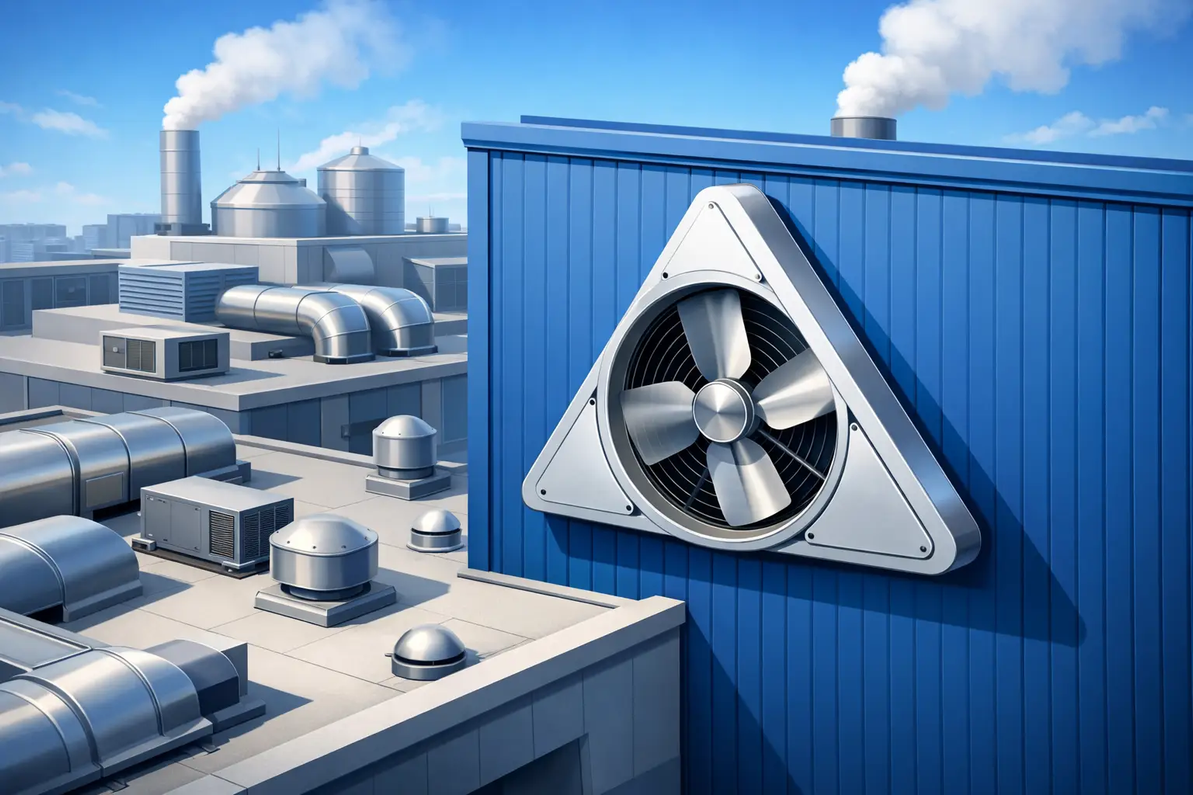
Triangle exhaust fans are a practical wall-mounted option for warehouses, manufacturing plants, agricultural buildings, equipment rooms, and other large spaces that need high-volume air exchange. Their triangular housing profile supports a large propeller in a compact wall-opening arrangement, making them especially useful where roof penetrations are undesirable or wall space is more accessible for installation and service.
Where Triangle Exhaust Fans Fit in Industrial Buildings
A triangle exhaust fan is generally selected for general ventilation, heat removal, and process-support airflow. Installed high on an exterior wall, it draws hot, stale air from the upper portion of the building and discharges it outdoors. Cooler replacement air enters through wall louvers, doors, dedicated make-up air openings, or powered supply equipment.
This arrangement works well when the goal is to reduce indoor temperature, clear humidity, dilute non-hazardous fumes, or remove accumulated heat from machinery. It is not automatically the right answer for every application. Welding smoke, corrosive vapors, combustible dust, paint overspray, and other hazardous contaminants may require source capture, specialized materials, spark-resistant construction, explosion-proof components, filtration, or code-driven exhaust design.
For general industrial heat relief, the strength of a triangle fan system is its ability to move large CFM at relatively low static pressure. That last condition matters. A fan rated at 30,000 CFM in free air will not necessarily deliver 30,000 CFM once it operates behind a restrictive shutter, weather hood, bird screen, intake louver, or long duct run.
Sizing Triangle Exhaust Fans for Industrial Buildings
Square footage alone is not enough to size industrial exhaust. Building volume, ceiling height, internal heat gain, process equipment, occupancy, climate, and desired air-change rate all affect the required airflow.
A basic starting point is to calculate the building volume in cubic feet and multiply it by the target air changes per hour, then divide by 60 to estimate CFM. For example, a 100,000-cubic-foot shop requiring six air changes per hour needs approximately 10,000 CFM. That may be adequate for light general ventilation, but it may be far too low when equipment, ovens, forklifts, or solar-loaded roof surfaces are adding substantial heat.
Heat-load calculations often provide a better answer for high-temperature facilities. The required airflow must be sufficient to carry heat out of the building while maintaining an acceptable indoor-to-outdoor temperature difference. In many operations, the design target is not air changes but a measurable reduction in temperature at employee work zones or around sensitive equipment.
Fan selection also needs to account for static pressure. Gravity shutters, motorized louvers, intake screens, evaporative media, light traps, and duct transitions all add resistance. A belt-drive fan may offer more flexibility for certain higher-static applications, while direct-drive units can simplify maintenance in straightforward wall-exhaust installations. Motor horsepower, voltage, phase, control requirements, and duty cycle should be confirmed before ordering.
Intake Air Is the Other Half of the System
An exhaust fan cannot move air that the building cannot replace. Undersized intake openings create negative pressure, reduce delivered CFM, pull dust through unwanted gaps, make doors difficult to open, and increase motor load in some system configurations.
As a practical design rule, provide adequate intake area with low face velocity. Large, properly located intake louvers usually perform better than relying on a few open doors. The intake location should also support the intended airflow path. If fresh air enters next to the exhaust fan, it may short-cycle outdoors without reaching the hot work area.
For facilities with conditioned areas, winter operations, controlled processes, or high outdoor contaminant exposure, powered make-up air may be necessary. A make-up air unit can temper incoming air and maintain pressure balance, but it adds equipment cost and controls complexity. The right choice depends on the building’s operating schedule and the cost of uncontrolled infiltration.
Placement, Controls, and Service Access
Place exhaust fans where heat and contaminants naturally collect, typically high on the leeward wall when site conditions allow. Multiple fans distributed across a long building often provide more even air movement than one oversized unit. In a facility with concentrated equipment heat, fan placement should support the path from the heat source to the exhaust point rather than simply follow the easiest wall opening.
Controls can make a major difference in operating cost. Thermostats, staged fan control, variable frequency drives, and building automation integration allow ventilation capacity to match actual conditions. Running every fan at full speed all day may be necessary in some production environments, but many buildings benefit from staged operation as temperatures rise.
Service access deserves attention during design. Belts, bearings, shutters, guards, motors, and disconnects should be reachable without creating a difficult roof or lift-dependent maintenance task. A fan that cannot be inspected easily is less likely to receive the preventive maintenance needed to protect airflow and motor life.
Call are team at 888-849-1233 before an undersized intake or overlooked pressure loss turns a fan purchase into a ventilation problem. Factory Fans Direct National Triangle Distributor.
Factory Fans Direct - Commercial & Industrial Ventilation & Cooling Experts | Contact Mike Miller VP Engineering at Factory Fans Direct for a FREE Project Evaluation 888-849-1233 | Mike@FactoryFansDirect.com
Recent Posts
-

Smart Buildings Architects Recommend Edmonds ecoPOWER Hybrid Ventilation
A rooftop ventilator should not force an all-or-nothing energy decision. Smart Buildings Architects …7th Sep 2026 -
Smart Industrial Buildings Use Edmonds ecoPOWER Hybrid Ventilation
A roof exhaust system can be the difference between a plant that controls heat at the source and one …7th Sep 2026 -
Smart Commercial Buildings Use Edmonds Hybrid Ventilation
A rooftop exhaust fan that only performs when the wind blows is not a complete ventilation strategy. …7th Sep 2026