
Save $$$ With a Centric Air Whole House Fan
If your air conditioner runs for hours just to pull out the heat that built up during the day, there is a smarter way to manage comfort. Homeowners looking to Save $$$ with a Centric Air Whole House Fan are usually trying to solve the same problem - high cooling costs, stale indoor air, and a house that never seems to cool down fast enough at night.
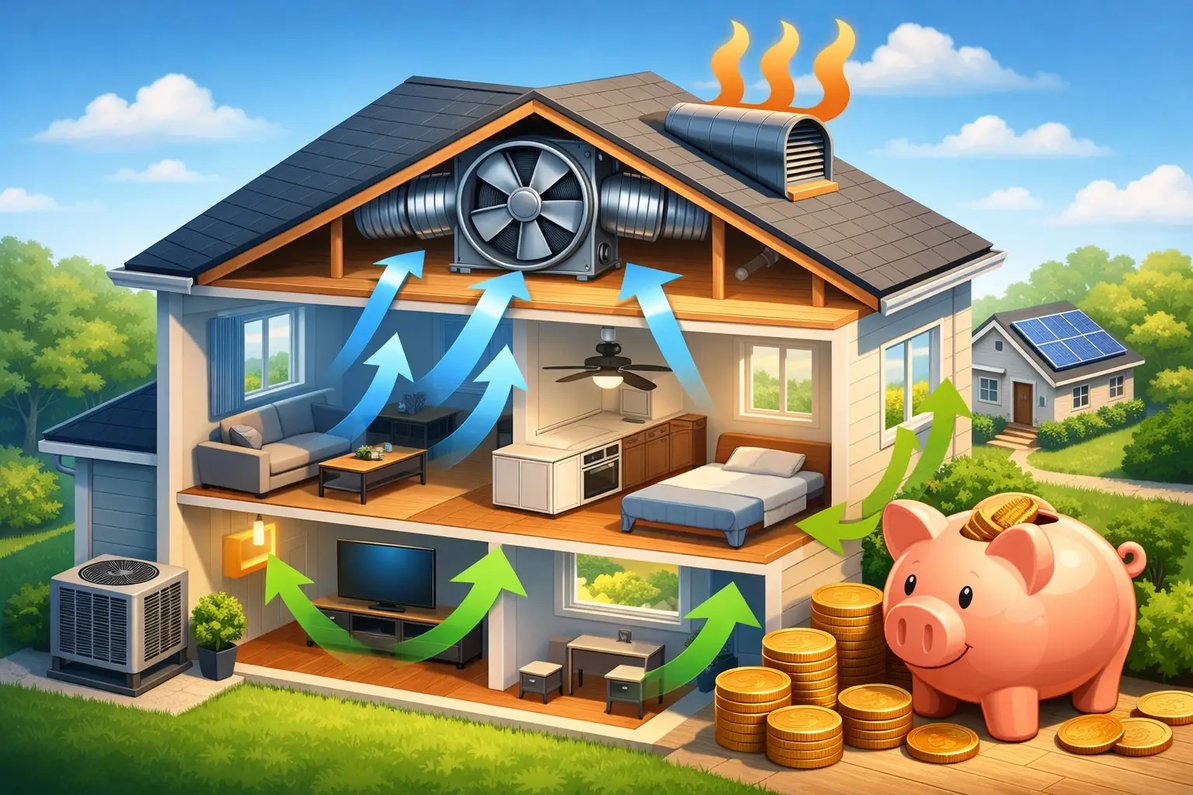
A properly selected whole house fan is not just a comfort upgrade. It is an airflow system. When outdoor temperatures drop below indoor temperatures, the fan pulls cooler air through open windows and exhausts hot air into the attic and out through the attic ventilation system. That rapid air exchange can reduce your dependence on central AC and lower seasonal cooling costs, especially in climates with cool evenings and shoulder-season temperature swings.
How a Centric Air whole house fan saves money
The savings come from reducing compressor runtime. Air conditioning is one of the largest electrical loads in a home, particularly during summer afternoons and evenings. A Centric Air whole house fan uses a fraction of the power required by most central AC systems while moving a high volume of air measured in CFM.
In practical terms, that means you can flush accumulated heat out of the living space and attic before your AC has to fight it. In many homes, the biggest comfort problem is not just indoor air temperature. It is stored heat in drywall, insulation, framing, and attic space. A whole house fan addresses that load directly by exchanging indoor air quickly instead of mechanically refrigerating the same trapped air.
This is where system matching matters. If the fan is undersized, cooling performance disappoints. If it is oversized without proper control, you may create noise, pressure imbalance, or unnecessary air movement. The right fan should be selected based on square footage, ceiling height, home layout, attic free ventilation area, and how aggressively you want to cool the structure.
Why Centric Air stands out
Centric Air whole house fans are known for quiet operation, insulated dampers, and efficient motor design. Those details matter more than many homeowners realize. Lower noise levels make the system easier to use consistently. Tight-sealing dampers matter in winter and summer because they help reduce unwanted air leakage when the fan is off. Motor efficiency matters because the fan only saves money when airflow and watt draw are balanced correctly.
For technically minded buyers, this is not just about picking a fan from a chart. It is about understanding delivered performance. Attic ventilation capacity has to support fan exhaust volume. The home needs enough open window area during operation. Installation location affects sound transmission and airflow distribution. These are the details that separate a successful project from a disappointing one.
Save $$$ with a Centric Air Whole House Fan in the right climate
A whole house fan is highly effective, but it is not a one-size-fits-all solution. It performs best when outdoor evening and overnight air is cooler than indoor air. In dry and mixed climates, the savings can be significant because you can cool the structure naturally during large parts of the season.
In hot and humid regions, the value depends more on timing and operating conditions. If nighttime humidity stays high and outdoor temperatures remain elevated, a whole house fan may still help with ventilation and heat purge, but AC reduction may be less dramatic. That does not make it the wrong product. It just means expectations should be based on actual climate data, not generic marketing claims.
Installation details that affect performance
The fan itself is only part of the system. Adequate attic exhaust area is critical. If the attic cannot relieve the airflow volume, fan performance drops and pressure can increase. Likewise, the fan should be located and sized to promote even air movement through the occupied space rather than pulling from only one part of the house.
Control strategy also matters. Many homeowners use the fan in the early morning or evening, then switch to AC later if needed. Others rely on the fan heavily during spring and fall and use AC only during peak summer conditions. The best operating schedule depends on your utility rates, local weather pattern, insulation level, and occupancy habits.
A professionally guided selection helps avoid common mistakes such as underestimating attic venting requirements, oversizing for the space, or ignoring sound expectations for bedrooms and hallways.
Who should consider one
A Centric Air whole house fan makes the most sense for homeowners who want lower cooling costs, better nighttime comfort, faster air exchange, and a more energy-conscious alternative to running AC nonstop. It is also a strong fit for buyers who want engineering-based product advice instead of guessing from a big-box specification sheet.
If you are comparing options, look beyond price alone. Evaluate airflow capacity, watt draw, damper quality, sound profile, attic ventilation requirements, and how the unit fits your actual home design. Those factors determine whether the fan will deliver real savings or just move air.
Factory Fans Direct can help homeowners evaluate fan sizing, attic ventilation compatibility, and installation requirements before purchase. That kind of project support is often what protects the energy savings you are trying to achieve in the first place.
Factory Fans Direct - Whole House Fans Experts | Contact Mike Miller at Factory Fans Direct for a FREE Home Evaluation 888-849-1233 and a $50 discount Coupon and Live Support on the Centric Air Whole House Fans.
Recent Posts
-

Smart Buildings Architects Recommend Edmonds ecoPOWER Hybrid Ventilation
A rooftop ventilator should not force an all-or-nothing energy decision. Smart Buildings Architects …7th Sep 2026 -
Smart Industrial Buildings Use Edmonds ecoPOWER Hybrid Ventilation
A roof exhaust system can be the difference between a plant that controls heat at the source and one …7th Sep 2026 -
Smart Commercial Buildings Use Edmonds Hybrid Ventilation
A rooftop exhaust fan that only performs when the wind blows is not a complete ventilation strategy. …7th Sep 2026