
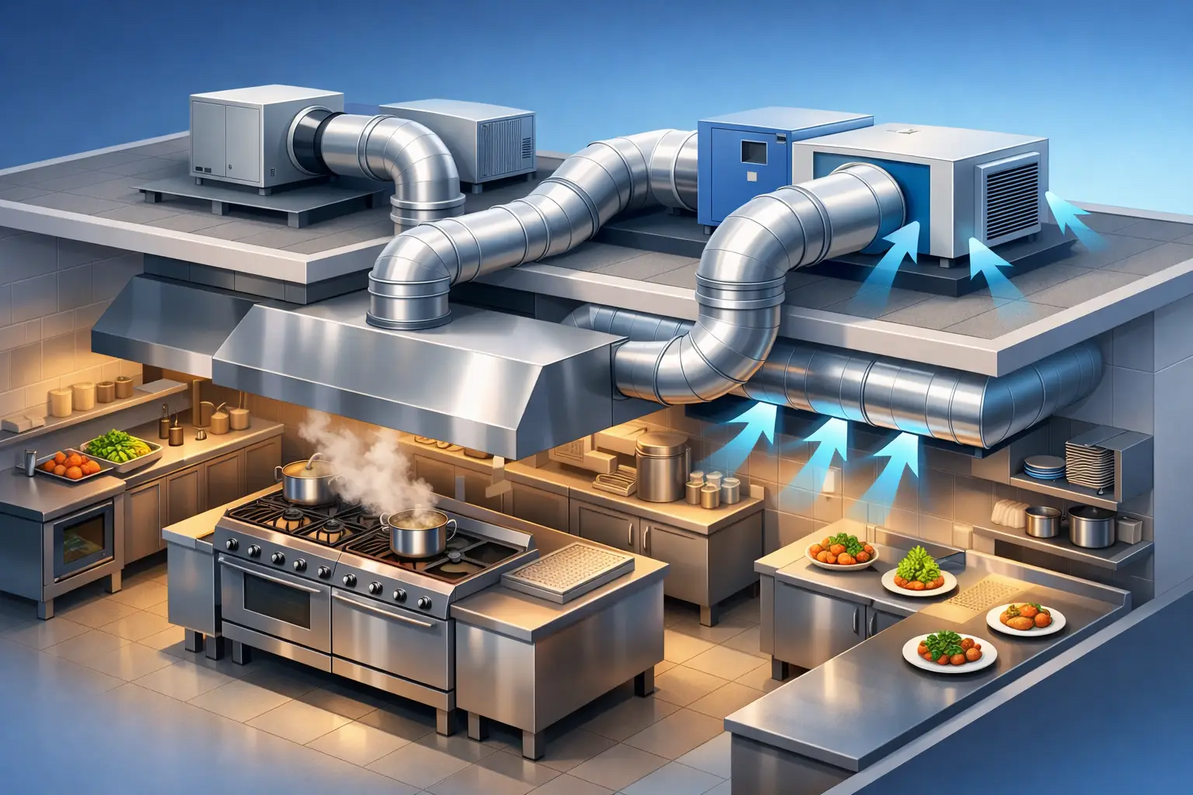
Make Up Air System for Restaurant Kitchen
When a kitchen hood pulls 4,000 to 10,000 CFM out of a restaurant, that air has to come from somewhere. If it does not come from a properly designed make up air system for restaurant kitchen ventilation, it usually gets dragged in through front doors, ceiling gaps, delivery entrances, and every other weak point in the building envelope. That is when operators start seeing hard-to-open doors, uneven kitchen temperatures, pilot light issues, and dining room comfort complaints.
Restaurant ventilation is not just about removing smoke and grease. It is about air balance, building pressure, and replacing exhausted air with the right volume, temperature, and delivery method. A good make-up air design protects hood performance, supports code compliance, and reduces the operating problems that show up when exhaust equipment is installed without a matching supply strategy.
Why a make up air system for restaurant kitchen matters
Commercial kitchens move a lot of air fast. Type I hoods over grease-producing equipment can exhaust thousands of cubic feet per minute, and dish areas, prep rooms, and adjacent spaces may add even more airflow demand. If the replacement air is undersized or poorly introduced, the hood may lose capture efficiency, the kitchen can go negative, and conditioned air from the dining room gets pulled into the back of house.
That negative pressure creates more than discomfort. It can interfere with door operation, backdraft gas-fired equipment, increase utility costs, and make the HVAC system fight a battle it cannot win. In colder climates, uncontrolled infiltration can create serious temperature swings near entries and workstations. In hotter regions, the kitchen can become a heat sink that drives up cooling load and staff fatigue.
A properly selected make-up air system solves those issues by replacing exhausted air in a controlled way. The key word is controlled. Simply adding air is not enough. The airflow rate, discharge velocity, air temperature, and location of supply all affect whether the hood performs as intended.
How the system actually works
At a basic level, a make-up air unit brings outside air into the building to offset exhaust. In a restaurant, that outside air may be delivered directly to the kitchen, into adjacent spaces, or into the HVAC return path depending on the design. The equipment can be untempered, heated only, cooled, or fully conditioned based on climate, occupancy, and budget.
The fan section is selected to deliver the required CFM against the actual static pressure of the duct system, filters, dampers, and discharge arrangement. That part matters. A unit rated for a certain airflow in free air may not deliver the same CFM once it is connected to real ductwork and accessories. This is where engineering support saves time and expensive field corrections.
Controls also matter more than many buyers expect. A restaurant kitchen load changes throughout the day, and the make-up air system should be coordinated with hood exhaust operation. In some projects, fixed-speed equipment is acceptable. In others, variable frequency drives, interlocks, and staged heating provide much better control and lower operating cost.
Sizing is not guesswork
The first mistake in restaurant ventilation is treating make-up air as an accessory instead of a matched system. The airflow requirement should be based on total exhaust volume, hood type, appliance line, local code requirements, and building pressure strategy. In many cases, the make-up air target is close to the total exhaust rate, but not always exactly 100 percent at the hood.
That is because the overall building may need to remain slightly negative or near neutral depending on the application. Too much positive pressure can push odors into the dining area or create moisture issues. Too much negative pressure causes the operating problems already mentioned. The right number depends on the full ventilation plan, not just the hood cut sheet.
Static pressure is another area where projects go wrong. Long duct runs, roof curbs, weather hoods, balancing dampers, and filtration all add resistance. If the fan is not selected for that resistance, delivered airflow drops. On paper the system looks adequate. In the field it underperforms. Contractors and facility owners then end up chasing comfort issues that are really fan selection problems.
Delivery method changes performance
How replacement air enters the kitchen is just as important as how much air is supplied. If the discharge pattern throws air directly across the hood face at too high a velocity, it can disrupt capture and containment. Grease vapor and heat that should rise into the hood can spill into the room instead.
That is why air distribution must be engineered around the hood and appliance line. Ceiling diffusers, perforated plenum supply, low-velocity front discharge, short-circuit hood supply, and integrated hood supply all have pros and cons. The best choice depends on hood style, ceiling height, kitchen layout, and climate conditions.
Short-circuit designs, for example, can reduce the load on space conditioning equipment by supplying outdoor air near the hood. But if that approach is overused or poorly balanced, it may compromise hood effectiveness. General kitchen supply can improve space comfort, but it may require more tempering capacity and better diffuser placement. There is no one-size-fits-all answer here. The right approach comes from matching airflow delivery to the actual cooking line and room geometry.
Tempered or untempered air
This is one of the biggest budget and performance decisions in a make up air system for restaurant kitchen applications. Untempered air units are less expensive up front and may work in mild climates or limited-use facilities. But outside air at winter or summer extremes can create very real comfort and operational issues.
Heated make-up air is common in northern markets where cold drafts can affect cooks, prep stations, and nearby equipment. Cooling is more expensive, but in hot and humid climates it may be justified to protect indoor working conditions and reduce strain on the primary HVAC system. Some owners choose partial tempering as a middle ground, especially when the unit serves a high-volume hood that runs long hours.
The trade-off is simple. Lower first cost usually means less control over comfort and energy performance. Higher first cost can improve working conditions and system stability, but only if the unit is properly sized and controlled. Overspending on conditioning without fixing airflow distribution will not solve the underlying problem.
Common restaurant warning signs
Many facilities already have make-up air problems and do not realize the root cause. If front doors are hard to open when the hood is on, the building is likely too negative. If smoke rolls out from the hood edge during busy periods, hood capture may be affected by poor supply placement or inadequate replacement air. If the dining room feels drafty near the kitchen or utility bills are climbing after a hood upgrade, the air balance may be off.
Another frequent issue is combustion interference. Gas water heaters, unit heaters, and other fuel-fired equipment can backdraft when the kitchen exhaust overpowers the building. That is a safety concern, not just a comfort issue. A ventilation design should always consider the full building interaction, not only the kitchen hood.
What buyers should have ready before selecting equipment
The best equipment recommendation starts with good field data. Hood exhaust CFM, hood dimensions, appliance lineup, fuel type, operating schedule, climate zone, duct path, and available power all matter. Roof or wall mounting requirements, curb size, and service access should also be known before final selection.
If the project includes heating, the entering air temperature and desired discharge temperature are needed to size the heating section correctly. If the unit will be ducted, external static pressure must be estimated realistically. If controls need to tie into existing building systems, that should be addressed early rather than after the unit ships.
This is where a consultative supplier adds value. The right question set catches problems before they become change orders. For restaurant owners and contractors, that means less rework, fewer startup issues, and a much better chance of getting the kitchen airflow right the first time.
Engineering support matters more than the box itself
Two make-up air units can look similar in a catalog and perform very differently once installed. Fan curve selection, motor sizing, burner capacity, filter arrangement, discharge configuration, and control sequence all affect real-world performance. That is why experienced ventilation guidance matters. Factory Fans Direct works with projects where airflow, static pressure, and equipment matching are not optional details - they are the difference between a system that works and one that creates callbacks.
For restaurant kitchens, the smartest purchase is rarely the cheapest standalone unit. It is the system that matches the hood, the room, the climate, and the operating profile. If your kitchen exhaust is strong enough to move thousands of CFM, your replacement air strategy deserves the same level of engineering attention.
Factory Fans Direct - Commercial & Industrial Ventilation & Cooling Experts | Contact Mike Miller VP Engineering at Factory Fans Direct for a FREE Project Evaluation 888-849-1233 | Mike@FactoryFansDirect.com
Recent Posts
-

AI Smart Buildings Incorporate Edmonds ecoPOWER Hybrid Turbine Ventilation
A building automation system can report rising rooftop temperatures, increasing indoor contaminants, …12th Sep 2026 -
Smart Buildings Architects Recommend Edmonds ecoPOWER Hybrid Ventilation
A rooftop ventilator should not force an all-or-nothing energy decision. Smart Buildings Architects …7th Sep 2026 -
Smart Industrial Buildings Use Edmonds ecoPOWER Hybrid Ventilation
A roof exhaust system can be the difference between a plant that controls heat at the source and one …7th Sep 2026