
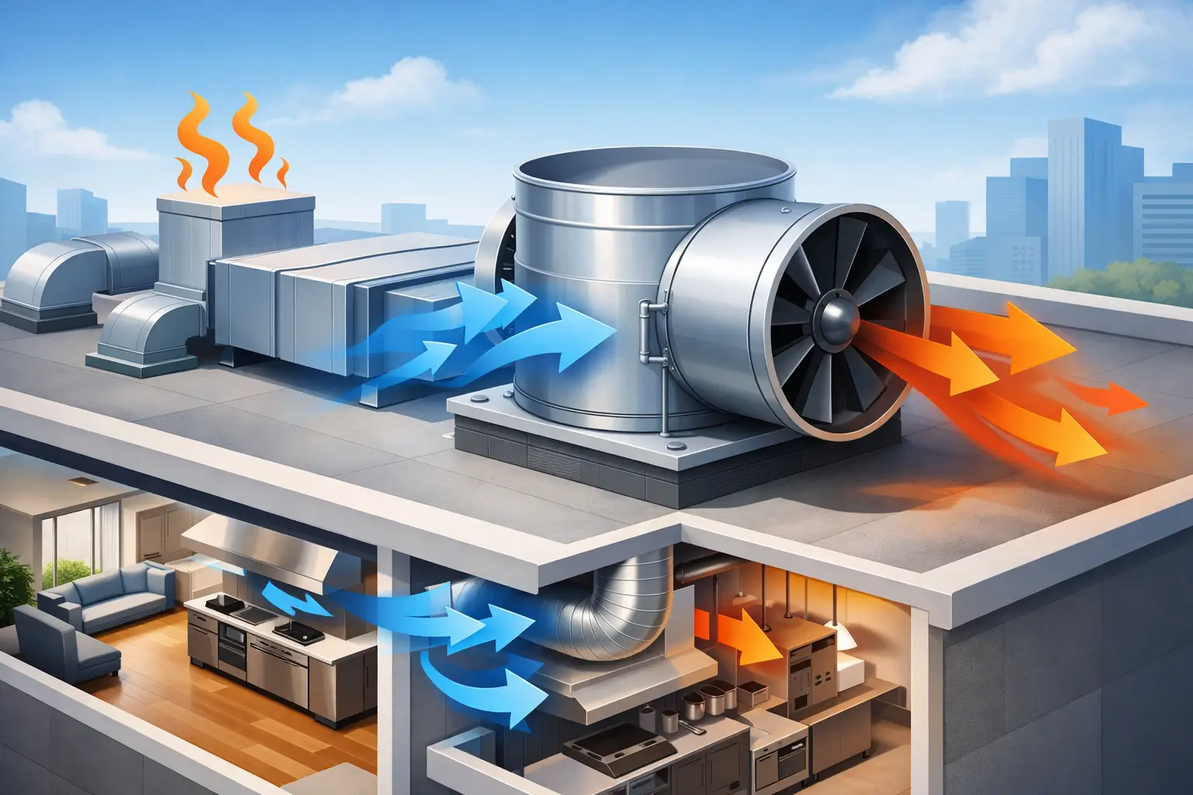
Make Up Air Fan Guide for Better Ventilation
Negative building pressure usually shows up before anyone checks a spec sheet. Dock doors get harder to open, exhaust hoods stop capturing heat and fumes, dust starts moving in the wrong direction, and combustion equipment may backdraft. A proper make up air fan guide starts there - with the operating problems that tell you the building is exhausting more air than it is replacing.
Make-up air is not just replacement airflow. It is controlled replacement airflow that has to match the building, the exhaust volume, the pressure target, and the climate. In a warehouse, plant, grow facility, commercial kitchen, or mechanical room, the wrong make-up air setup can create comfort complaints, process issues, energy waste, and code problems at the same time. The fan matters, but so do the intake location, discharge velocity, heating method, filtration, and controls.
What a make up air fan actually does
A make-up air fan brings outside air into a building to replace air that is being exhausted. That sounds simple until you look at the operating conditions. If a facility has kitchen exhaust, welding exhaust, paint processes, dust collection, bathroom exhaust, boiler room exhaust, or general heat removal fans, every CFM leaving the building has to be addressed.
The goal is usually not to make supply equal exhaust at all times. In many applications, the target is slightly negative, neutral, or slightly positive pressure depending on the process and contamination risk. A restaurant may need balance for hood performance. A manufacturing plant may tolerate a slight negative pressure. A clean process area may need positive pressure to limit infiltration. That is why fan selection based on catalog CFM alone is often the wrong starting point.
Make up air fan guide: start with the air balance
The first step is to calculate how much air is leaving the building. That includes all continuously operating exhaust fans and any process exhaust that runs under peak load. If the building has multiple operating modes, such as summer purge, occupied production, and night setback, those should be evaluated separately.
Once exhaust is known, the next question is how much of that air needs to be mechanically replaced. In some buildings, infiltration covers part of the deficit, but relying on uncontrolled leakage is usually expensive and inconsistent. In cold weather, that approach creates drafts and frozen complaints near doors. In hot and humid regions, it pulls in untreated air where you do not want it.
A practical design starts by identifying total exhaust CFM, the desired building pressure, and whether the incoming air needs heating, cooling, tempering, or filtration. If you skip any one of those, the selected fan may move air, but the system still may not solve the problem.
Why static pressure changes the fan selection
One of the most common mistakes in make-up air fan selection is ignoring static pressure. A fan rated for a certain CFM in free air may deliver far less once you add intake hoods, birdscreen, filters, dampers, ductwork, discharge nozzles, or heaters.
This matters even more in commercial and industrial projects where the intake path is not short and open. A roof-mounted system with filtration and a burner section will perform very differently than a simple wall supply fan. The fan curve, brake horsepower, motor service factor, and real operating static pressure need to line up. If they do not, the result is low airflow, motor overload, noise, or all three.
Heated versus unheated make-up air
Not every system needs fully heated make-up air. In some facilities, tempered air is enough. In others, unheated outside air can work if discharge is kept away from occupants and process-sensitive areas. The climate, occupancy, and duty cycle decide that.
In colder states, untempered make-up air can create immediate comfort and freeze risks. In a warehouse with frequent door openings, that may be manageable. In a production floor with stationary workers, it usually is not. In a restaurant or plant with combustion appliances, introducing cold air incorrectly can also disrupt draft performance.
Heated make-up air systems typically use direct-fired, indirect-fired, electric, hot water, or gas-fired heating sections. Direct-fired equipment is efficient and common in large commercial applications, but it is not right for every project. Indirect-fired units are often selected where process requirements or code considerations call for separated combustion. The answer depends on the application, jurisdiction, and budget.
Where the air enters matters as much as fan size
A make-up air fan guide that focuses only on equipment misses the biggest field issue: air distribution. You can have the correct CFM and still create a bad system if the incoming air hits workers directly, short-circuits to exhaust points, or pulls contaminants across occupied space.
In many industrial buildings, the best intake location is determined by process layout, prevailing winds, roof geometry, and exhaust fan placement. Wall-mounted intake can simplify service access, but roof-mounted systems can improve distribution and save wall space. Ducted discharge gives more control, but it adds static pressure and installation cost.
The design question is not just, Where can the fan fit? It is, Where should the replacement air enter so the building performs correctly under full load?
Controls make the system work in real life
A make-up air fan should not be treated like a simple on-off exhaust fan unless the building load is equally simple. Most better-performing systems use some level of control logic to match actual operating demand.
That may include motorized dampers, inlet modulation, variable frequency drives, discharge temperature control, building pressure sensors, or interlocks with exhaust equipment. A kitchen system might require direct interlock with hood exhaust. A manufacturing facility may need staged operation based on process lines. A grow or specialty cultivation facility may need coordinated control with dehumidification and environmental setpoints.
Without control integration, the building may swing from negative to positive pressure as exhaust loads change. That leads to inconsistent capture, comfort complaints, excess infiltration, and avoidable utility cost.
Filtration and air quality trade-offs
Outside air is not automatically clean air. In agricultural zones, industrial corridors, and urban areas, intake air may carry dust, pollen, grease, smoke, or corrosive contaminants. Filtration helps, but every filter section adds resistance and maintenance requirements.
Higher-efficiency filtration can protect the space and equipment, especially in electronics, cultivation, and light manufacturing environments. The trade-off is fan energy, replacement cost, and service access. If filters are added as an afterthought, the fan may not maintain design airflow. That is why filtration should be part of the original fan and cabinet selection, not a field fix.
Common sizing mistakes
Oversizing and undersizing both create problems. An undersized make-up air unit leaves the building excessively negative, which can pull in dirt, rain, humid air, and combustion byproducts. An oversized unit can over-pressurize the building, force conditioned air out through openings, and interfere with exhaust capture.
Another mistake is sizing only to floor area. Square footage can help estimate general ventilation, but make-up air is primarily driven by measured or calculated exhaust volume and operating conditions. A 20,000-square-foot warehouse with minimal exhaust has very different requirements than a 20,000-square-foot production plant with multiple process exhaust systems.
Motor voltage, phase, fuel availability, curb dimensions, service clearance, winter design temperature, and code requirements also affect what equipment will actually work on site. Good design lives in those details.
Applications where make-up air is often mission-critical
Commercial kitchens are the obvious example, but they are far from the only one. Manufacturing plants with welding, grinding, and heat-producing equipment often need carefully matched replacement air. Warehouses with large exhaust and destratification strategies can drift into pressure problems. Agricultural and livestock facilities may need outside air control tied to seasonal conditions. Specialty cultivation spaces need balance between ventilation, odor control, and environmental consistency. Crypto mining and high-heat electrical environments often require deliberate intake and exhaust planning to avoid recirculation and hot spots.
Each of these applications has different acceptable pressure ranges, contaminant loads, and temperature tolerance. That is why there is no single best make-up air fan. There is only the right fan and system configuration for the job.
How to choose the right system
Start with operating data, not product preference. Quantify exhaust CFM, peak heat load, target building pressure, climate conditions, intake air quality, and utility constraints. Then look at fan type, housing configuration, heating options, control strategy, and installation path.
This is also where a free project evaluation can save money. Replacing a pressure problem with a larger fan is not always the answer. Sometimes the issue is short-cycling controls, poor intake placement, missing dampers, or static pressure that was never accounted for. A properly engineered review usually costs less than correcting a bad install after startup.
For commercial and industrial buyers, this is where Factory Fans Direct typically adds value - matching fan performance, heating options, and application details to the real operating environment instead of pushing a one-size-fits-all package.
If your building has persistent negative pressure, poor exhaust performance, or comfort complaints near doors and workstations, treat those as system design warnings, not minor annoyances. The right make-up air approach should make the whole facility run better, not just move more air.
Factory Fans Direct - Commercial & Industrial Ventilation & Cooling Experts | Contact Mike Miller VP Engineering at Factory Fans Direct for a FREE Project Evaluation 888-849-1233 | Mike@FactoryFansDirect.com
Recent Posts
-

AI Smart Buildings Incorporate Edmonds ecoPOWER Hybrid Turbine Ventilation
A building automation system can report rising rooftop temperatures, increasing indoor contaminants, …12th Sep 2026 -
Smart Buildings Architects Recommend Edmonds ecoPOWER Hybrid Ventilation
A rooftop ventilator should not force an all-or-nothing energy decision. Smart Buildings Architects …7th Sep 2026 -
Smart Industrial Buildings Use Edmonds ecoPOWER Hybrid Ventilation
A roof exhaust system can be the difference between a plant that controls heat at the source and one …7th Sep 2026