Industrial Ventilation System Design Basics
A fan that looks right on paper can still fail in the field. The usual reason is not the motor, the brand, or even the installer. It is the industrial ventilation system design behind it. When heat load, contaminant source, duct resistance, building leakage, and make-up air are not calculated together, the result is predictable - hot zones, poor capture, wasted energy, and equipment that never reaches rated performance.
For plant managers, engineers, contractors, and facility owners, ventilation is not a cosmetic upgrade. It is a performance system tied to worker safety, product quality, moisture control, equipment life, and operating cost. Good design starts before any fan is selected.
What industrial ventilation system design actually covers
Industrial ventilation system design is the process of matching airflow equipment to the real conditions inside a facility. That includes sensible heat removal, fume or dust capture, air changes, pressure balance, duct layout, discharge strategy, and make-up air. In many projects, the fan is the last decision, not the first.
A warehouse with stratified heat near the roof has a different requirement than a welding bay, a battery charging room, a cannabis dry room, or a crypto mining container. One application may need broad air exchange. Another may need source capture with higher static pressure capability. Another may need corrosion resistance, variable speed control, filtration, or winterized dampers. Treating all of them as simple CFM problems is where expensive mistakes start.
Start with the load, not the product
The first design question is straightforward: what exactly are you trying to remove or control? In industrial spaces, that usually means heat, airborne contaminants, moisture, or a combination of all three.
Heat-driven applications often focus on total BTU load from equipment, lighting, process machinery, solar gain, and envelope conditions. Contaminant-driven applications are different. If welding smoke, chemical vapor, dust, or diesel exhaust is the issue, the design priority shifts toward capture effectiveness and discharge location rather than room air changes alone.
This is also where many buyers underestimate process variability. A facility may run one shift during part of the year and three shifts during peak season. A grow room may change latent load by growth stage. A mining operation may add racks over time. If the load changes, the ventilation strategy may need staged fans, VFD control, or extra capacity margin.
Air changes are useful, but not enough
Air changes per hour can help estimate general ventilation, especially in warehouses, barns, greenhouses, and large open spaces. But air changes are only a starting point. They do not account for point-source contaminants, duct losses, localized heat concentration, or poor air distribution.
A building can meet an air change target and still have stagnant zones, negative pressure problems, or ineffective capture where the work is actually happening. That is why experienced design work checks the air path, not just the air volume.
Static pressure decides whether the fan will perform
One of the biggest failures in industrial ventilation system design is selecting a fan by free-air CFM and ignoring static pressure. Once air has to move through louvers, filters, dampers, duct turns, hoods, evaporative media, or light traps, the fan sees resistance. If that resistance is not included in the selection, delivered airflow can drop fast.
This matters across industrial and specialty applications. Dust collection pre-filters, greenhouse shutters, intake hoods, and long duct runs all add system effect. Even a decent fan can underperform badly when matched to the wrong pressure curve.
The right approach is to estimate total external static pressure first, then select a fan operating in an efficient part of its performance curve. That often changes the equipment type. An axial fan may be ideal for high-volume, low-resistance wall exhaust. A centrifugal unit may be a better fit when ducting or filtration raises pressure requirements. The cheapest fan on the quote sheet is rarely the cheapest system to operate.
Make-up air is not optional
Every exhaust system removes air that has to be replaced. If it is not replaced intentionally, the building will pull air from wherever it can - dock doors, roof gaps, process openings, adjacent offices, or combustion zones. That creates comfort issues, backdraft risk, dirt intrusion, door problems, and unstable fan performance.
Proper make-up air design keeps the building balanced. In some facilities, neutral pressure is the goal. In others, slight negative or positive pressure is deliberate because of process, odor, contamination, or humidity control. The target depends on the application.
Temperate climates sometimes allow passive intake through gravity shutters or wall louvers. Colder climates, cleaner processes, and tighter buildings often need powered make-up air, tempered air, or controlled inlet placement. This is one of the biggest differences between a fan sale and a real ventilation design.
Air distribution matters as much as total CFM
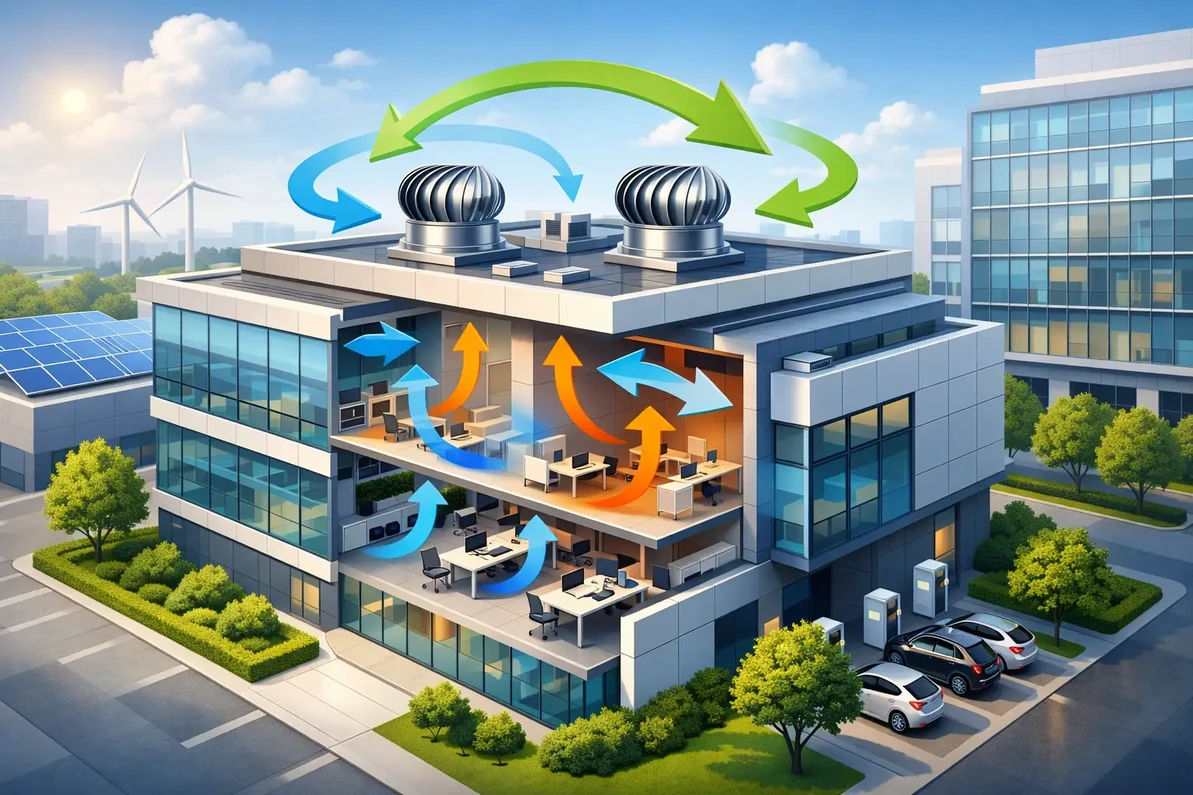
Moving enough air is only part of the job. You also need that air to travel through the space in a way that removes heat or contaminants efficiently. Poorly placed exhaust fans can short-cycle intake air directly to discharge. Ceiling-mounted destratification fans can help reduce heat stacking, but they are not a substitute for proper exhaust and intake balance. HVLS fans can improve perceived cooling and air mixing, but they do not provide code-required exhaust where contaminants are present.
That trade-off matters in manufacturing, livestock, and warehouse environments. Recirculation can improve comfort and reduce stratification, but it should not be confused with ventilation. If airborne contaminants or moisture are driving the problem, the system must actually exchange or capture air, not just stir it.
Duct routing and hood placement change results
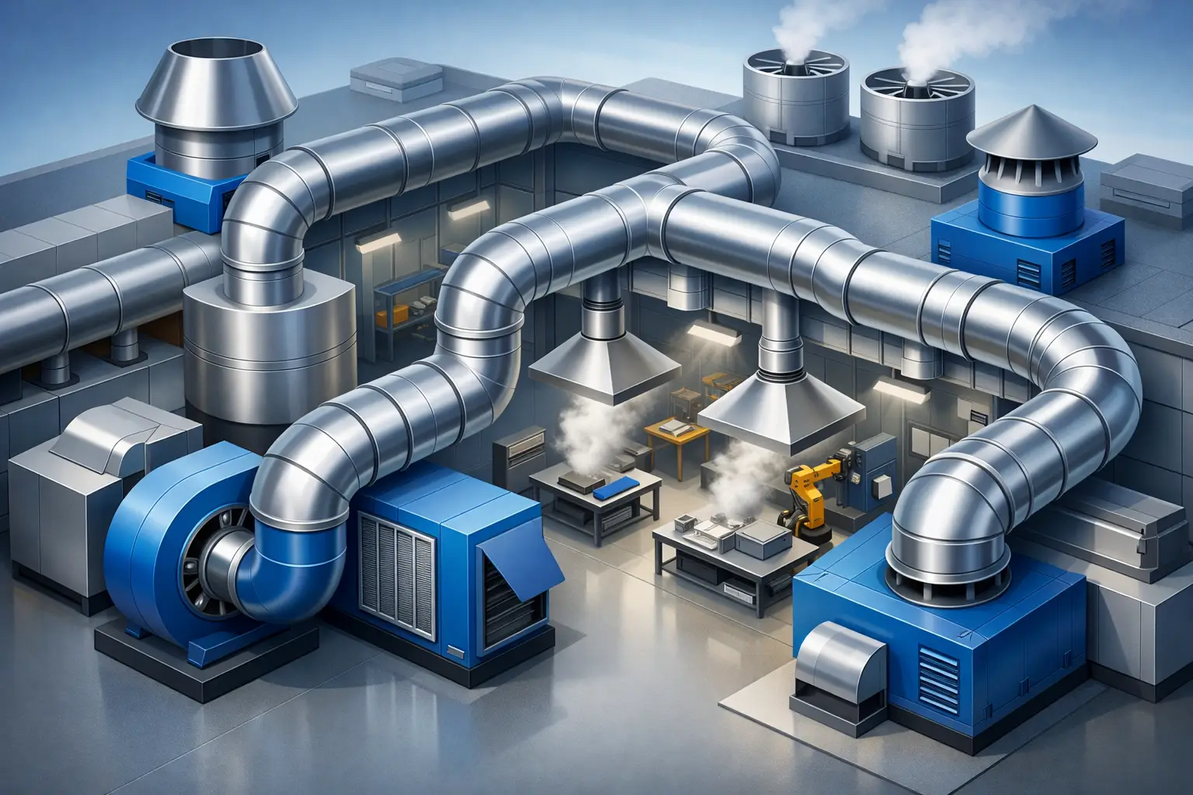
In source-capture systems, the hood is often more important than the fan. A poorly placed hood with high advertised CFM can miss the contaminant plume entirely. Capture velocity, hood geometry, worker position, and cross-drafts all affect performance.
The same is true for discharge. Exhausting hot or contaminated air near an intake can pull the problem right back into the building. Roof-mount versus wall-mount layout, discharge height, and intake separation should be considered early, not after equipment arrives.
Controls make the system usable
Industrial spaces rarely operate at one constant condition. Occupancy changes. Outdoor air changes. Process loads ramp up and down. That is why controls deserve attention during design rather than as an afterthought.
Variable frequency drives, thermostats, humidistats, pressure sensors, and staged control logic can reduce energy use while keeping conditions within target range. In a greenhouse, that may mean integrating exhaust with shutters and circulation fans. In a warehouse, it may mean staging roof ventilators by temperature. In a mining or equipment room, it may mean maintaining intake and exhaust balance as rack load changes.
The best control package depends on how dynamic the space is. Simpler is sometimes better, especially in harsh environments where maintenance access is limited. But no-control systems often end up running harder and longer than needed.
Common design mistakes that cost real money
Most ventilation problems are traceable to a short list of design errors. The first is undersizing make-up air. The second is ignoring static pressure. The third is assuming one fan type fits every application. The fourth is relying on rough air-change estimates where source capture or pressure balance is the real issue.
Another common mistake is buying around the motor nameplate instead of the duty point. Horsepower alone does not tell you whether a fan will deliver the needed CFM at the required static pressure. Cut sheets, fan curves, motor data, and application details all have to line up.
There is also the issue of future expansion. A system designed with no margin may work on day one and fail once equipment, crop density, occupancy, or process intensity increases. Oversizing is not always the answer because it can waste energy and create control problems. But planning for staged growth often saves money later.
Why project-specific design pays off
Industrial ventilation system design works best when the system is built around the facility, not around whatever happens to be in stock. The right solution may be a simple wall exhaust package with shutters and intake louvers. It may be a roof exhaust system with powered make-up air. It may combine HVLS fans for destratification, exhaust fans for heat rejection, and speed controls for load matching.
What matters is getting the duty point right. That means reviewing dimensions, heat load, contaminant type, operating schedule, climate, and installation constraints before equipment is selected. For facilities with multiple zones or specialized applications, that front-end engineering work usually prevents the callbacks, hot spots, and replacement costs that follow rushed purchases.
If you are planning a new build, correcting a problem installation, or comparing fan options for a demanding space, get the numbers right first. A free project evaluation from a ventilation design team with real field experience can save far more than it costs - and the best time to ask those questions is before the fan is on the roof.
Factory Fans Direct - Commercial & Industrial Ventilation & Cooling Experts www.FactoryFansDirect.com | Contact Mike Miller VP Engineering at Factory Fans Direct for a FREE Project Evaluation 888-849-1233 | Mike@FactoryFansDirect.com
Recent Posts
-

Smart Buildings Architects Recommend Edmonds ecoPOWER Hybrid Ventilation
A rooftop ventilator should not force an all-or-nothing energy decision. Smart Buildings Architects …7th Sep 2026 -
Smart Industrial Buildings Use Edmonds ecoPOWER Hybrid Ventilation
A roof exhaust system can be the difference between a plant that controls heat at the source and one …7th Sep 2026 -
Smart Commercial Buildings Use Edmonds Hybrid Ventilation
A rooftop exhaust fan that only performs when the wind blows is not a complete ventilation strategy. …7th Sep 2026