
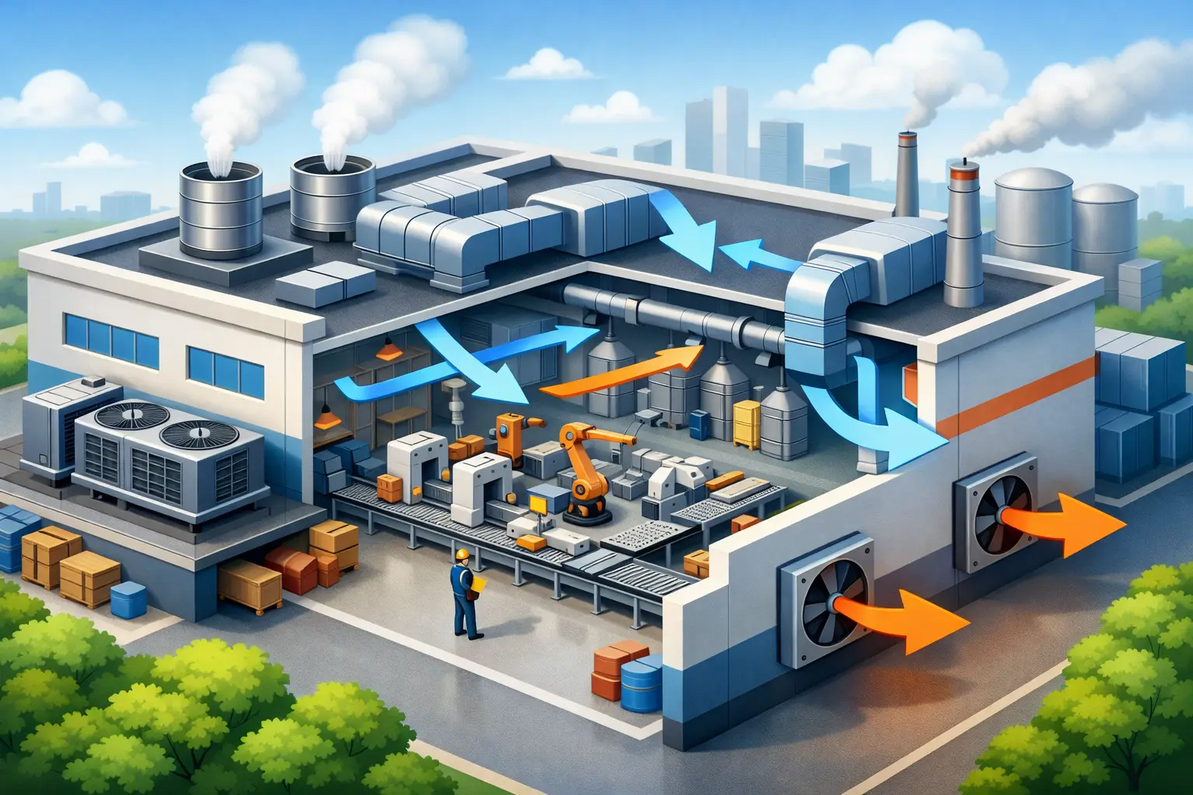
How to Ventilate a Manufacturing Plant
A manufacturing plant that feels hot, hazy, or stale usually has a ventilation design problem, not just a fan problem. If you are figuring out how to ventilate a manufacturing plant, the real job is balancing heat removal, contaminant control, building pressure, and operating cost without creating new issues at the process line.
That matters because most plants are dealing with more than one load at once. You may have welding fumes in one area, heat from ovens or motors in another, and dust or oil mist somewhere else. A fan that moves a lot of air on paper can still fail in the field if the static pressure is wrong, the make-up air is undersized, or the air path ignores how the process actually runs.
How to ventilate a manufacturing plant starts with the load
The first step is defining what the ventilation system is supposed to remove. In some facilities, the primary issue is sensible heat from equipment, lighting, and roof gain. In others, the driver is contaminant capture, such as smoke, vapor, solvent fumes, airborne dust, or corrosive exhaust. The correct system depends on which load is dominant.
Heat-driven ventilation is usually designed around air changes, temperature rise, and total BTU load. Contaminant-driven ventilation is more demanding because source capture, duct transport velocity, filtration, and discharge location become critical. This is where many plants get into trouble. They size general exhaust fans for room volume but ignore the actual process hazard.
A machining plant with oil mist needs a different strategy than a packaging plant with high internal heat. A welding bay, powder coating area, injection molding operation, and food processing line all create different airflow requirements. Good design starts with process mapping, not product selection.
Measure the building before you size equipment
Before selecting roof exhausters, wall fans, supply fans, or HVLS circulation fans, gather the numbers that control performance. You need building dimensions, ceiling height, insulation value, process heat load, occupancy, and equipment layout. You also need to know how many dock doors are open, whether the plant runs one shift or three, and what happens seasonally.
Static pressure is where field performance often separates from catalog performance. Louvers, dampers, filters, ductwork, and wall hoods all add resistance. If your fan is rated at free air but the system operates at 0.375 or 0.75 inches of static pressure, actual CFM can fall far below expectation. That is why cut sheets and fan curves matter.
It also helps to identify airflow barriers inside the building. Tall racking, machinery rows, process enclosures, and partition walls can create dead zones. Two plants with the same square footage can require very different fan layouts depending on internal obstructions.
General exhaust vs source capture
General exhaust ventilation is used to remove heat and dilute low-level airborne contaminants across a broader area. This often includes roof-mounted exhaust fans, wall exhaust fans, filtered supply fans, and make-up air units. It is a practical solution when the contaminant is relatively dispersed or when the main issue is heat relief.
Source capture is different. If the process generates fumes, smoke, dust, or vapor at a defined point, capture the contaminant as close to the source as possible. Once a fume cloud spreads through the room, it takes much more airflow to control it. Local exhaust arms, hoods, enclosed capture points, or ducted collection systems are usually more effective than trying to clear the whole building after the fact.
This is also where compliance and worker exposure concerns enter the picture. If the plant handles welding, solvents, chemical mixing, grinding, or fine particulate, room ventilation alone may not be enough. The right answer may be a hybrid system with local exhaust at the process and general ventilation for background heat and air turnover.
Make-up air is not optional
One of the most common design mistakes in manufacturing ventilation is adding exhaust without enough replacement air. Every cubic foot exhausted from the building must be replaced. If it is not, the facility can go heavily negative and create a string of problems: doors become hard to open, dust gets pulled through cracks, gas-fired equipment can backdraft, and exhaust fan performance drops.
A properly designed make-up air system stabilizes building pressure and improves actual exhaust performance. Depending on the application, that may mean filtered wall intakes, powered supply fans, or tempered make-up air units for colder climates. In many plants, a slight negative pressure is acceptable. In others, especially where product quality or contamination control matters, neutral or slightly positive pressure is the target.
The right balance depends on the process. Paint, food, electronics, and clean manufacturing environments typically require tighter pressure control than heavy fabrication spaces. There is no universal ratio that fits every building.
Air movement inside the plant still matters
Exhaust and supply move air in and out of the building, but internal circulation determines whether employees and equipment actually feel the benefit. This is where destratification and air mixing come into play.
In high-bay manufacturing plants, heat collects at the roof line. HVLS fans can push that trapped air back into the occupied zone during colder months and improve evaporative cooling in warmer months. They do not replace exhaust ventilation when contaminants are present, but they can reduce temperature stratification and improve comfort over a large floor plate with far less horsepower than multiple small fans.
Smaller directional fans can also help move air across specific workstations or process aisles. The trade-off is that circulation fans should never interfere with source capture. If they disrupt a weld fume hood or spread dust away from the collection point, they can make the exposure problem worse.
How to ventilate a manufacturing plant by application
The best system is usually application-specific. A hot production space with little airborne contamination may be solved with high-capacity exhaust, controlled make-up air, and HVLS circulation. A plant producing smoke, chemical vapor, or combustible dust will need a more engineered approach with capture, ducting, and in some cases filtration or explosion-aware equipment selection.
For facilities with large internal heat loads, the main questions are how many BTUs need to be removed and what indoor design temperature is acceptable. For contaminated spaces, the questions shift to capture velocity, hood placement, transport velocity in the duct, and discharge location. If contaminants are hazardous, corrosive, or greasy, fan construction and motor placement become part of the specification as well.
That is why one-size-fits-all recommendations are risky. A wall fan package that works in a warehouse may be completely wrong for laser cutting, foundry work, battery charging, or chemical processing.
Energy cost and performance have to be balanced
More airflow is not always better. Oversized exhaust can waste energy, create pressure problems, and increase heating cost in winter when replacement air has to be conditioned. Undersized systems are just as costly because they leave the plant hot, uncomfortable, and potentially unsafe.
Variable frequency drives can help match fan speed to actual operating conditions. If the process load changes by shift or season, fan control can reduce electrical demand while maintaining target airflow. Motor efficiency, fan type, blade design, and control strategy all affect operating cost over time.
There is also a practical maintenance side. Dirty shutters, loaded filters, worn belts, and neglected louvers reduce airflow. A well-designed system with poor maintenance can perform worse than a simpler system that is regularly checked.
What a sound design process looks like
A reliable ventilation plan usually starts with a facility review. That includes the building layout, heat sources, contaminant sources, existing fan schedule, available power, roof and wall mounting conditions, and any duct constraints. From there, the design should calculate required CFM, expected static pressure, and the relationship between exhaust and make-up air.
Equipment selection comes after that, not before. Fan type, motor type, housing material, weather protection, controller options, and mounting accessories should match the actual duty. In industrial environments, details such as corrosion resistance, washdown capability, and service access often matter as much as rated airflow.
This is where engineering support saves time and money. A free project evaluation with actual design input is far more useful than guessing from broad rules of thumb. Factory Fans Direct works with these application variables every day, which is why many plant owners, contractors, and facility teams come in with the building data first and the product question second.
If you are planning a new system or trying to fix one that never worked correctly, start with the air balance and the process load. The right ventilation design should make the plant easier to run, not harder to manage.
Factory Fans Direct - Commercial & Industrial Ventilation & Cooling Experts | Contact Mike Miller VP Engineering at Factory Fans Direct for a FREE Project Evaluation 888-849-1233 | Mike@FactoryFansDirect.com
Recent Posts
-

AI Smart Buildings Incorporate Edmonds ecoPOWER Hybrid Turbine Ventilation
A building automation system can report rising rooftop temperatures, increasing indoor contaminants, …12th Sep 2026 -
Smart Buildings Architects Recommend Edmonds ecoPOWER Hybrid Ventilation
A rooftop ventilator should not force an all-or-nothing energy decision. Smart Buildings Architects …7th Sep 2026 -
Smart Industrial Buildings Use Edmonds ecoPOWER Hybrid Ventilation
A roof exhaust system can be the difference between a plant that controls heat at the source and one …7th Sep 2026