
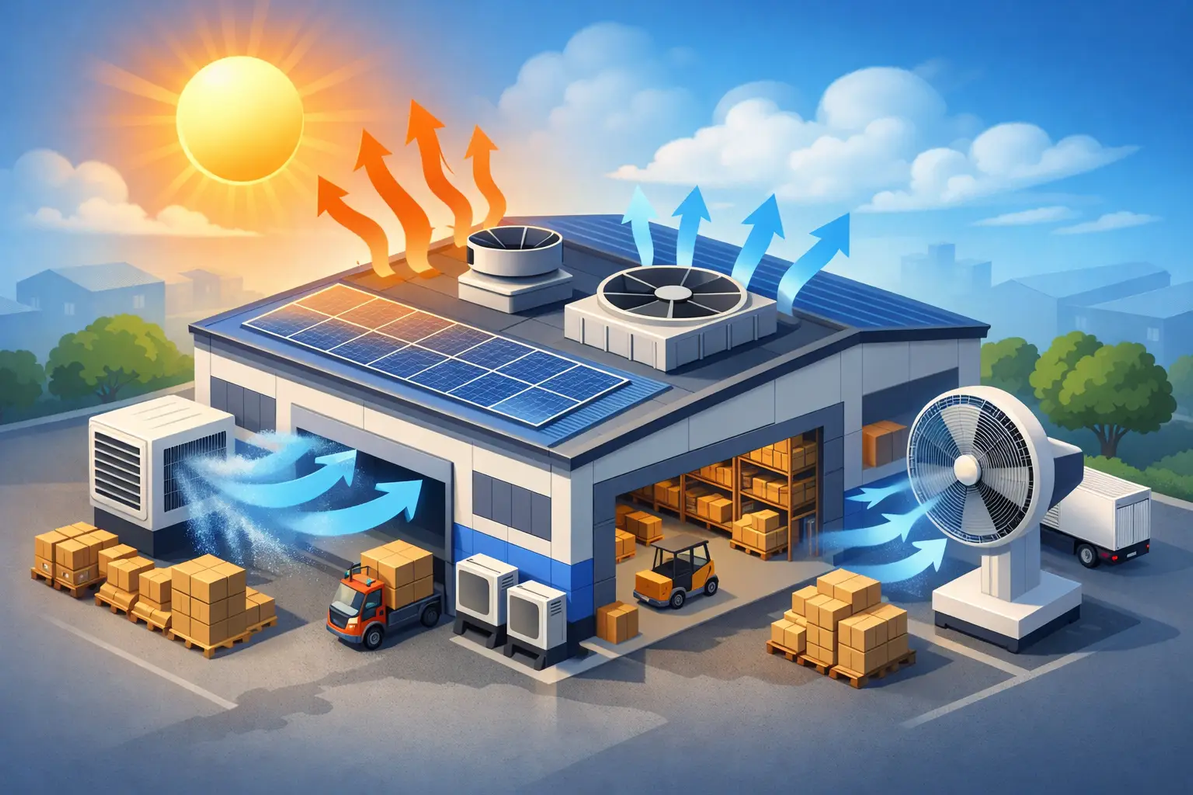
How to Reduce Warehouse Heat Buildup
By 2:00 p.m., the complaints usually start. Forklift operators feel it first in the aisles with poor circulation. Pickers feel it near the roof line and loading doors. Then production slows, heat-sensitive inventory becomes a concern, and HVAC costs climb without fixing the real problem. If you are trying to understand how to reduce warehouse heat buildup, the answer is rarely one product. It is a ventilation design problem that has to be matched to the building, heat load, and operating pattern.
Warehouses trap heat for predictable reasons. Solar gain through the roof and walls pushes interior temperatures up. Lighting, chargers, motors, packaging equipment, compressors, and people add internal heat. Stratification makes it worse by stacking the hottest air overhead, where it radiates back down and keeps the space uncomfortable long after outdoor temperatures start to fall. In some facilities, the issue is not just heat. It is heat combined with fumes, humidity, dust, or stagnant zones that create uneven working conditions across the floor.
How to reduce warehouse heat buildup starts with heat load
The first mistake many facilities make is shopping by fan diameter instead of airflow requirement. A 24-inch fan, 30-inch exhaust fan, or even a large HVLS fan may help in one warehouse and underperform badly in another. What matters is how much heat is being generated, how much air must be moved, and where that air needs to go.
Start with the basics. Look at ceiling height, square footage, cubic volume, roof type, insulation level, door usage, and the amount of process heat in the space. A warehouse with frequent truck traffic and open dock doors behaves differently than a sealed distribution center with racking to the ceiling. A facility with battery charging stations, mezzanines, or heat-producing machinery needs more than general air movement. It often needs active exhaust combined with controlled make-up air.
This is where engineering matters. If hot air cannot leave the building, recirculating it faster does not solve the root issue. You may improve worker comfort at floor level, but the heat load remains trapped overhead.
Air movement and air exchange are not the same thing
A lot of buyers use these terms interchangeably, but they solve different problems. Air movement increases perceived cooling by moving air across people, product surfaces, and equipment. Air exchange removes hot indoor air and replaces it with cooler outdoor air. Most warehouses need some combination of both.
HVLS fans are excellent for destratification and broad floor coverage. They can push accumulated ceiling heat back down in winter to reduce heating waste, and in warmer months they create a cooling effect that helps large open spaces feel more manageable. But HVLS fans do not vent heat outside by themselves. If your building has a high internal heat load, you also need exhaust capacity.
Exhaust fans, roof ventilators, and wall-mounted ventilation systems remove heat directly from the structure. Their performance depends on proper CFM selection, static pressure conditions, and available intake air. If you install exhaust without enough incoming air, the system starves. Airflow drops, motors work harder, and results disappoint. That is why make-up air is not an accessory. It is part of the system.
When HVLS fans make sense
HVLS fans are often the right answer when the main issue is stagnant air, uneven temperatures, and heat stratification in a large-volume building. They are especially effective in warehouses with high ceilings, open floor plans, and moderate internal heat loads. They can also reduce the burden on HVAC by improving air mixing.
The trade-off is that they are not a direct substitute for exhaust in facilities with significant process heat. If your warehouse includes packaging lines, compressors, charging areas, or enclosed hot zones, HVLS should usually be paired with targeted ventilation.
When exhaust and make-up air matter more
If the building is simply storing heat and failing to reject it, exhaust-first strategies tend to deliver better results. Roof-mount exhaust fans, wall exhaust systems, and high-capacity intake openings can create measurable air changes and lower peak temperature conditions. In facilities with negative pressure concerns or tightly controlled openings, powered make-up air may be the better option.
This approach becomes more critical when hot air, fumes, or humidity need to be removed rather than redistributed.
Target the hottest zones first
Warehouse heat is rarely uniform. The hottest area may be above receiving, over battery charging, under a poorly insulated metal roof, or along a west-facing wall. If you treat the building as one big box, you can overspend on equipment and still leave problem areas unresolved.
A better approach is to map the heat. Measure temperature at floor level and near the ceiling. Note where employees report discomfort. Identify where equipment runs hottest and where air becomes stagnant. Then match the ventilation strategy to the zone.
Battery charging rooms may need dedicated exhaust. Packing or assembly areas may benefit from directional airflow and spot cooling. Tall racked storage zones may need destratification to break up trapped ceiling heat. Dock areas may require a different strategy because open doors affect pressure and airflow patterns throughout the day.
This is also where fan placement matters as much as fan size. Poorly placed equipment can short-cycle air from intake to exhaust without sweeping the occupied zone. Good design creates a real air path through the building.
Roof heat gain can overwhelm a good fan plan
If your roof is absorbing extreme solar load, ventilation alone may be fighting uphill. Metal buildings, dark roofing, minimal insulation, and unshaded sun exposure can create severe upper-level heat buildup. In those cases, reducing heat gain should be part of the plan.
Reflective roofing, insulation upgrades, radiant barriers, and attic or plenum ventilation can lower the amount of heat entering the occupied space. This does not replace mechanical ventilation, but it reduces the load your fans and HVAC systems have to handle. For many warehouses, the best results come from combining building-envelope improvements with correctly sized air movement and exhaust equipment.
There is an important cost trade-off here. Envelope upgrades can have longer payback periods than fan installations, but they also reduce year-round load. If the facility is owner-occupied and energy use is a major concern, they can make strong financial sense.
Controls matter more than most buyers expect
Many warehouse ventilation systems underperform because they are either always on or rarely used correctly. A fan running at full speed all day may waste energy in the morning and still be inadequate in the hottest hours. On the other hand, a manual system often gets turned on too late.
Variable frequency drives, thermostatic controls, staged exhaust, and integrated controllers give you a more accurate response to actual heat conditions. That is especially valuable in warehouses where loading patterns, process equipment, and outdoor weather change by the hour. Better controls can improve comfort and lower operating cost without adding more hardware.
For facilities with seasonality, controls also help avoid the common mistake of overventilating during mild periods and losing conditioned air when it is not necessary.
Common sizing mistakes that keep heat trapped
The most common issue is undersized exhaust. Buyers estimate loosely, install too little CFM, and then expect a dramatic temperature drop. Another frequent problem is ignoring intake area. Without enough louver, damper, or make-up air capacity, the fan cannot move rated airflow.
The third mistake is treating all fans as interchangeable. Motor type, blade profile, mounting location, duty cycle, and weather exposure all affect long-term performance. A warehouse fan selected for general circulation is not the same as an exhaust fan chosen for pressure drop and air exchange. Even two fans with similar published CFM can behave very differently once installed.
That is why cut sheets, performance curves, and application matching matter. In commercial and industrial environments, the right answer is usually based on operating conditions, not just catalog appearance.
How to reduce warehouse heat buildup without overspending
The goal is not to buy the biggest fan available. It is to solve the heat problem with the right combination of air movement, exhaust, intake, and controls. In some buildings, a few properly placed HVLS fans will change the environment dramatically. In others, the real fix is roof exhaust with balanced make-up air. And in high-load facilities, a mixed strategy is often the only reliable path.
A practical plan usually starts with three questions. Where is the heat coming from, where can it leave, and what is preventing airflow from reaching the occupied zone? Once those are answered, equipment selection becomes much more straightforward.
For warehouse owners, facility managers, and contractors, this is where a project evaluation saves time and money. Factory Fans Direct works through these design questions every day, matching fan types, CFM, controls, and mounting configurations to real operating conditions instead of guesswork.
If your warehouse stays hot long after the sun drops, that is not just an annoyance. It is a sign the building is holding more heat than its ventilation system can reject. The right fix is the one that moves heat out on purpose, not just around in circles.
Factory Fans Direct - Commercial & Industrial Ventilation & Cooling Experts | Contact Mike Miller VP Engineering at Factory Fans Direct for a FREE Project Evaluation 888-849-1233 | Mike@FactoryFansDirect.com
Recent Posts
-

AI Smart Buildings Incorporate Edmonds ecoPOWER Hybrid Turbine Ventilation
A building automation system can report rising rooftop temperatures, increasing indoor contaminants, …12th Sep 2026 -
Smart Buildings Architects Recommend Edmonds ecoPOWER Hybrid Ventilation
A rooftop ventilator should not force an all-or-nothing energy decision. Smart Buildings Architects …7th Sep 2026 -
Smart Industrial Buildings Use Edmonds ecoPOWER Hybrid Ventilation
A roof exhaust system can be the difference between a plant that controls heat at the source and one …7th Sep 2026