How to Cool a Metal Building That Runs Hot
A metal building can be 15 to 25 degrees hotter than the outside air by midafternoon, even before you add people, machinery, lighting, or process heat. If you are figuring out how to cool a metal building, the real issue is not just temperature. It is solar gain, radiant heat, trapped hot air, air change rate, and whether the building can move enough air to match the load.
That is why many buildings stay hot even after the owner installs a few fans. Air movement helps occupants feel cooler, but it does not remove enough heat unless the system is designed around building volume, heat sources, intake area, and exhaust capacity. In most cases, cooling a metal structure means combining insulation, ventilation, and mechanical airflow instead of relying on a single product.
Why metal buildings get hot so fast
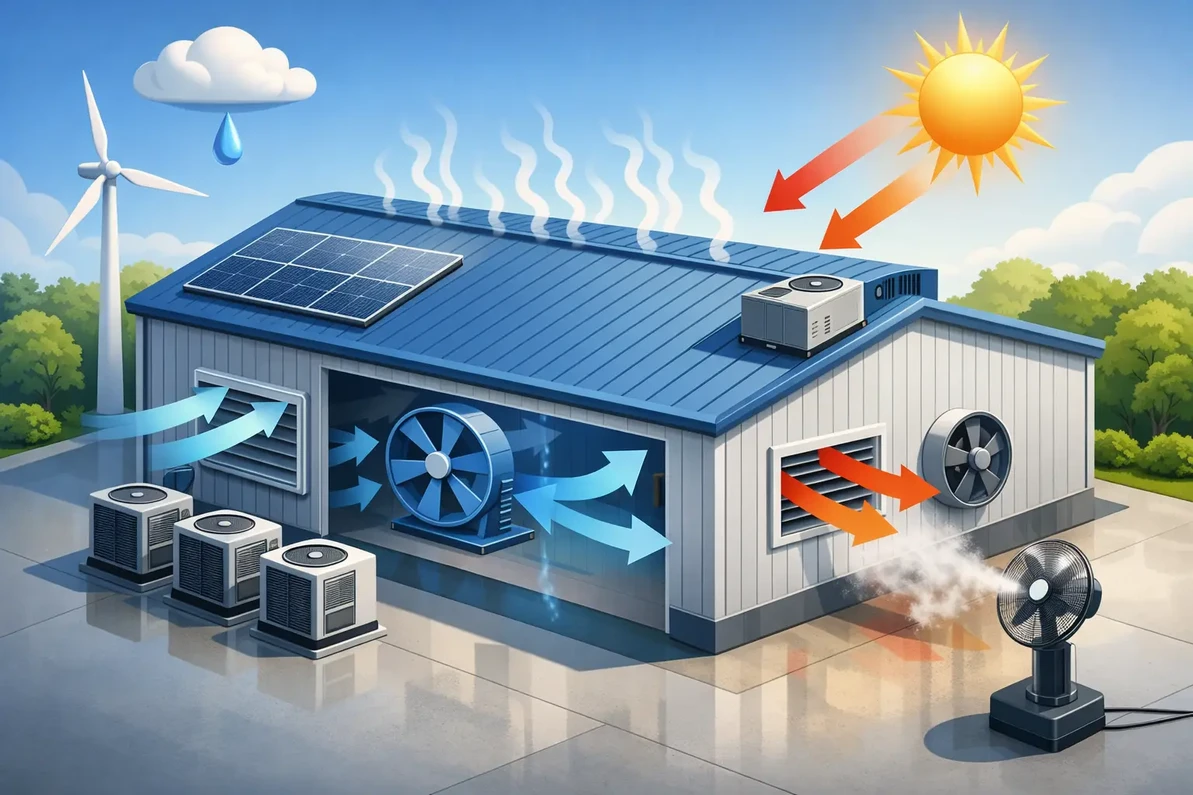
Metal transfers heat quickly. When roof and wall panels are exposed to direct sun, the building shell absorbs radiant energy and sends that heat inward. If the roof assembly is poorly insulated or has little reflective value, the interior temperature climbs fast.
The problem gets worse when hot air has nowhere to go. Heat stratifies under the roof, especially in warehouses, shops, barns, garages, gymnasiums, and manufacturing spaces with high ceilings. A closed metal building can become a heat reservoir, with the upper air layer reaching temperatures far above the occupied zone.
Internal loads matter too. Forklifts, welders, ovens, compressors, servers, grow lights, livestock, and dense occupancy all add heat. If you only look at square footage and ignore process load, you will usually undersize the solution.
How to cool a metal building the right way
The best approach starts with reducing heat gain, then removing hot air, then improving air movement where people or equipment need relief. The order matters because you do not want to spend money forcing conditioned or tempered air through a building envelope that is working against you.
Start with the building envelope
If the structure has little or no insulation, ventilation equipment has to fight a constant heat load. Roof insulation, insulated panels, radiant barriers, and lighter exterior roof colors can all reduce heat gain. In many metal buildings, the roof is the first place to focus because that is where the largest solar load occurs.
This does not mean every facility needs a full retrofit. A storage building used occasionally has a different target than a packaging plant with employees on multiple shifts. But if the building is occupied daily, adding airflow without addressing a bare hot roof often leaves the owner disappointed.
Air leakage also deserves attention. Some leakage helps old buildings breathe, but uncontrolled gaps can pull in hot, dusty, or humid outdoor air from the wrong locations. A better system uses intentional intake points and controlled exhaust so airflow goes where it should.
Ventilate the heat out
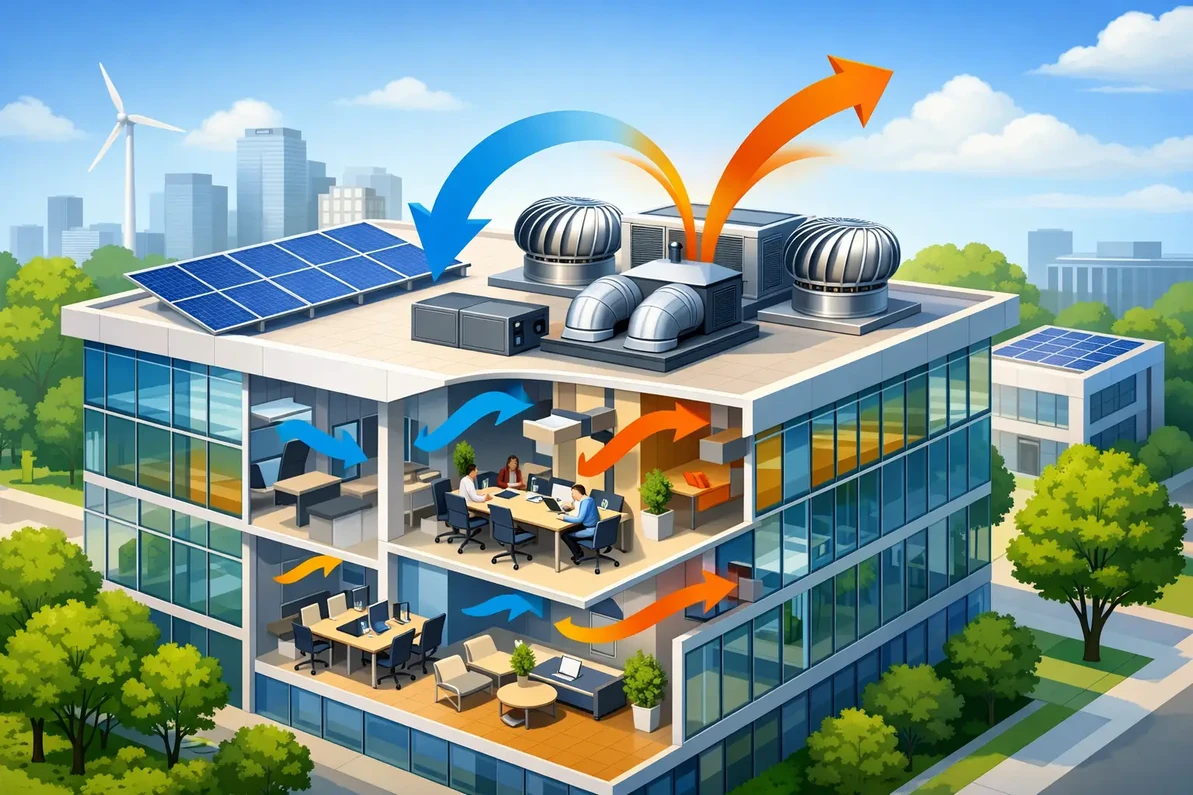
Ventilation is usually the backbone of a practical cooling strategy for metal buildings. The goal is to remove accumulated hot air from the upper part of the structure and replace it with lower-temperature outside air when conditions allow.
Roof exhaust fans, wall exhaust fans, ridge vents, gravity ventilators, and hybrid rooftop ventilators can all be effective depending on the building use and static pressure. The critical point is balance. If you exhaust 30,000 CFM from a building but do not provide enough intake air, performance drops. Fans cannot deliver rated airflow if they are starved for makeup air.
This is where many installations go wrong. Owners add exhaust but leave the building sealed, or they crack a few doors and hope for the best. Proper intake louver sizing, placement, and free area are not minor details. They directly affect fan output, motor load, and the pressure relationship inside the building.
Use high-volume air movement where people work
If your main goal is occupant comfort rather than strict temperature control, air circulation can make a major difference. HVLS fans, directional barrel fans, and industrial panel fans increase perceived cooling by improving evaporation at the skin and breaking up stagnant hot zones.
That said, air movement is not the same as ventilation. A large ceiling fan recirculates air, but it does not remove heat from the building unless it works with an exhaust and intake strategy. In production spaces, the best results often come from combining destratification and spot cooling with dedicated exhaust.
Match the equipment to the building use
A light-duty garage, a livestock barn, and a fabrication plant may all be metal buildings, but they do not have the same cooling profile.
In a workshop or service bay, heat tends to come from solar gain, open doors, and intermittent equipment use. A combination of roof or wall exhaust and strong air circulation may be enough for much of the year.
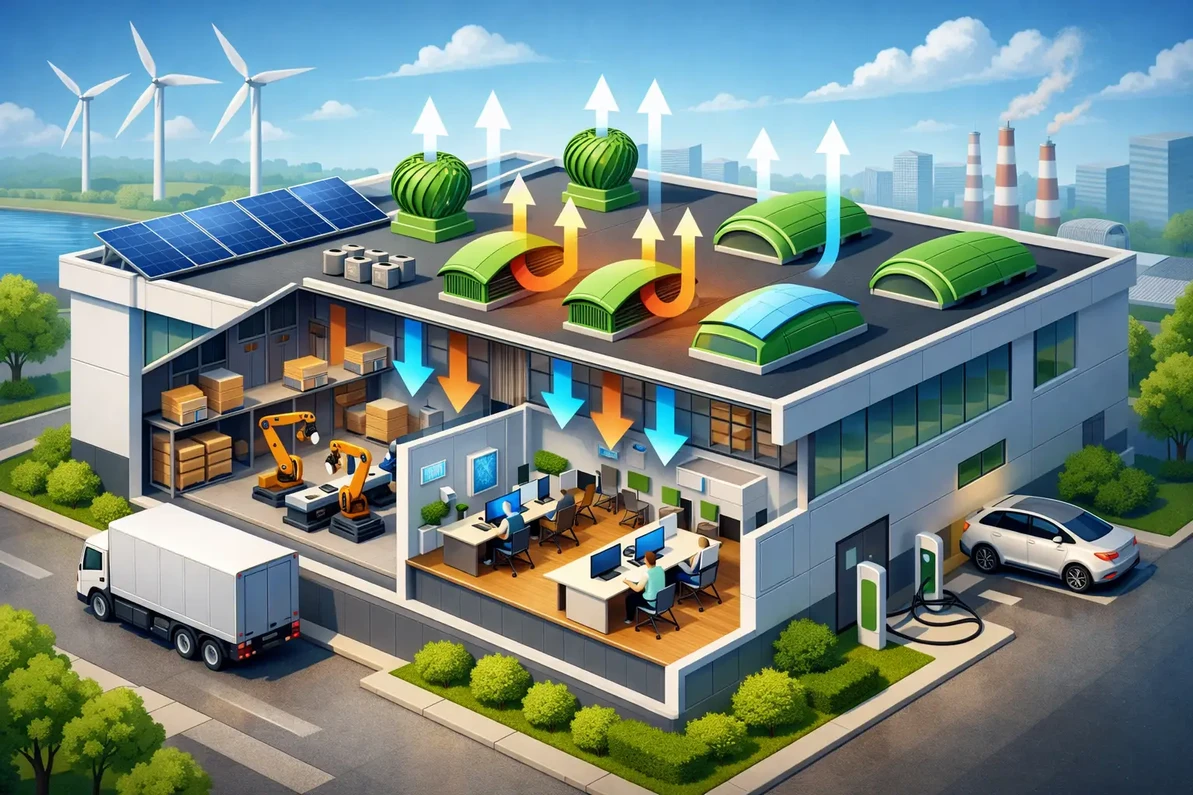
In warehouses and manufacturing buildings, the challenge is often volume. Large cubic footage means the system must move a lot of air to create meaningful air changes per hour. High roof peaks also create deep heat stratification, so fan placement matters as much as fan size.
Agricultural buildings add moisture, ammonia, dust, and animal heat load. That changes fan selection, motor enclosure, corrosion resistance, and intake design. In those spaces, reliability and washdown suitability can matter just as much as CFM.
If the building houses sensitive equipment, electronics, or process controls, comfort ventilation may not be enough. You may need a more engineered system with makeup air, filtration, evaporative cooling, or packaged mechanical cooling depending on indoor temperature targets and local humidity.
When ventilation is enough, and when it is not
A lot depends on climate. In hot-dry regions, ventilation paired with evaporative cooling can work extremely well and at a lower operating cost than conventional air conditioning. In hot-humid regions, outside air may still be uncomfortable, so ventilation improves heat buildup but does not always achieve desired indoor conditions.
This is where expectations need to be realistic. If it is 95 degrees outside with high humidity, exhaust fans alone will not make the building 72 degrees. They can lower heat accumulation, improve air turnover, and reduce dangerous hot spots, but they do not create refrigerated air.
For buildings that need tighter control, mechanical cooling may need to be layered on top of envelope improvements and ventilation design. Even then, ventilation still matters. Air conditioning a metal building with poor airflow and no heat relief path can be expensive and inefficient.
Common mistakes that keep metal buildings hot
The first mistake is undersizing the system. Buyers often choose fans based on price or blade diameter without calculating building volume, required air changes, heat load, and intake restrictions.
The second is ignoring makeup air. Exhaust and intake have to work together. Without enough replacement air, the fan curve changes, airflow drops, and doors may become hard to open.
The third is putting all the emphasis on floor fans. They help with comfort nearby, but they do not solve trapped roof heat.
The fourth is treating every metal building the same. A 40 x 60 hobby shop does not require the same design approach as a distribution warehouse, a riding arena, or a crypto mining enclosure.
A practical design path
If you need a workable answer to how to cool a metal building, start by defining the objective. Are you trying to protect people, reduce attic-like heat buildup, improve equipment reliability, or hold a specific indoor temperature? That answer changes the design.
Next, measure the building. Record length, width, eave height, peak height, roof style, current insulation levels, and the location of doors, windows, and existing vents. Then identify internal heat sources and whether they are constant or intermittent.
After that, determine how air can enter and exit. Exhaust fan sizing without intake planning is incomplete. In many commercial and industrial structures, louvered wall intake, gravity intake, or powered makeup air may be part of the final system.
Finally, select the airflow strategy. Some buildings benefit most from rooftop exhaust and low-wall intake. Others need wall exhaust, circulating fans, and destratification. If summer temperatures or process demands are severe, evaporative or refrigerated cooling may need to be evaluated as part of the overall design rather than as a last-minute fix.
The reason engineering support matters is simple. Nameplate fan CFM is only one piece of the picture. Static pressure, mounting location, duty cycle, motor type, controls, and the building envelope all affect real-world performance.
For owners, facility managers, and contractors, the fastest route is usually a project-specific evaluation instead of guessing from a catalog. Factory Fans Direct works with commercial and industrial applications where heat load, airflow path, and equipment matching have to be right the first time.
A cooler metal building rarely comes from one magic product. It comes from a system that reduces heat gain, moves the right amount of air, and fits the way the building is actually used.
Factory Fans Direct - Commercial & Industrial Ventilation & Cooling Experts | Contact Mike Miller VP Engineering at Factory Fans Direct for a FREE Project Evaluation 888-849-1233 | Mike@FactoryFansDirect.com
Recent Posts
-

AI Smart Buildings Incorporate Edmonds ecoPOWER Hybrid Turbine Ventilation
A building automation system can report rising rooftop temperatures, increasing indoor contaminants, …12th Sep 2026 -
Smart Buildings Architects Recommend Edmonds ecoPOWER Hybrid Ventilation
A rooftop ventilator should not force an all-or-nothing energy decision. Smart Buildings Architects …7th Sep 2026 -
Smart Industrial Buildings Use Edmonds ecoPOWER Hybrid Ventilation
A roof exhaust system can be the difference between a plant that controls heat at the source and one …7th Sep 2026