How to Cool a Grow Facility Correctly
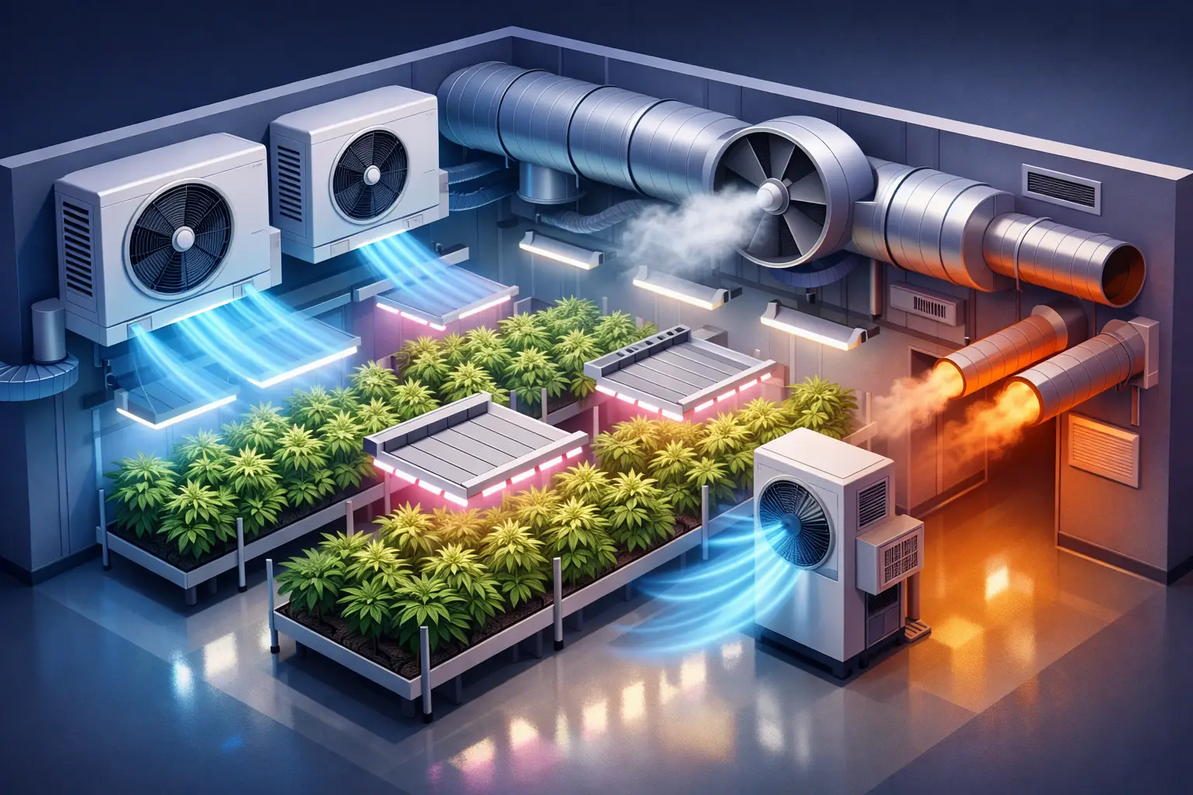
A grow room that runs 5 to 10 degrees hotter than target is not just uncomfortable - it changes plant behavior, increases transpiration, drives humidity swings, and puts your HVAC equipment in a constant losing battle. If you are figuring out how to cool a grow facility, the real answer is not one piece of equipment. It is a matched system built around heat load, moisture removal, air movement, filtration, and controlled air exchange.
That matters because cultivation spaces create a very different cooling problem than a standard warehouse or office. Lighting loads are intense. Irrigation adds moisture. Dehumidifiers add sensible heat back into the room. CO2 strategies can reduce outside air exchange. Even plant canopy density affects how air behaves across the room. If the cooling plan ignores any one of those variables, you end up with hot zones, wet zones, short cycling, mold risk, and higher utility costs.
How to cool a grow facility starts with load calculations
The first mistake many operators make is sizing equipment by square footage alone. That shortcut usually fails in cultivation because the major drivers are not just floor area. You need to calculate total sensible and latent load.
Sensible load is the direct heat you can measure from lighting, pumps, motors, dehumidifiers, people, and the building shell. Latent load is the moisture that must be removed from irrigation, plant transpiration, and any outside air being introduced. In many grow environments, latent load is just as critical as temperature control because moisture management directly affects disease pressure and crop consistency.
A proper evaluation should account for fixture type and wattage, room dimensions, insulation levels, crop stage, plant count, target VPD range, irrigation schedule, and whether the facility is sealed, semi-sealed, or fully ventilated. It should also consider local climate. Cooling a flower room in Arizona is a different engineering exercise than cooling one in Michigan or Florida.
If you skip that design step, oversizing and undersizing both create problems. Undersized systems run nonstop and never stabilize the room. Oversized systems can cool too fast without pulling enough moisture, which leaves the grower with a cold, damp room and poor environmental control.
Choose the right facility strategy first
Before selecting fans, evaporative systems, or air conditioners, decide how the facility will operate. There are three broad approaches.
A sealed grow facility relies mostly on mechanical cooling, dehumidification, and recirculated air. This gives the highest level of environmental control and is common where CO2 enrichment is part of the production strategy. The trade-off is higher equipment cost, tighter controls, and more heat generated indoors by the support equipment itself.
A ventilated facility uses exhaust and intake air to remove heat and humidity. This can be very effective in certain climates and for certain cultivation models, especially when outside conditions are favorable. The downside is less control over temperature, humidity, and contamination unless filtration and make-up air are properly engineered.
A hybrid design blends mechanical cooling with controlled ventilation. For many operators, this is the practical middle ground. It gives better efficiency during cooler seasons or overnight periods while still maintaining tighter environmental control when outside conditions become unfavorable.
Ventilation is not the same as cooling
This is where many projects go sideways. Exhaust fans can remove hot air, but they do not guarantee the room will hit target temperature. That depends on replacement air volume, intake air temperature, static pressure, and internal heat load.
If your lighting and equipment generate more heat than your exhaust system can carry out, room temperature keeps climbing. If the incoming make-up air is already hot and humid, ventilation may barely help at all. And if air paths are poorly designed, the room can show acceptable average temperature while certain aisles or corners stay several degrees warmer.
For ventilated or hybrid grow operations, fan selection should be based on required CFM, duct resistance, filter resistance, light trap pressure loss, and the need to keep odor and contaminants controlled. Intake sizing matters as much as exhaust sizing. Starving an exhaust fan for make-up air reduces actual airflow and raises motor stress.
Air exchange should also support room pressure strategy. Some cultivation areas need negative pressure for odor control. Others need carefully managed balance between rooms. That is a design issue, not a guess.
Air movement at canopy level fixes hidden temperature problems
Room temperature on the wall sensor is only part of the picture. Plants live at canopy height, and that is where microclimates form. Without proper horizontal and vertical air movement, heat and moisture collect around leaves, especially in dense flower rooms.
High-performance circulation fans, HAF systems, and properly placed directional airflow devices help equalize conditions across the room. They reduce stagnant zones, improve leaf surface drying, and allow cooling equipment to work more efficiently because the room behaves more uniformly.
Too much airspeed can stress plants. Too little allows stratification and disease pressure. The right answer depends on crop type, stage, room geometry, and rack configuration. Single-tier grows, vertical farms, and multi-room facilities all require different airflow patterns.
Cooling equipment must be matched to the moisture load
Air conditioning removes both heat and some moisture, but in many grow applications it cannot handle the full latent load on its own. That is why dehumidification often becomes a parallel system rather than a backup function.
The challenge is that dehumidifiers remove water while adding heat back to the space. That added heat then has to be removed by the cooling system. If the HVAC designer sizes cooling only for lighting and ignores dehumidifier heat rejection, the facility will run warmer than expected.
This is one of the clearest examples of why grow cooling has to be engineered as a total climate-control package. Mini splits, packaged units, split DX systems, make-up air units, and dedicated dehumidification all have a place, but selection depends on room use and operating strategy. There is no universal best product.
Evaporative cooling can also be effective in dry climates, especially for greenhouse or semi-open cultivation. In humid climates, it often creates more problems than it solves by raising indoor moisture levels when the crop already needs aggressive humidity control.
How to cool a grow facility without wasting energy
The cheapest cooling system to buy is rarely the cheapest system to operate. Energy efficiency comes from control strategy and equipment matching.
Variable speed fans can reduce power draw while maintaining more stable airflow. Staged cooling avoids large temperature swings and short cycling. Night setback strategies may help in some facilities, but not if they create humidity spikes that drive disease or force hard recovery cycles at lights on. Insulation, air sealing, and reflective building materials also matter more than many operators expect, especially in metal buildings and retrofits.
Controls are a major part of the equation. If exhaust, intake, AC, and dehumidification are not coordinated, one device can work against another. It is common to see a room where air conditioning is trying to cool while poorly timed ventilation is pulling that conditioned air outside. The result is unstable conditions and high electrical cost.
A better approach is integrated control around temperature, humidity, pressure, and sometimes CO2 setpoints. That lets the facility shift modes based on actual room conditions rather than simple timer logic.
Common mistakes that make grow rooms run hot
Some failures are mechanical, but many are design related. Undersized exhaust fans, restrictive duct runs, neglected filters, poor intake placement, and unaccounted light trap resistance can all cut delivered airflow. So can trying to cool one room while heat from adjacent rooms bleeds through walls or ceilings.
Another common issue is ignoring service conditions. Dirty coils, failed dampers, drifting sensors, and blocked louvers change system performance over time. What worked during commissioning may not be what the room is getting six months later.
Facility expansion is another trap. Operators often add more lights or increase plant density without revisiting the cooling design. The original system may have worked for the first crop layout and fail completely under the new one.
The best answer is a facility-specific design
If you want predictable cooling, start with engineering data, not product guesses. Measure the true load. Define your operating model. Then match exhaust, make-up air, circulation, cooling, and dehumidification so they support the same setpoints.
For growers, contractors, and facility managers, that usually means reviewing plans, cut sheets, room volumes, fixture loads, pressure losses, and climate conditions before equipment is ordered. That up-front work prevents expensive corrections after installation.
Factory Fans Direct works with cultivation projects where airflow, static pressure, heat rejection, and equipment matching cannot be left to trial and error. A free project evaluation can help identify whether the facility needs more CFM, better canopy air movement, additional cooling tonnage, improved make-up air strategy, or a different control sequence.
Stable crop rooms are built on repeatable environmental control. When the cooling plan fits the room, plants stop reacting to stress and start performing the way the genetics were meant to.
Factory Fans Direct - Greenhouse, Cannabis & Hemp Ventilation & Cooling Experts | Contact Mike Miller VP Engineering at Factory Fans Direct for a FREE Project Evaluation 888-849-1233 | Mike@FactoryFansDirect.com
Recent Posts
-

AI Smart Buildings Incorporate Edmonds ecoPOWER Hybrid Turbine Ventilation
A building automation system can report rising rooftop temperatures, increasing indoor contaminants, …12th Sep 2026 -
Smart Buildings Architects Recommend Edmonds ecoPOWER Hybrid Ventilation
A rooftop ventilator should not force an all-or-nothing energy decision. Smart Buildings Architects …7th Sep 2026 -
Smart Industrial Buildings Use Edmonds ecoPOWER Hybrid Ventilation
A roof exhaust system can be the difference between a plant that controls heat at the source and one …7th Sep 2026