How to Cool a Crypto Mining Room
A mining room that runs 10 to 20 degrees hotter than planned rarely has a hardware problem first. It usually has an airflow problem. If you are figuring out how to cool a crypto mining room, the real job is not just adding fans. It is removing heat at the same rate your miners produce it, while controlling intake air, pressure, dust, and noise.
Crypto mining puts a mechanical load on a space that looks a lot like a small industrial process room. Racks, ASICs, power supplies, and electrical infrastructure create constant sensible heat. Once that heat builds up, hash rate stability, equipment life, and power efficiency all start to suffer. The right cooling strategy is less about guesswork and more about heat load, air volume, and room design.
How to cool a crypto mining room starts with heat load
Before anyone picks a wall fan, exhaust fan, or louver, the first number to calculate is total heat output. Nearly all electrical power consumed by miners ends up as heat in the room. If your operation draws 50 kW, you are dealing with roughly 170,600 BTU per hour of heat. At 100 kW, that doubles.
That is why undersized ventilation systems fail so often in mining applications. Operators may install a few high-speed fans and expect a dramatic temperature drop, but fans do not remove heat unless the room has a defined path for intake and exhaust. Air has to enter, pass through the equipment, and leave fast enough to carry the heat outside.
A proper design starts with four variables: total equipment wattage, target indoor temperature, expected outdoor ambient temperature, and the allowable temperature rise across the room. Those numbers determine the airflow requirement in CFM. If the room is in a hot climate, your allowable temperature rise is smaller, and the system usually needs more airflow or mechanical cooling support.
Air exchange alone is not enough
One of the most common mistakes in mining rooms is thinking in terms of general air circulation instead of directional airflow. A ceiling fan may move a lot of air inside the room, but if hot air is not being exhausted and replaced with cooler outside air, the room still runs hot.
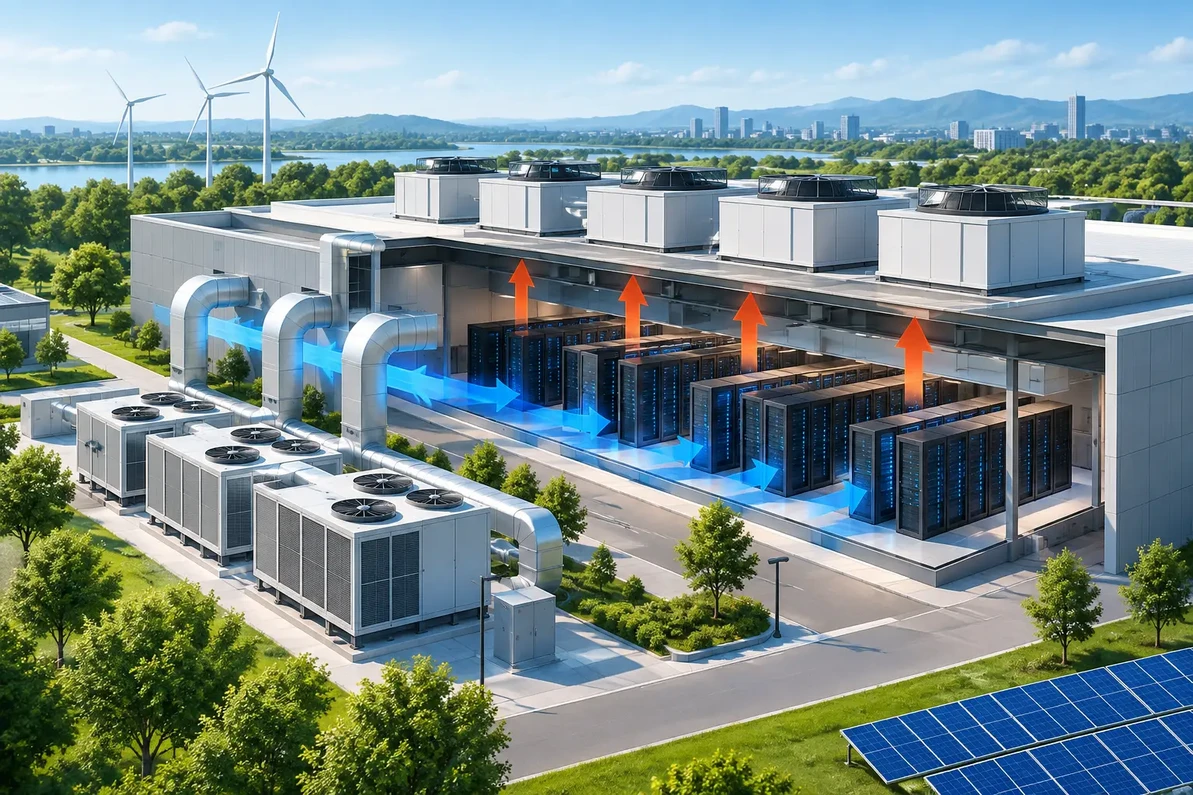
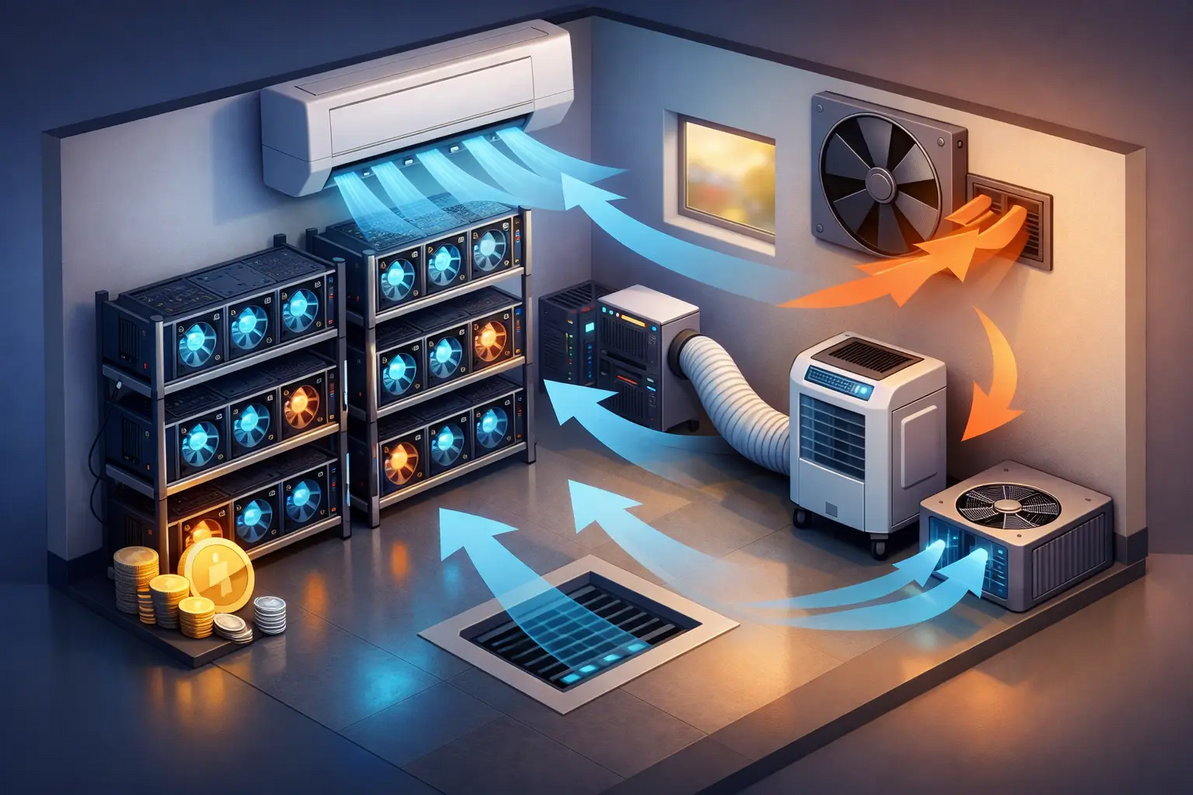
The better approach is to create a clear air path. Cool air should enter from one side of the room or through a dedicated intake zone. It should move directly through the mining equipment and discharge into an exhaust zone on the opposite side. That is what keeps inlet temperatures more stable at the equipment level.
If the room layout allows hot exhaust from miners to recirculate back into the intake side, temperatures climb fast. You lose control of the thermal profile and create hot spots that no amount of random fan placement will fix. Good cooling is really good air management.
Intake and exhaust must be balanced
Exhaust-only strategies can work, but only if there is enough free intake area. If a room is pulling air out aggressively without adequate intake openings, static pressure rises, fan performance drops, and airflow falls short of the nameplate rating. The result is a hot room with loud fans working harder than they should.
That is why intake louvers, shutters, or filtered openings need just as much attention as exhaust equipment. In many mining applications, large-volume exhaust fans paired with correctly sized intake openings produce a more predictable result than relying on incidental cracks, door gaps, or passive leakage.
In simple terms, air cannot leave efficiently unless replacement air can enter efficiently.
Choosing the right cooling method for the room
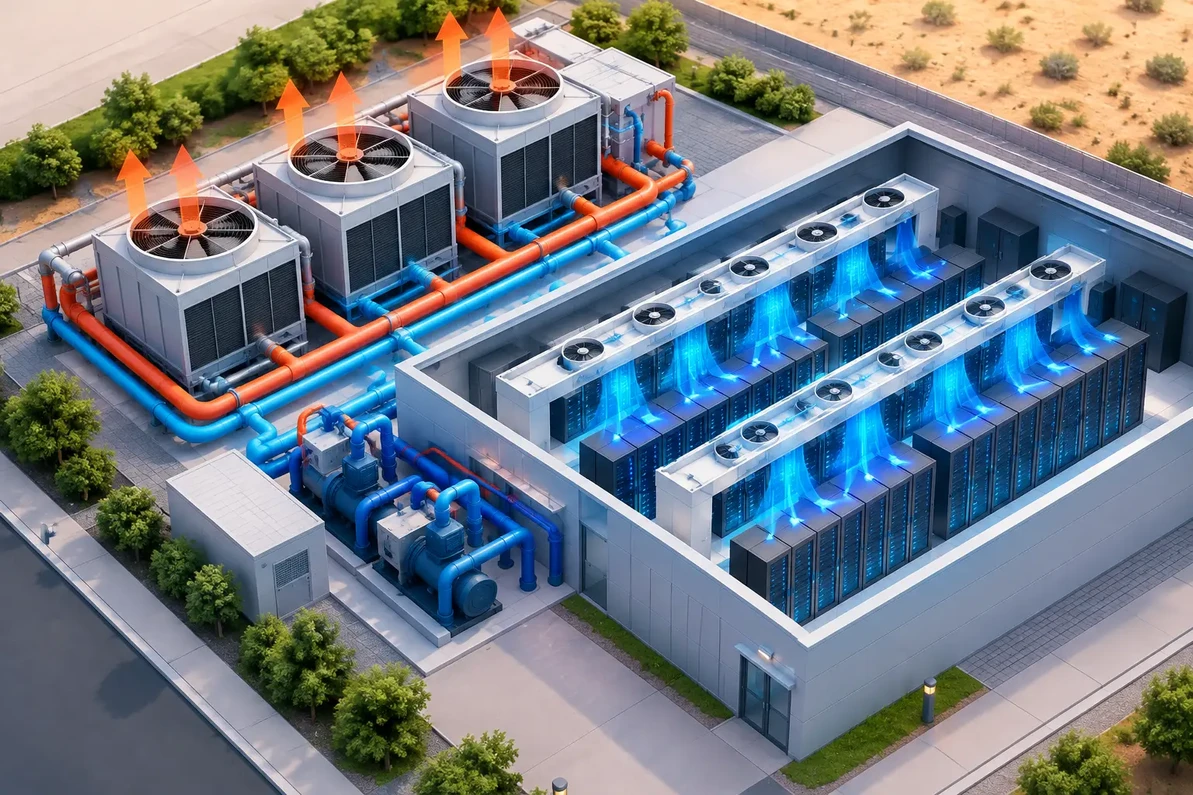
The best answer for how to cool a crypto mining room depends on the room size, miner density, climate, and operating budget. In many installations, ventilation-based cooling is the first and most cost-effective step. In others, especially in hotter climates or enclosed structures, ventilation may need help from evaporative or mechanical cooling.
For a moderate-density mining room in a region with workable outdoor temperatures, high-capacity exhaust ventilation can be enough. This setup usually uses dedicated exhaust fans, large intake openings, and directional airflow through racks or aisles. It is relatively efficient, straightforward to maintain, and easier to scale.
For hotter climates, evaporative cooling may reduce intake air temperature before it reaches the equipment. That can be effective, but it depends on ambient humidity. In dry regions, evaporative systems can provide meaningful relief. In humid conditions, the benefit drops, and moisture management becomes a concern.
Mechanical air conditioning is sometimes used, but it is often the most expensive option to operate for high-heat mining environments. Traditional comfort cooling was not designed for dense, continuous industrial heat loads. It may make sense in smaller installations, sealed rooms, or specialty deployments, but many mining operators find that ventilation-first design delivers a better operating cost profile.
Room layout matters more than many operators expect
Even a well-sized fan package can underperform if the room layout fights the airflow. The goal is to keep intake air separated from exhaust air and move heat out with the least resistance possible.
Equipment orientation matters. If miners are facing different directions, or if racks are placed without a defined hot aisle and cold aisle concept, hot exhaust can wash back over adjacent units. That raises inlet temperatures and creates uneven operating conditions across the room.
A better layout uses discipline. Align units so all equipment pulls from the same cool side and discharges to the same hot side. Keep cable bundles, stored materials, and structural obstructions out of the main air path. If needed, use containment panels or partitions to keep hot and cold zones separated.
Short-circuiting is another common problem. That happens when outside air enters and exits without actually moving through the heat-producing equipment. On paper, the room may have enough total CFM, but the miners themselves are not seeing the cooling benefit because the airflow path is wrong.
Static pressure changes the fan you need
Mining rooms are not open-air test chambers. Louvers, filters, wall caps, dampers, guards, duct transitions, and long airflow paths all add resistance. That resistance is static pressure, and it affects real fan performance.
A fan rated for high CFM in free air may move much less once it is mounted in a real wall with shutters and intake restrictions. This is where engineering support matters. Fan selection should be based on the actual pressure conditions of the room, not just the largest airflow number on a product page.
This is especially important when filtration is required. Filters help with dust control, but they also add pressure drop. In a mining room, that trade-off has to be managed carefully. Cleaner air protects equipment, but over-filtering with undersized fans can starve the room of airflow.
Dust, noise, and seasonal swings are part of the design
Cooling a crypto mining room is not just a summer problem. Seasonal changes affect intake temperature, humidity, and control strategy. In winter, aggressive ventilation may overcool the room or create control issues if airflow is not staged. In shoulder seasons, variable-speed control can help match ventilation to actual load and outdoor conditions.
Dust is another major factor, especially in agricultural, industrial, or desert-adjacent environments. More airflow means more airborne particulates unless intake air is managed. Operators need to decide how much filtration is necessary, how often filters can realistically be serviced, and how much static pressure the system can absorb.
Noise also deserves attention. High-capacity ventilation for mining can get loud fast, particularly with multiple axial fans and high-velocity airflow. If the room is near staff areas, adjacent tenants, or residential boundaries, sound levels may affect the equipment choice. Sometimes a slightly larger, slower-running fan package gives a better result than a smaller high-speed configuration.
Controls turn a fan package into a system
The difference between a basic ventilation setup and a reliable mining-room cooling system is usually control. Thermostats, staged fan operation, and variable frequency drives help maintain a tighter temperature range while reducing unnecessary power use.
Instead of running every fan at full speed all day, a controlled system can ramp airflow with room temperature or equipment load. That reduces wear, limits noise during mild conditions, and improves energy efficiency. It also gives the operator a more stable environment instead of a room that swings between too hot and over-ventilated.
For larger mining spaces, it often makes sense to think in zones. Different rows, pods, or rooms may need different airflow based on equipment density and wall exposure. A one-size-fits-all control strategy can leave one area comfortable and another area struggling.
When to get a ventilation design review
If the room has more than a handful of miners, or if the cooling plan includes filters, louvers, dampers, or any kind of mechanical assistance, it is worth getting the airflow engineered before buying equipment. That is particularly true when uptime matters and electrical load is already committed.
A ventilation design review can help determine required CFM, intake free area, exhaust placement, expected static pressure, and the right control approach for the space. That avoids the expensive pattern of buying fans, adding more fans, and still fighting heat because the room was never designed as a system.
Factory Fans Direct works with these kinds of heat-load and airflow applications every day, which is why project-specific fan selection matters more than generic sizing advice. Mining rooms are demanding environments. They reward designs based on measured performance, not assumptions.
The simplest way to think about cooling is this: every watt has to go somewhere. If your room gives that heat a clean, controlled path out of the building, your miners have a much better chance of running stable, efficient, and profitable over the long haul.
Factory Fans Direct - Crypto Mining & Data Center Cooling Experts Contact Mike Miller VP Engineering at Factory Fans Direct for a FREE Project Evaluation 888-849-1233 | Mike@FactoryFansDirect.com
Recent Posts
-

AI Mega Factories Use Edmonds ecoPOWER Hybrid Ventilation
AI Mega Factories use Edmonds ecoPOWER Hybrid Turbine Ventilation because heat rejection cannot be t …4th Oct 2026 -
AI Cooling for High-Heat Facilities
A server aisle running 12°F hotter than its neighboring aisle, a crypto container recirculating exha …4th Oct 2026 -
AI Ventilation: Better Control Starts With Data
A warehouse can look adequately ventilated on paper and still have a 15-degree temperature differenc …4th Oct 2026