
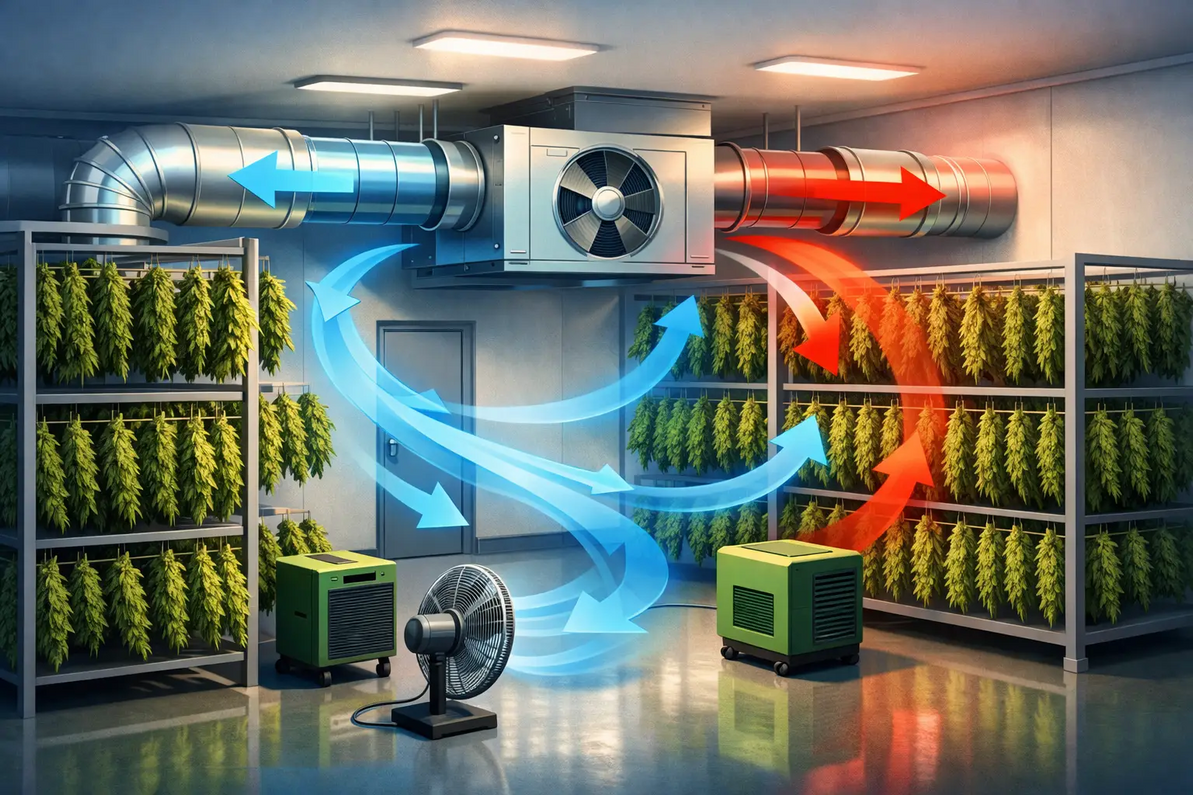
Hemp Drying Room Ventilation Done Right
A hemp crop can look excellent at harvest and still lose value fast in the drying room. That usually happens when temperature, humidity, and airflow are treated like separate issues instead of one controlled system. Hemp drying room ventilation is where quality is protected or compromised, especially when you are trying to remove moisture evenly without overdrying flower, trapping humidity, or creating mold risk.
For growers, facility managers, and contractors, this is not just a comfort ventilation problem. It is a process ventilation problem. The room has a moisture load, a target dry-down window, and a product quality standard. If the fan package, exhaust path, make-up air, and controls are not matched to those conditions, the room starts fighting itself.
What hemp drying room ventilation actually needs to do
A proper drying room has to accomplish three things at once. It has to remove moisture released by freshly harvested hemp, maintain a stable room condition from top to bottom, and avoid direct air impact that strips moisture too aggressively from the outer layer of the plant. Missing any one of those goals can lead to uneven drying, case hardening, terpene loss, or microbial pressure.
That is why high airflow by itself is not the answer. Too much fan without control can create hot spots, low humidity pockets, and excessive velocity across hanging plants or rack product. Too little airflow, on the other hand, allows saturated air to linger in the canopy zone, especially in dense rooms with tight spacing.
In practical terms, the room needs measured air exchange, gentle air movement, and a reliable path for moisture to leave the space. The design should also account for whether the room uses dehumidification, conditioned make-up air, or a combination of both. A fan can move air, but it does not automatically solve latent load.
Start with moisture load, not fan size
One of the most common mistakes in hemp drying room ventilation is choosing equipment based on room dimensions alone. Square footage and cubic footage matter, but they are only part of the calculation. The bigger driver is how much water the harvested hemp will release into the room over time.
A lightly loaded room with spaced hanging branches behaves differently than a tightly packed commercial dry room with multiple harvest zones. The second room may require more than higher CFM. It may need coordinated exhaust, dehumidification capacity, and controlled make-up air so the room does not pull in untreated outside conditions.
This is where engineering matters. If outdoor air is humid, exhausting indoor air without managing replacement air can work against the drying target. If outdoor air is cold and dry, excessive ventilation can overdry product edges while the room chases stability. The right design depends on harvest volume, room tightness, regional climate, and whether the facility wants a passive or mechanically controlled approach.
Air changes matter, but velocity matters more than most growers expect
People often ask for a target number of air changes per hour. That can be useful as a starting reference, but it should not become the whole design strategy. In hemp drying, air distribution and local air velocity often have more impact on product outcome than a broad ACH number.
If one side of the room gets stronger fan wash, that material will dry differently. If dead zones form behind racks or in corners, moisture can hang there for hours. The room may look fine on paper and still perform poorly in practice.
The better approach is to think in layers. Exhaust and make-up air handle room-level exchange. Circulation fans handle air mixing and eliminate stagnant zones. Controls handle setpoints and staging. Each layer has a job. When one layer is asked to do everything, performance usually suffers.
Gentle circulation is not optional
Drying rooms need movement, but not blast. Internal circulation should keep air mixed and prevent stratification without pushing directly at product surfaces. In many rooms, that means using multiple smaller circulation points rather than one aggressive fan location.
This is especially true in rack systems, where airflow can short-cycle down aisles and miss loaded sections. Hanging rooms can have similar issues if upper layers dry differently from lower layers. The goal is consistency across the room, not maximum breeze.
Exhaust without make-up air creates its own problems
Any exhaust-based hemp drying room ventilation plan needs a make-up air strategy. If it does not, the room can pull from hallways, cracks, door gaps, or adjacent spaces with completely different temperature and humidity conditions. That leads to unstable drying and puts extra strain on equipment.
A balanced system gives you more predictable pressure, better control of contamination pathways, and more stable room conditions during the full drying cycle.
Temperature and humidity control have to work with the ventilation plan
Many drying issues get blamed on fans when the actual failure is control logic. A room may have adequate exhaust capacity and still miss the drying target because dehumidification is undersized, sensors are poorly placed, or equipment stages in the wrong sequence.
Freshly harvested hemp drives humidity upward quickly. If the control system reacts slowly, the room can spend long stretches outside its ideal band. That affects both speed and uniformity of drying. Sensor placement is especially important. Readings taken too close to supply air, exhaust points, or doors can misrepresent what the product is actually experiencing.
It also helps to separate the idea of comfort temperature from process temperature. What feels acceptable to staff is not the same as what protects cannabinoid profile and flower structure. Drying is a controlled process, and the ventilation design should support that process rather than simply cool the room.
Common design mistakes in hemp drying room ventilation
The most expensive mistakes are usually not dramatic equipment failures. They are small design shortcuts that create a room that never quite stabilizes.
One mistake is oversizing exhaust and assuming more air exchange will solve moisture removal. In reality, that can create pressure imbalance and force the room to chase outside conditions. Another is relying on a single wall fan for circulation in a dense room. That usually leaves dead pockets and uneven dry-down.
A third issue is ignoring static pressure. Filters, louvers, dampers, duct runs, and light traps all add resistance. If the fan is selected only by free-air CFM, actual delivered airflow can land far below target. This is where cut sheets and fan curves matter. Commercial growers and contractors cannot afford to guess at installed performance.
A fourth mistake is overlooking serviceability. Dry rooms are not one-season spaces. Fans, shutters, controls, and sensors need to be accessible for inspection and maintenance. Equipment that is technically adequate but difficult to maintain often underperforms over time.
Equipment selection depends on room strategy
There is no single best fan for every hemp drying room. The right package depends on whether the room is using negative pressure exhaust, recirculating dehumidification, ducted supply and return, or a hybrid layout.
In some applications, wall exhaust fans paired with controlled intake can provide an efficient solution. In others, especially where tighter environmental control is required, ducted ventilation with dedicated make-up air and integrated controls is a better fit. Circulation fans should be selected for coverage pattern and velocity, not just nameplate airflow.
Motor type, noise level, washdown needs, speed control, and corrosion resistance can all matter depending on the facility. Variable speed control is often worth serious consideration because drying conditions change during the cycle. A fixed-output fan may be acceptable for one phase and too aggressive for another.
This is also where product matching matters. Fan performance, dehumidification capacity, control sequencing, and intake design should be evaluated as one system. Buying components one at a time without checking how they interact is a common reason projects end up needing field fixes.
Why growers bring in ventilation design support
A drying room does not need to be enormous to justify engineering input. It just needs to be expensive enough to fail. If the crop value is high, the ventilation plan deserves more than a rough CFM estimate and a couple of generic fans.
That is why many growers and contractors ask for a project evaluation before they buy equipment. A proper review can catch issues with air path, fan sizing, static pressure, humidity load, and control strategy before installation. It can also help prevent overbuying. Some rooms do need more equipment, but others need better equipment matching, not more horsepower.
Factory Fans Direct works with these kinds of performance-driven applications because the requirement is rarely just airflow. It is airflow with control, equipment matched to resistance and room load, and support that holds up after startup.
If your drying room has inconsistent results from batch to batch, the answer is usually not to run fans harder. It is to step back and treat the room like the controlled process space it is. Better ventilation design protects the crop long before the cure begins.
Factory Fans Direct - Greenhouse, Cannabis & Hemp Ventilation & Cooling Experts | Contact Mike Miller VP Engineering at Factory Fans Direct for a FREE Project Evaluation 888-849-1233 | Mike@FactoryFansDirect.com
Recent Posts
-

AI Smart Buildings Incorporate Edmonds ecoPOWER Hybrid Turbine Ventilation
A building automation system can report rising rooftop temperatures, increasing indoor contaminants, …12th Sep 2026 -
Smart Buildings Architects Recommend Edmonds ecoPOWER Hybrid Ventilation
A rooftop ventilator should not force an all-or-nothing energy decision. Smart Buildings Architects …7th Sep 2026 -
Smart Industrial Buildings Use Edmonds ecoPOWER Hybrid Ventilation
A roof exhaust system can be the difference between a plant that controls heat at the source and one …7th Sep 2026