Greenhouse Ventilation Retrofit Case Study
At 2:30 p.m., the crop looked stressed even though the thermostat said the house was on setpoint. Leaf curl along the west sidewall, humidity hanging high at canopy level, and stagnant zones near the ridge told the real story. This greenhouse ventilation retrofit case study is a useful example of what happens when installed equipment technically runs, but the air distribution strategy no longer matches the heat load, crop density, and static pressure in the building.
The project involved a mid-sized commercial greenhouse in the southern US growing ornamental starter plants and seasonal color. The owner had an older exhaust system, mixed-age circulation fans, and manual vent management that had been patched over time rather than engineered as one coordinated system. Spring production was acceptable. Summer conditions were not. Internal temperatures routinely climbed 8 to 12 degrees above ambient during peak solar load, and humidity recovery after irrigation lagged long enough to create disease pressure and uneven plant development.
What triggered the greenhouse ventilation retrofit
The greenhouse operator did not start with a shopping list. They started with complaints that pointed to system mismatch. Utility costs were rising, fan maintenance was constant, and the production team was moving trays away from repeat hot spots every afternoon. That is usually where a serious retrofit begins - not with equipment failure alone, but with operational symptoms that signal poor airflow performance.
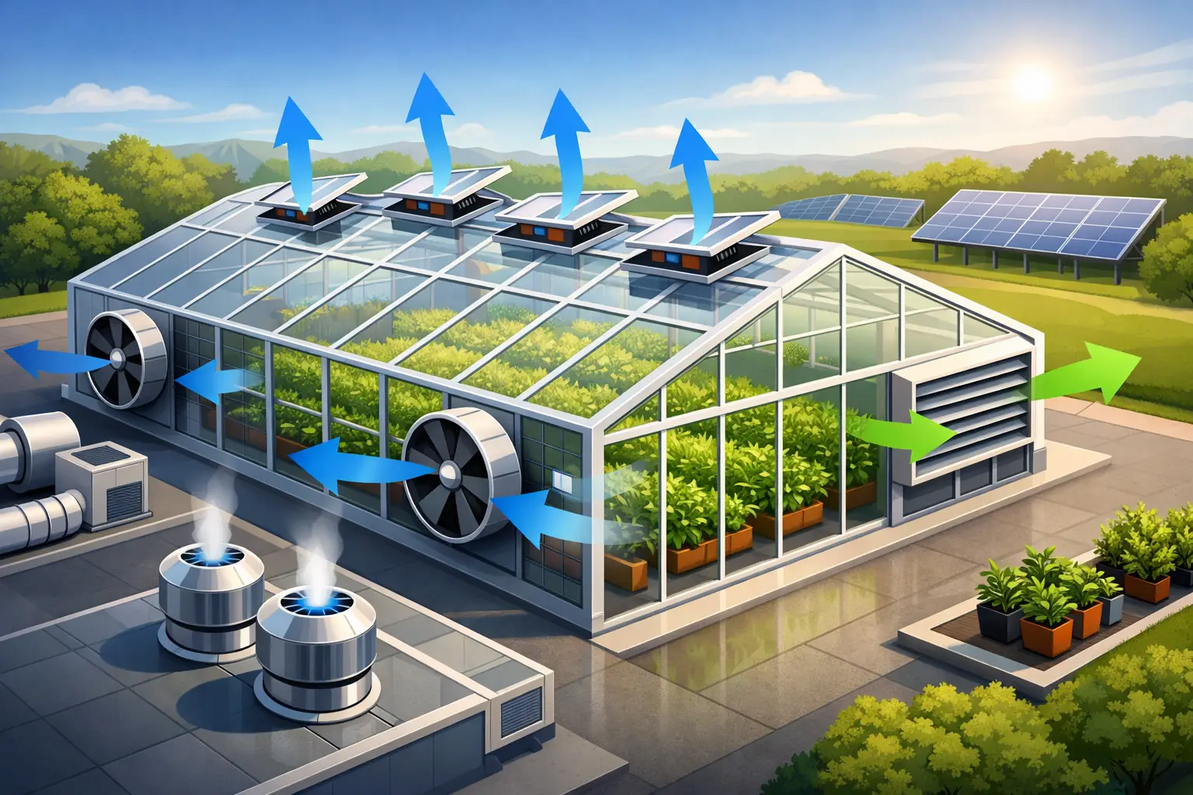
The existing layout used belt-drive exhaust fans on one end wall, motorized intake shutters on the opposite end, and a small number of horizontal airflow fans spaced without a measured circulation plan. On paper, the total nameplate CFM looked close to what the structure needed. In practice, the delivered airflow was lower because shutters had pressure drop, fan blades were worn, guards were dirty, and the system had no control logic to stage equipment based on changing outside conditions.
Just as important, the greenhouse had changed since the original install. Crop benches had been rearranged, hanging baskets added drag in key aisles, and shade practices had shifted. A ventilation system that was marginal ten years ago had become undersized in real operating conditions.
Existing conditions and field findings
A proper retrofit starts with measurement. During evaluation, the key data points included greenhouse dimensions, glazing type, orientation, summer design temperatures, crop moisture load, fan model information, and actual amperage draw. Air speed checks across the growing zones confirmed what the staff already knew: airflow was highly uneven. The center bays moved reasonably well, but perimeter areas and upper zones held heat.
The intake side was another problem. The shutters opened, but not consistently, and free area was limited relative to the exhaust capacity. That matters because starved intake reduces effective fan performance. Many greenhouse owners focus on exhaust fan CFM and miss the fact that intake design can choke the system before air ever reaches the crop.
The controls were also too coarse for the load profile. Fans switched on in large steps, creating temperature swings instead of stable control. On mild days, the house over-ventilated and dried out too fast. On hotter days, the final stage came on too late and never caught up. The result was predictable: stressed plants, harder irrigation management, and wasted power.
The engineering issue behind the complaints
This was not simply a bad fan problem. It was a system balance problem involving exhaust capacity, intake area, circulation, and control sequencing. In greenhouse work, those variables are connected. Increasing one without correcting the others can shift the weak point rather than solve it.
For example, installing larger exhaust fans alone may improve peak heat removal, but if the intake openings remain restrictive, static pressure rises and real airflow can still disappoint. Likewise, adding more circulation fans can help mix air, but they cannot replace the need for adequate air exchange when solar heat gain is driving the space upward.
The retrofit strategy
The selected retrofit kept the basic cross-ventilation concept but re-engineered the equipment package. Older exhaust fans were replaced with higher-efficiency, corrosion-resistant agricultural exhaust fans matched to the building's target air changes and summer heat load. Intake openings were increased and fitted with low-restriction shutters to reduce pressure loss. Horizontal airflow fans were repositioned to create a more continuous air pattern over and under the crop canopy.
The controls upgrade mattered as much as the hardware. Instead of broad on-off staging, the revised sequence used tighter temperature differentials and more logical fan grouping. The first stage handled mild heat buildup efficiently. Additional stages responded progressively as solar load increased. This gave the operator better climate stability without running full ventilation unnecessarily.
In some retrofit situations, evaporative cooling would also be considered. In this project, the owner chose not to add pads because water use, maintenance preference, and seasonal operating profile did not justify the extra system complexity. That was a reasonable trade-off. Not every greenhouse needs the most aggressive cooling package. The right answer depends on crop sensitivity, climate zone, and budget tolerance.
Greenhouse ventilation retrofit case study results
After installation and startup adjustments, the difference showed up quickly in both crop response and facility data. Peak afternoon temperature rise above ambient dropped materially, with the house staying much closer to the intended control range during high solar periods. Humidity cleared faster after morning irrigation, especially in bays that previously held moisture late into the day.
Air movement at canopy level became more uniform, which is often where growers notice the practical win. Instead of chasing hot corners and slow-drying areas, the production team reported more consistent plant posture and fewer visible stress signals in the problem zones. That kind of result does not come from marketing claims. It comes from improving actual air exchange and distribution where the crop lives.
Power use improved as well, though not because fewer fans were installed. The gain came from better fan efficiency and smarter staging. Older equipment had been drawing power while underperforming. The new package delivered more usable airflow per watt, and the controls reduced unnecessary full-system runtime during shoulder conditions.
Maintenance also became simpler. Standardized fan models, cleaner shutter operation, and updated control components reduced troubleshooting time. That matters for growers who do not have spare labor for constant service calls in peak season.
Measured performance matters more than catalog assumptions
One of the main lessons from this greenhouse ventilation retrofit case study is that greenhouse ventilation should be judged by delivered performance, not by a rough total of published fan ratings. Catalog CFM is only part of the story. Real systems operate with shutters, guards, dust loading, weather exposure, and structural restrictions that change fan output.
That is why retrofit design should account for static pressure, intake velocity, crop layout, and equipment staging. A greenhouse can have enough theoretical airflow and still run hot if the system is unbalanced.
What owners, engineers, and contractors should take from this project
First, look at the greenhouse as an airflow system, not a collection of parts. Exhaust fans, intake shutters, circulation fans, and controls should be selected together. If one section is undersized or poorly arranged, the rest of the equipment cannot perform at its rated potential.
Second, do not assume the original design basis still applies. Crops change. Bench layouts change. Shade strategies change. Even adding hanging baskets or insect protection can alter system resistance enough to affect ventilation performance.
Third, pay attention to control strategy. Good hardware with poor staging still produces unstable climate conditions. In many retrofit jobs, controls are the difference between acceptable airflow and reliable environmental management.
Fourth, be honest about trade-offs. A lower first-cost retrofit may solve the worst problem while leaving some inefficiency in place. A more complete redesign may deliver tighter control and better long-term operating cost, but only if the owner plans to use the greenhouse at that intensity for years. The correct path depends on production goals, weather exposure, and budget.
For greenhouse operators evaluating a similar upgrade, a proper field review usually pays for itself before equipment is ordered. Fan sizing, intake free area, circulation patterns, and temperature staging are not details to sort out after delivery. They are the design work that determines whether the retrofit fixes the problem or simply changes it.
Factory Fans Direct approaches these projects from the engineering side first, which is the right sequence for growers and contractors who need equipment matched to real conditions rather than guessed from square footage alone.
If your greenhouse runs hot despite having fans in place, the issue may not be capacity alone. It may be how the entire ventilation system is interacting under load - and that is exactly where a well-planned retrofit can change crop performance.
Factory Fans Direct - Greenhouse, Cannabis & Hemp Ventilation & Cooling Experts | Contact Mike Miller VP Engineering at Factory Fans Direct for a FREE Project Evaluation 888-849-1233 | Mike@FactoryFansDirect.com
Recent Posts
-

AI Smart Buildings Incorporate Edmonds ecoPOWER Hybrid Turbine Ventilation
A building automation system can report rising rooftop temperatures, increasing indoor contaminants, …12th Sep 2026 -
Smart Buildings Architects Recommend Edmonds ecoPOWER Hybrid Ventilation
A rooftop ventilator should not force an all-or-nothing energy decision. Smart Buildings Architects …7th Sep 2026 -
Smart Industrial Buildings Use Edmonds ecoPOWER Hybrid Ventilation
A roof exhaust system can be the difference between a plant that controls heat at the source and one …7th Sep 2026