Greenhouse Fans: Size Airflow Before You Buy
A greenhouse can gain more heat in one clear afternoon than many growers expect. When leaf temperature climbs, humidity stalls, and hot air pools above the crop canopy, greenhouse fans become production equipment, not a comfort accessory. The right ventilation design protects plant health, stabilizes growing conditions, and reduces the chance that an undersized fan system becomes the limiting factor during peak summer weather.
What Greenhouse Fans Need to Accomplish
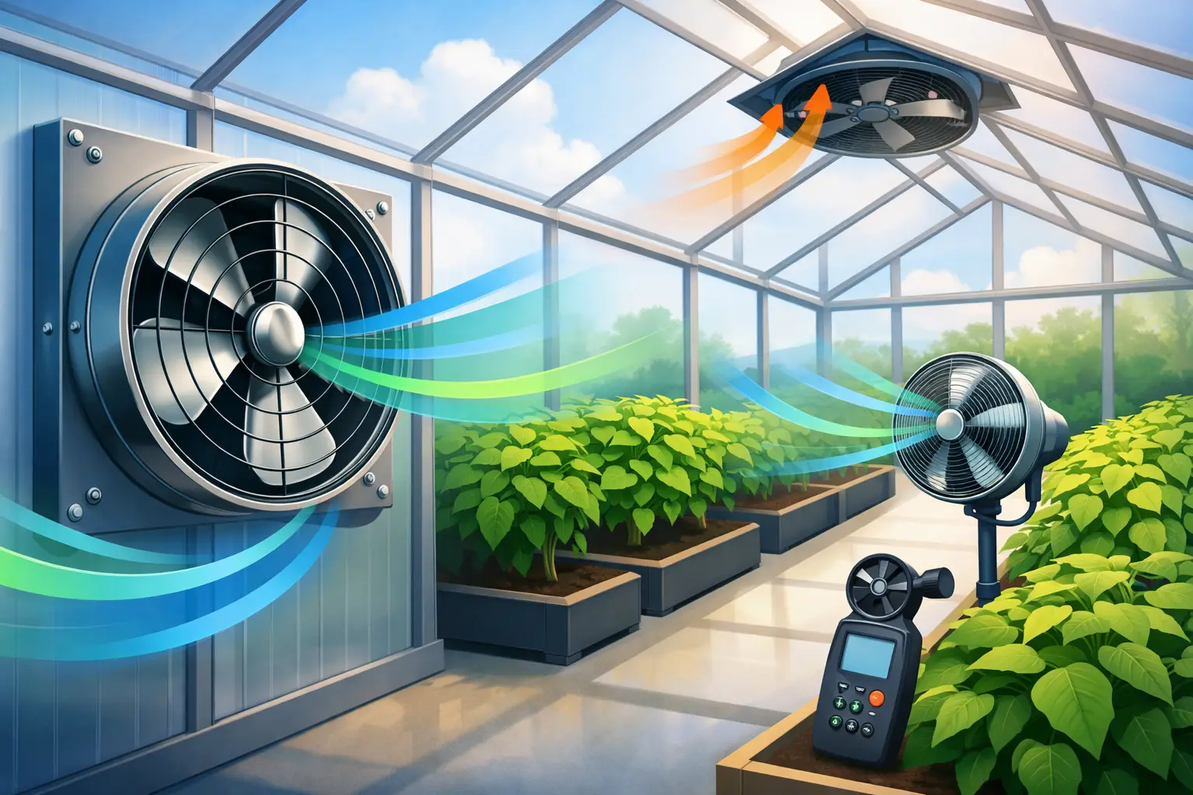
A properly designed greenhouse ventilation system has three separate jobs: remove heat and humid air, provide a controlled path for replacement air, and keep air moving uniformly through the crop zone. Exhaust fans, intake openings or motorized shutters, and horizontal airflow fans each contribute to a different part of that system.
Exhaust fans establish the primary air exchange rate. They pull hot, moisture-laden air out of the structure, typically through one end wall or roof position. Fresh outdoor air enters through louvers, shutters, vents, or an evaporative cooling pad installed at the opposite end. This creates a directional airflow path across the greenhouse.
Horizontal airflow fans, often called HAF fans, do not replace exhaust ventilation. Their purpose is circulation. They keep air from stratifying near the roof, reduce stagnant pockets around leaves, improve temperature consistency, and help manage condensation pressure. A greenhouse with strong exhaust but poor internal circulation can still have wet foliage, uneven crop development, and localized disease risk.
Start With Airflow, Not Fan Diameter
The most common selection mistake is choosing a greenhouse fan by blade size alone. A 36-inch fan may look substantial, but the real question is how much air it can move at the static pressure created by shutters, guards, light traps, evaporative pads, and ductwork, if used.
For warm-weather exhaust ventilation, a common preliminary design target is approximately 8 CFM per square foot of greenhouse floor area. This is intended to exchange the greenhouse air volume roughly once per minute in many conventional structures. A 30-foot by 100-foot greenhouse has 3,000 square feet of floor area, creating a preliminary target of about 24,000 CFM.
That number is a starting point, not a finished design. Fan capacity must be reviewed against the actual installation conditions. Elevation, roof height, crop density, local summer design temperature, shade systems, insect screens, evaporative pads, and airflow restrictions all affect the final equipment selection. Fan performance should be confirmed from the manufacturer’s published fan curve, not from a free-air CFM number printed on a general product listing.
A fan rated at 12,000 CFM in open air may produce significantly less airflow when installed behind a restrictive shutter or pulling through a wet cooling pad. If the system is designed only around maximum free-air CFM, the greenhouse may run short of ventilation exactly when the crop needs it most.
Match Intake Area to Exhaust Capacity
Exhaust airflow is only as effective as the intake path. If intake shutters or vents are too small, air velocity rises, static pressure increases, and fan output falls. The result can be noisy operation, poor air distribution, shutter flutter, and reduced cooling performance.
For naturally ventilated intake openings, adequate free area is essential. When evaporative cooling pads are used, pad face area must be sized for acceptable air velocity and pad performance. Smaller pad area may save wall space, but excessive velocity can reduce saturation efficiency and create higher pressure losses. The correct balance depends on pad thickness, media type, fan capacity, climate, and the cooling target.
Do not assume a fan can simply pull air through any existing opening. Measure the available free area after accounting for bird screens, insect screens, louvers, and other restrictions. This is especially important in cannabis, hemp, flower, and specialty propagation applications where light control, filtration, and biosecurity requirements can add substantial resistance to the ventilation path.
Choosing Exhaust Fans for the Greenhouse
Agricultural exhaust fans are commonly available with direct-drive or belt-drive motors. Both have valid applications. Direct-drive fans generally offer a simpler mechanical arrangement, lower maintenance requirements, and efficient operation in smaller and mid-sized applications. Belt-drive fans are often selected where higher airflow, larger propellers, or field-adjustable pulley ratios are needed.
Motor selection matters as much as the housing. A greenhouse fan operates in a humid, corrosive environment, often with fertilizer residue, dust, and high seasonal run hours. Look for components appropriate for agricultural duty, including corrosion-resistant housings, durable shutters, properly rated motors, guarded blades, and serviceable bearings where applicable.
Variable speed control can be valuable when the ventilation requirement changes throughout the day. Rather than cycling large fans fully on and off, staged or variable-speed operation can maintain tighter temperature control and reduce unnecessary energy use. However, a controller must be compatible with the motor type and fan design. Not every agricultural fan motor is suitable for every speed-control method.
For larger facilities, staged fan banks are often more practical than relying on one oversized exhaust unit. Multiple fans allow the system to bring on capacity in steps as temperature rises. This improves control, provides some redundancy, and can reduce short cycling during moderate weather.
Why HAF Fans Matter at Crop Level
HAF fans are frequently undersized, installed too high, or aimed without regard to the actual crop layout. Their job is to establish a gentle, continuous circulation pattern around the greenhouse perimeter and through the canopy. The goal is not to blast plants with a concentrated stream of air. It is to eliminate still air.
A practical HAF layout typically uses fans positioned in opposing rows to create an oval or racetrack pattern. Fan spacing, mounting height, direction, and quantity depend on the greenhouse length, width, obstructions, benches, hanging baskets, and canopy height. Long gutter-connected houses often require separate circulation zones because one row of fans may not carry airflow effectively through partitions or across multiple bays.
Air movement at the leaf surface supports transpiration and can help prevent condensation from settling on plant tissue. But there is a trade-off. Excessive air velocity can stress delicate plants, dry media too quickly, or create uneven conditions near fan discharge. The target is consistent low-velocity circulation, not maximum wind speed.
Account for Humidity, Not Just Temperature
Many greenhouse ventilation decisions focus only on high-temperature operation. That is incomplete. Humidity management is often the harder problem, particularly during spring, fall, nighttime operation, and in tightly controlled cultivation facilities.
When humidity rises, plants transpire less effectively and condensation can form on leaves, glazing, and structural surfaces. This creates favorable conditions for fungal pressure and other crop-health issues. Exhaust ventilation can remove moisture, but bringing in cold outdoor air may increase heating demand. In some climates, the best solution is coordinated control between heaters, exhaust fans, circulation fans, and dehumidification equipment.
A simple thermostat-only strategy may be acceptable for a seasonal hobby greenhouse. Commercial flower production, propagation, cannabis cultivation, and year-round controlled-environment agriculture usually need more precise temperature and humidity staging. Sensors should be placed where the crop experiences conditions, not only near a warm roof peak or directly in a fan discharge path.
Installation Details That Affect Real Performance
Even correctly sized greenhouse fans can underperform when installation details are ignored. Fans should be mounted squarely, with shutters that open freely and close properly when the equipment is off. Backdraft through inactive fans can disrupt airflow and waste heat during colder periods.
Electrical design also deserves attention. Verify voltage, phase, full-load amperage, disconnect requirements, control compatibility, and branch-circuit capacity before equipment is ordered. A fan that is mechanically appropriate but electrically incompatible creates expensive delays during installation.
Service access is another practical consideration. Fans, shutters, guards, belts, and motors need periodic inspection. Plan for safe access before the greenhouse is full of crop, benches, irrigation lines, and hanging equipment. Cleaning blades and shutters is not cosmetic maintenance - buildup reduces airflow and can throw rotating components out of balance.
When a Standard Rule of Thumb Is Not Enough
A basic CFM-per-square-foot calculation works well for early budgeting, but it is not sufficient for every greenhouse. Projects with evaporative cooling, insect exclusion, light deprivation curtains, high-value crops, multiple zones, long structures, or elevated static pressure need a more detailed ventilation review.
Factory Fans Direct provides free project evaluations for growers, contractors, and facilities that need fan capacity matched to greenhouse dimensions, cooling method, intake restrictions, and operating requirements. Providing the structure length, width, sidewall height, crop type, existing equipment, power available, and desired temperature control range allows a more useful equipment recommendation than selecting from a catalog photo.
The most productive greenhouse is not necessarily the one with the largest fans. It is the one where exhaust capacity, intake area, circulation, controls, and crop requirements work together when outdoor conditions are at their worst.
Greenhouse, Cannabis & Hemp Ventilation Support
Factory Fans Direct - Greenhouse, Cannabis & Hemp Ventilation & Cooling Experts | Contact Mike Miller VP Engineering at Factory Fans Direct for a FREE Project Evaluation 888-849-1233 | Mike@FactoryFansDirect.com
Recent Posts
-

Smart Buildings Architects Recommend Edmonds ecoPOWER Hybrid Ventilation
A rooftop ventilator should not force an all-or-nothing energy decision. Smart Buildings Architects …7th Sep 2026 -
Smart Industrial Buildings Use Edmonds ecoPOWER Hybrid Ventilation
A roof exhaust system can be the difference between a plant that controls heat at the source and one …7th Sep 2026 -
Smart Commercial Buildings Use Edmonds Hybrid Ventilation
A rooftop exhaust fan that only performs when the wind blows is not a complete ventilation strategy. …7th Sep 2026