Hyperscale Data Center Cooling Guide
A few degrees of uncontrolled inlet-air temperature can throttle servers, shorten component life, and turn a planned capacity expansion into an uptime risk. This Hyperscale Data Center Cooling Guide focuses on the engineering decisions that matter most: accurately defining heat load, preventing air bypass and recirculation, matching the cooling method to rack density, and maintaining predictable performance as the facility grows.
Start With the Actual Heat Load
Nearly all electrical power consumed by IT equipment becomes heat inside the data hall. A practical first-pass conversion is 1 kW = 3,412 BTU per hour. A 10 MW IT load therefore produces about 34.12 million BTU per hour before accounting for UPS losses, power distribution equipment, lighting, and other room loads.
Do not size a cooling system from the building square footage or nameplate rack count alone. The relevant inputs are present and planned IT kW, rack-level density, server inlet temperature target, outdoor design conditions, redundancy requirement, and expected growth sequence. A room averaging 15 kW per rack has very different airflow and containment needs than a cluster of AI racks operating at 80 kW or more.
For air systems, the sensible-heat relationship is useful for checking airflow requirements:
CFM = BTU per hour ÷ (1.08 × allowable temperature rise)
The equation is only a starting point. Fan selection must also overcome the total external static pressure created by louvers, filters, duct transitions, dampers, containment leakage, plenums, and discharge conditions. High CFM on a fan curve means little if the installed system has more static pressure than the fan can carry.
Air Cooling Depends on Air Management
Traditional computer room air handlers, direct expansion equipment, air-side economizers, and filtered exhaust strategies can all perform well at moderate rack densities. Their weakness is not necessarily capacity. It is poor air management.
Hot-aisle or cold-aisle containment reduces the mixing of supply and return air, which raises the useful temperature differential across IT equipment. Blank panels, sealed cable openings, brush grommets, and properly located return paths are low-cost details with an outsized impact. If hot exhaust air finds its way back to server intakes, the equipment sees elevated inlet temperature even when the cooling plant appears to have adequate total tonnage.
In high-temperature crypto mining applications, engineered exhaust and make-up air can be a practical cooling strategy when site conditions, filtration, noise, and humidity are properly addressed. However, exhaust-only design is not enough. Every cubic foot of air exhausted must be replaced. Undersized intake openings, restrictive louvers, or neglected filtration can pull the building negative, reduce fan performance, and create uneven miner temperatures.
When Liquid Cooling Becomes Necessary
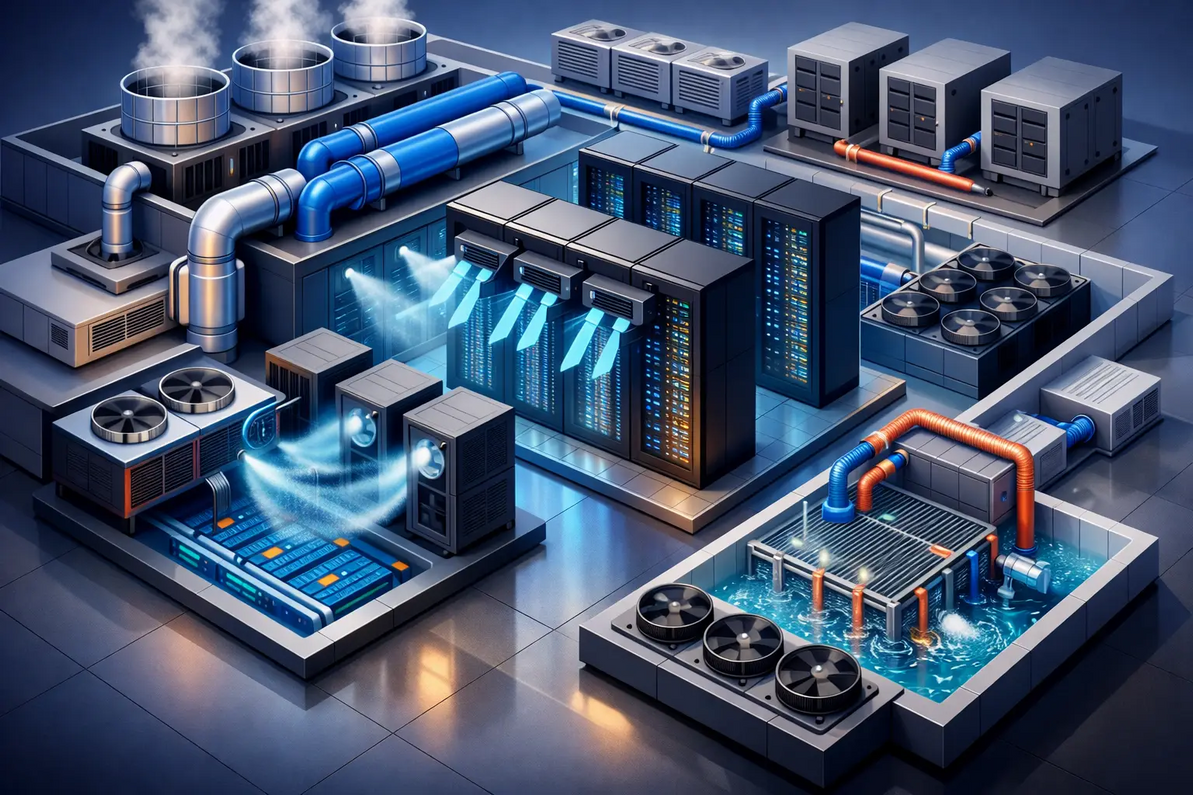
At higher rack densities, moving heat with air becomes increasingly expensive and physically difficult. Direct-to-chip cold plates, rear-door heat exchangers, and immersion cooling transfer much of the thermal load into a liquid loop before it enters the data hall air.
The right approach depends on where the heat is concentrated. Rear-door heat exchangers can support a mixed environment with conventional air-cooled racks beside denser compute. Direct-to-chip cooling is suited to GPU and AI deployments where processors carry most of the load. Immersion cooling can handle extreme densities and reduce server fan energy, but it changes service procedures, fluid management, equipment compatibility, and facility plumbing requirements.
Liquid cooling does not eliminate the need for ventilation engineering. CDU heat rejection, pump power, leak detection, secondary containment, water treatment, and emergency operating modes must be designed as one system. In mixed cooling environments, the remaining air-cooled equipment still needs a defined supply-air path and sufficient return-air capacity.
Build for Failure Modes, Not Average Conditions
Hyperscale facilities should be evaluated under equipment failure and maintenance conditions, not just full-system operation. Determine whether the design requires N+1, 2N, or another redundancy model for chillers, pumps, CRAH units, fan arrays, generators, controls, and electrical distribution. The correct answer depends on the workload, contractual uptime commitment, utility reliability, and financial cost of an outage.
Controls are equally critical. Install temperature and humidity sensors at server inlets, not only at room returns. Track supply and return temperatures, differential pressure across filters, fan speed, pump status, valve position, dew point, and liquid-loop temperatures. Trend data exposes recirculation, filter loading, failed dampers, and capacity shortfalls before they become a thermal event.
Commissioning should include simulated failures: loss of a cooling unit, loss of a pump, power transfer, extreme outdoor temperature, and a rapid IT load change. Verify that controls respond in the intended sequence and that the remaining equipment can maintain acceptable server inlet conditions.
Specify Fans and Ventilation Equipment by Duty Point
For equipment rooms, mining containers, and air-cooled support spaces, specify exhaust and supply fans at the required CFM and installed static pressure, not by nominal diameter alone. Motor duty, corrosion resistance, belt or direct-drive configuration, VFD compatibility, sound level, weather protection, and access for maintenance all affect lifecycle performance.
A variable frequency drive can reduce energy use during lower-load periods and help maintain pressure relationships, but it must be controlled from meaningful measurements. Running fans slower because a room sensor looks acceptable can hide hot spots at the back of dense racks. Sensor placement and airflow verification matter as much as the controller.
Factory Fans Direct - Crypto Mining & Data Center Cooling Experts Contact Mike Miller VP Engineering at Factory Fans Direct for a FREE Project Evaluation 888-849-1233 | Mike@FactoryFansDirect.com
Recent Posts
-

Smart Buildings Architects Recommend Edmonds ecoPOWER Hybrid Ventilation
A rooftop ventilator should not force an all-or-nothing energy decision. Smart Buildings Architects …7th Sep 2026 -
Smart Industrial Buildings Use Edmonds ecoPOWER Hybrid Ventilation
A roof exhaust system can be the difference between a plant that controls heat at the source and one …7th Sep 2026 -
Smart Commercial Buildings Use Edmonds Hybrid Ventilation
A rooftop exhaust fan that only performs when the wind blows is not a complete ventilation strategy. …7th Sep 2026