GPU Cooling Guide for Mining and Data Centers
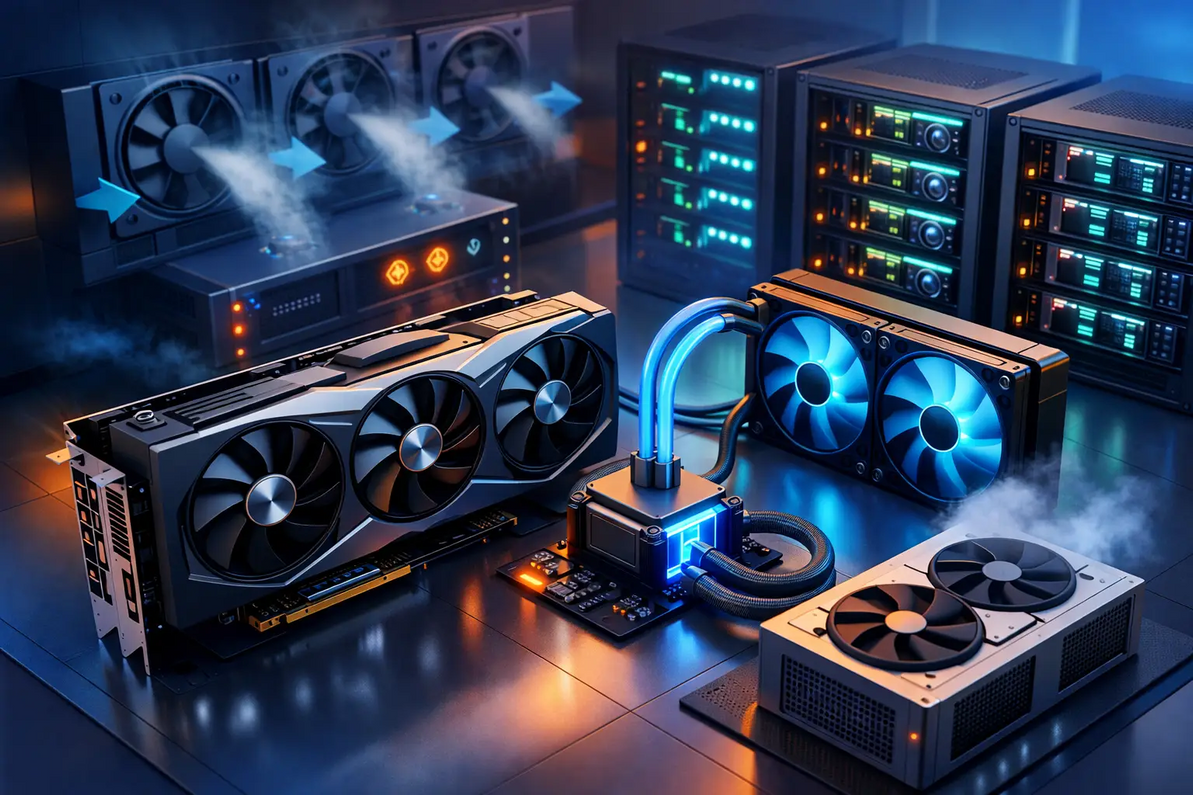
A GPU mining operation can turn nearly all of its electrical input into heat. That makes cooling a capacity and uptime problem, not a comfort problem. This GPU Cooling Guide outlines how to calculate the heat load, move the required air volume, and avoid the airflow mistakes that cause thermal throttling, shutdowns, and premature hardware failures.
Start With GPU Heat Load, Not Fan Size
Do not select exhaust fans based on room square footage alone. Mining rooms and data centers must be designed around the actual operating wattage of the equipment. Every watt consumed by GPUs, power supplies, networking gear, and supporting equipment becomes heat within the space.
For a practical estimate, multiply electrical load in watts by 3.412 to determine BTU per hour. A 3,000-watt mining rig produces approximately 10,236 BTU/hr. A 100-rig operation at that same draw releases about 1,023,600 BTU/hr, before adding heat from lighting, people, transformers, or other equipment.
That total is the foundation for every cooling decision. If the heat load is understated, even a large fan package can leave hot spots around the GPU intake side of the racks.
GPU Cooling Guide: Calculate Required Airflow
For air-cooled operations, a common sensible-heat airflow calculation is:
CFM = BTU/hr ÷ (1.08 × allowable temperature rise)
If a mining room produces 1,023,600 BTU/hr and the design allows a 20°F rise from intake air to exhaust air, the required airflow is approximately 47,400 CFM. A lower allowable temperature rise requires more CFM. A 10°F rise would require roughly twice as much airflow.
This calculation is a starting point, not a finished fan selection. Actual design must account for elevation, outdoor summer design temperature, fan performance at static pressure, louver losses, filters, ductwork, and restrictions at the intake and discharge. A fan rated at 50,000 CFM in free air may deliver substantially less once installed behind louvers, screens, or duct transitions.
Prevent Recirculation Before Adding More CFM
The most expensive cooling mistake is exhausting hot air only to pull it back into the same building. This often occurs when intake louvers are too close to exhaust fans, when exhaust discharges into a roof overhang, or when adjacent containers and walls trap the hot plume.
Create a clear airflow path: bring outside air into the cold side of the equipment, pull it through the GPU racks in one direction, and discharge it well away from the intake zone. Hot-aisle/cold-aisle arrangements are effective when the room layout supports them. In containerized mining, equipment should be positioned so every miner receives comparable intake air rather than allowing the first row to receive cool air while downstream units ingest preheated discharge air.
Negative-pressure exhaust designs can work well, but excessive negative pressure can make doors difficult to operate, pull in dust through uncontrolled openings, and reduce planned intake performance. The intake opening must be large enough to maintain low face velocity and avoid creating unnecessary static pressure.
Select Fans for Static Pressure and Duty Cycle
Mining ventilation is continuous-duty equipment. Fan selection should consider more than published CFM. Verify motor horsepower, voltage, phase, motor enclosure, bearings, blade design, control compatibility, and the complete performance curve at the expected static pressure.
Direct-drive fans can be appropriate for lower-static applications and reduce belt maintenance. Belt-drive units may be better suited for certain higher-pressure applications and allow sheave adjustments, but they require routine inspection and tensioning. Variable frequency drives provide valuable control when load varies, outdoor temperatures change, or a facility needs to reduce fan energy during cooler hours.
For dusty environments, use properly sized intake filtration and establish a maintenance schedule. Filters protect GPU heat sinks, but dirty filters add static pressure and can sharply reduce airflow. Monitoring differential pressure across filtration is more reliable than changing filters only by calendar date.
When Air Cooling Is Not Enough
Air cooling is usually the lowest-cost approach when outdoor air conditions are favorable and a building can support large intake and exhaust openings. It becomes more difficult in high-ambient climates, locations with heavy dust or smoke exposure, and sites where noise, humidity, or limited building openings restrict airflow.
Evaporative pre-cooling can reduce intake-air temperature in dry climates, but it adds water management, maintenance, and humidity considerations. It is not automatically appropriate for every electronics environment. Immersion cooling and hydro-cooling can support much higher equipment density and reduce dependence on massive room airflow, but they require a properly engineered heat-rejection system, fluid management plan, pumps, heat exchangers, and redundancy strategy.
The correct approach depends on local climate, electrical density, site geometry, expansion plans, and the temperature limits of the specific GPU hardware. A fan-only design should not be expected to overcome a poor equipment layout or an intake-air temperature that is already above the desired GPU inlet target.
Verify Performance After Startup
Commission the system with measurements, not assumptions. Record outside-air temperature, intake temperature at multiple rack locations, discharge temperature, fan amperage, room pressure, and GPU temperatures under full load. Large temperature differences between racks usually point to bypass air, recirculation, blocked intake paths, or uneven fan pull.
Factory Fans Direct - Crypto Mining & Data Center Cooling Experts Contact Mike Miller VP Engineering at Factory Fans Direct for a FREE Project Evaluation 888-849-1233 | Mike@FactoryFansDirect.com to review heat load, CFM, static pressure, and equipment matching before installation.
Recent Posts
-

Smart Buildings Architects Recommend Edmonds ecoPOWER Hybrid Ventilation
A rooftop ventilator should not force an all-or-nothing energy decision. Smart Buildings Architects …7th Sep 2026 -
Smart Industrial Buildings Use Edmonds ecoPOWER Hybrid Ventilation
A roof exhaust system can be the difference between a plant that controls heat at the source and one …7th Sep 2026 -
Smart Commercial Buildings Use Edmonds Hybrid Ventilation
A rooftop exhaust fan that only performs when the wind blows is not a complete ventilation strategy. …7th Sep 2026