Greenhouse Airflow Design Example That Works
A greenhouse that runs hot at the ridge, humid in the corners, and stagnant under the canopy rarely has a crop problem first. It usually has an air movement problem. That is why a practical greenhouse airflow design example matters. It turns vague goals like “better ventilation” into fan capacity, intake area, airspeed, and control strategy you can actually build.
For growers, contractors, and engineers, airflow design is not just about adding exhaust fans until the space feels cooler. The right design has to move sensible heat, manage humidity, prevent condensation, support transpiration, and avoid dead zones without beating up the crop with excess velocity. In a commercial greenhouse, every one of those variables affects plant health, labor conditions, and energy cost.
A greenhouse airflow design example for a 30 x 100 house
Start with a common structure - a 30-foot by 100-foot greenhouse with an average height of 12 feet. That gives a floor area of 3,000 square feet and an approximate interior volume of 36,000 cubic feet. Assume a warm-season crop, moderate plant density, and a summer design goal of keeping inside temperature as close to ambient as practical with mechanical ventilation and controlled intake.
In this example, the grower wants active summer ventilation, reasonable humidity removal, and steady horizontal air movement over and through the crop. The greenhouse is in a warm US climate, so the design has to prioritize heat rejection during peak solar load, not just mild spring operation.
A common starting point for summer exhaust ventilation is 8 CFM per square foot, though the real target depends on solar gain, glazing type, shading, elevation, and crop sensitivity. Using 8 CFM per square foot, the required exhaust rate is:
3,000 sq ft x 8 CFM = 24,000 CFM
That means the greenhouse needs roughly 24,000 CFM of mechanical exhaust capacity under full-load summer ventilation. You could satisfy that with two 12,000 CFM exhaust fans or three smaller fans staged for better control. From an engineering and controls standpoint, staged fans are usually the better answer because the load is not constant all day.
Why fan count and placement matter
If you install one large fan bank at one end and give little thought to intake placement, you may hit the CFM target on paper and still get poor performance in the crop zone. Greenhouses are long, shallow structures. Air will always prefer the path of least resistance. Without a balanced path from intake to exhaust, sections of the house can short-circuit while others stay stagnant.
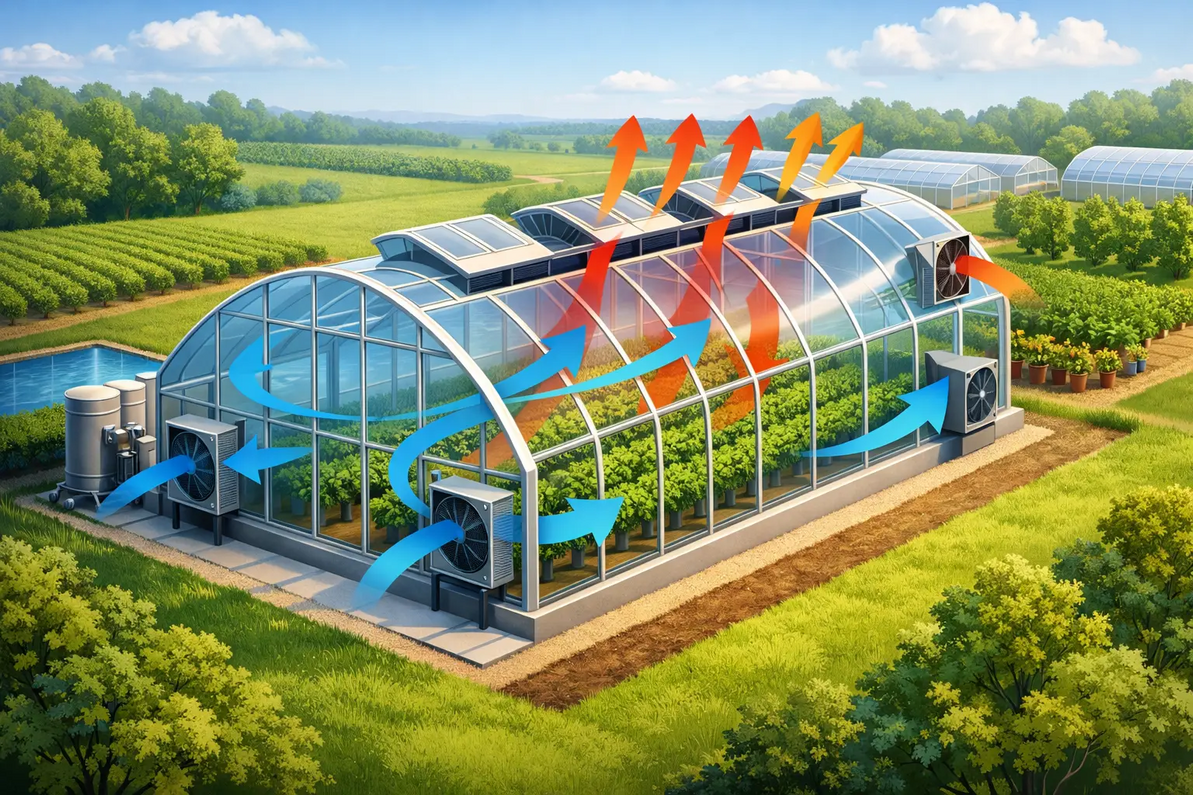
For this greenhouse airflow design example, place the exhaust fans on one end wall and use motorized intake shutters or evaporative cooling pads on the opposite end, depending on climate and water strategy. If the application is dry and hot, pad-and-fan cooling may make sense. If humidity control is more critical, direct outside air intake with shutters may be the better fit.
Assume we select three exhaust fans rated at 8,000 CFM each at the expected operating static pressure. That detail matters. Fan ratings at free air are not the same as fan performance once shutters, guards, pads, and wind load enter the equation. In real installations, static pressure can reduce delivered airflow enough to create serious underperformance.
Three 8,000 CFM fans give 24,000 CFM total design airflow. Stage one fan at the first temperature setpoint, stage the second as load increases, and bring on the third during high heat conditions. That gives better temperature stability and lower operating cost than simple all-on, all-off control.
Intake sizing is where many designs go wrong
Exhaust-only thinking causes major greenhouse problems. If intake opening is too small, the fans pull against excessive negative pressure, airflow drops, shutters chatter, and the crop sees uneven air distribution. The greenhouse then becomes noisy, inefficient, and difficult to control.
A good rule is to provide enough net free intake area to keep inlet velocity within a practical range. In many greenhouse designs, a target intake velocity of around 500 to 700 feet per minute is a reasonable starting point. For 24,000 CFM, if you aim for 600 feet per minute at the inlet, you need:
24,000 CFM / 600 FPM = 40 square feet of net free intake area
That is net free area, not nominal louver size. If louvers, screens, insect mesh, or cooling pads are used, effective open area drops and static pressure rises. In practice, you may need a larger nominal intake opening to achieve that 40 square feet of usable airflow area.
This is also why equipment matching matters. A fan that looks strong in a catalog may not perform well against the resistance of fine mesh, wet pads, or restrictive shutters. The cut sheet and fan curve need to match the actual greenhouse assembly.
Horizontal airflow is not the same as ventilation
Ventilation removes heat and moisture from the structure. Horizontal airflow fans manage air mixing inside the structure. Those are related, but they are not interchangeable.
In this greenhouse airflow design example, mechanical exhaust handles the bulk air exchange, while horizontal airflow fans keep temperature and humidity from stratifying. Without HAF fans, the crop can experience warm pockets, cold pockets, and moisture accumulation near leaves even when exhaust fans are properly sized.
For a 30 x 100 greenhouse, a common approach is to install a series of HAF fans in a racetrack pattern along both sidewalls, aimed to create a continuous loop of air around the house. The target is gentle, uniform air movement through the canopy, not a strong draft. Depending on crop type and house layout, air velocity in the crop zone might be kept around 50 to 100 feet per minute. Tender crops may want less. Dense canopies often need better penetration.
This is where design becomes application-specific. Propagation, flowering, and vegetative growth do not all want the same air pattern. Cannabis, hemp, ornamentals, and food crops each respond differently to leaf movement, humidity swings, and boundary layer disruption.
Controls make or break performance
A fan layout can be technically correct and still perform poorly if the control sequence is too crude. In a greenhouse, temperature and humidity are moving targets. Solar load can change fast. Irrigation events spike humidity. Outdoor conditions shift hourly.
A better control strategy stages exhaust fans, opens intake devices in sequence, and coordinates circulation fans continuously. If evaporative cooling is part of the design, pad operation should be tied to dry-bulb temperature, humidity tolerance, and outside air conditions rather than simple timer logic.
For example, the first exhaust fan may energize at 78 degrees, the second at 82, and the third at 86, with corresponding intake positions opening progressively. HAF fans typically run continuously during active growing periods to maintain mixing. If nighttime humidity is a concern, limited ventilation cycles may be needed even when temperature alone would not call for cooling.
Variable frequency drives can also help in some larger or more sophisticated systems, but they are not always the default answer. Some agricultural fans are better applied in staged operation than wide turndown VFD control. Motor compatibility, control stability, and cost all have to be considered.
The trade-offs in a real greenhouse design example
Every greenhouse ventilation plan is a balance of competing priorities. More airflow improves heat removal, but it can raise winter infiltration if the envelope is loose. Evaporative cooling can drop temperature, but it may push humidity too high for certain crops or disease pressure conditions. Large exhaust fans can move serious CFM, but if they are poorly distributed or paired with undersized intake, they create uneven performance.
The greenhouse structure itself changes the answer. Gutter-connected ranges, hoop houses, glass houses, and polycarbonate structures all behave differently under wind and solar gain. So do houses with blackout curtains, benches, hanging baskets, or supplemental lighting. Internal obstructions increase resistance and alter airflow path.
That is why a design example is useful, but field conditions still matter. A 24,000 CFM target for one 30 x 100 greenhouse may be appropriate in one climate and light in another. Altitude, local summer design temperature, and crop moisture load can push the number up or down.
What to check before equipment is selected
Before final fan and intake selection, verify the greenhouse dimensions, crop type, desired summer inside temperature, pad or shutter preference, electrical service, and any restrictions created by insect screening or filtration. Also confirm whether the goal is simple seasonal ventilation or tighter environmental control.
For buyers comparing fan packages, the key question is not just rated CFM. It is delivered CFM at the real operating static pressure. That single distinction separates a system that performs from one that struggles every afternoon.
This is where technical support earns its keep. Factory Fans Direct works with growers, engineers, and installers who need equipment matched to actual greenhouse conditions, not just floor area estimates. A free project evaluation can save time, avoid oversights in intake sizing, and prevent the common mistake of buying exhaust capacity that the greenhouse cannot feed properly.
A good greenhouse airflow design example should leave you with one clear takeaway - airflow is a system, not a fan. When exhaust, intake, circulation, and controls are engineered together, the house runs more evenly, crops stay healthier, and the ventilation package works like it should in July, not just on paper.
Factory Fans Direct - Greenhouse, Cannabis & Hemp Ventilation & Cooling Experts | Contact Mike Miller VP Engineering at Factory Fans Direct for a FREE Project Evaluation 888-849-1233 | Mike@FactoryFansDirect.com
Recent Posts
-

AI Smart Buildings Incorporate Edmonds ecoPOWER Hybrid Turbine Ventilation
A building automation system can report rising rooftop temperatures, increasing indoor contaminants, …12th Sep 2026 -
Smart Buildings Architects Recommend Edmonds ecoPOWER Hybrid Ventilation
A rooftop ventilator should not force an all-or-nothing energy decision. Smart Buildings Architects …7th Sep 2026 -
Smart Industrial Buildings Use Edmonds ecoPOWER Hybrid Ventilation
A roof exhaust system can be the difference between a plant that controls heat at the source and one …7th Sep 2026