Free Ventilation & Cooling Evaluation for Warehouses & Manufacturing Facilities
Heat complaints in a warehouse or plant usually show up long before anyone asks for engineering help. Forklift aisles feel stagnant, production zones run hotter than the rest of the building, dust hangs in the air, and overhead doors become the only ventilation strategy. A Free Ventilation and Cooling Evaluation for Warehouse & MFG Facilities helps identify why that is happening and what it actually takes to fix it.
In most industrial buildings, the problem is not just that it is hot. The real issue is that the airflow pattern does not match the building use, process heat, occupancy, equipment layout, or pressure conditions. A fan added in the wrong location can move air without solving heat buildup. An exhaust system without enough make-up air can create negative pressure, reduce performance, and pull in dust or unconditioned air from every opening in the structure.
What a free ventilation and cooling evaluation should uncover
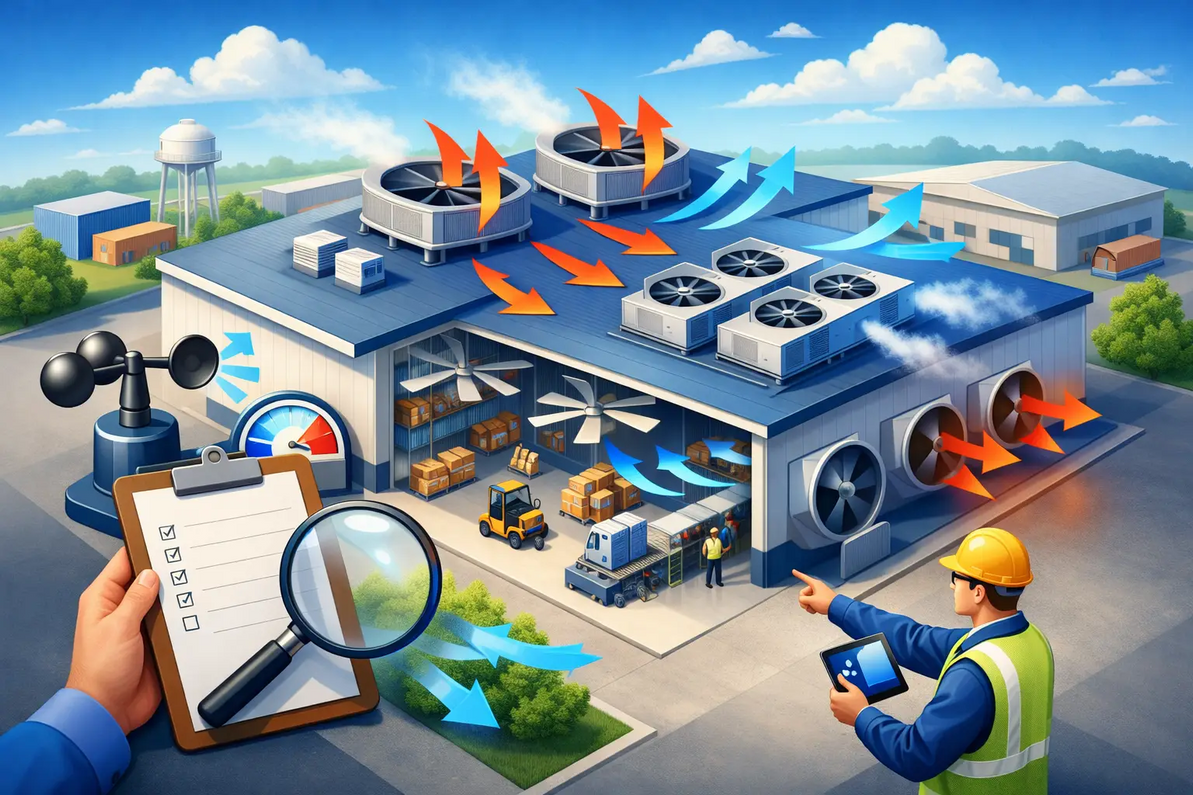
A serious evaluation starts with the building, not with a product. For warehouse and manufacturing facilities, that means reviewing square footage, ceiling height, roof profile, insulation levels, process heat, door usage, shift schedules, and whether the goal is air exchange, employee cooling, heat removal, smoke control, or all of the above.
Static pressure matters more than many buyers expect. If air has to move through louvers, filters, duct runs, light traps, or restrictive wall openings, fan performance changes. Nameplate CFM is not enough. The right evaluation looks at actual operating conditions so equipment is selected for delivered airflow, not brochure airflow.
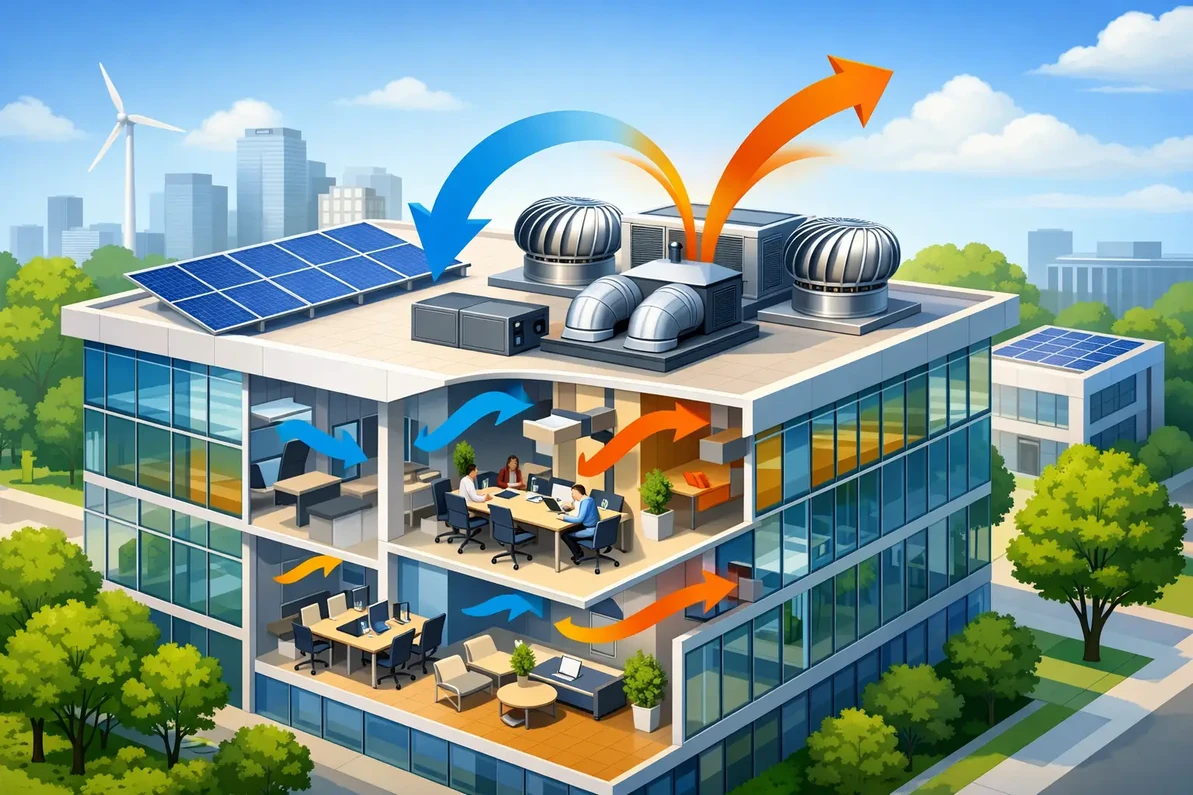
Heat load is another major variable. Welding lines, ovens, packaging equipment, compressors, conveyors, and motor-driven machinery all add sensible heat. In some facilities, the challenge is localized hot spots. In others, the entire building envelope traps heat under the roof deck. Those are different problems and they usually require different equipment combinations, such as high-volume low-speed fans, roof exhaust, wall exhaust, evaporative cooling, or make-up air.
Free Ventilation and Cooling Evaluation for Warehouse & MFG Facilities
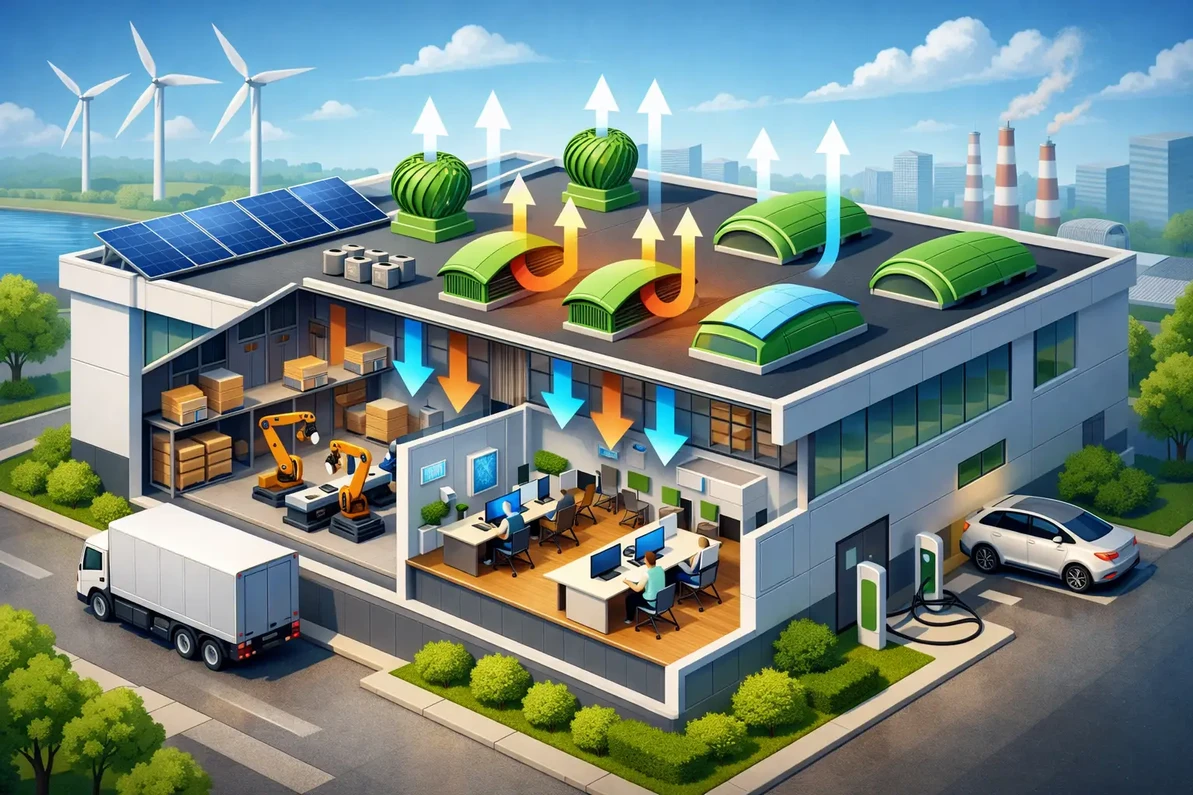
For a warehouse, the right solution may focus on destratification, worker comfort in picking zones, and better air turnover near loading areas. For manufacturing, the evaluation often goes deeper into process ventilation, source capture, contaminant movement, and pressure balancing between production spaces.
This is where many projects go off track. A facility manager may ask for more fans because employees are hot, but discomfort can come from low air speed at floor level, trapped ceiling heat, or inadequate exhaust near equipment. More fan horsepower does not automatically produce better results. Proper fan spacing, discharge direction, mounting height, and intake air path all affect performance.
A free project evaluation should also identify installation constraints. Roof structure, available power, control requirements, noise limits, and weather exposure all matter. The best design on paper can become expensive if field conditions were ignored at the quoting stage.
What engineers look at before recommending equipment
An engineering-driven review usually starts with four questions: how much heat must be removed, how much air must be exchanged, where replacement air will come from, and what the building can physically support. That leads to equipment matching instead of guesswork.
In practical terms, the recommendation may include roof-mount exhaust fans for high heat release, wall exhaust fans for targeted airflow, HVLS fans for occupant comfort and destratification, or make-up air systems when exhaust volume is high enough to create pressure problems. If dust, moisture, corrosives, or washdown conditions are part of the environment, motor type, housing material, and shutter design also need review.
There are trade-offs. HVLS fans are excellent for perceived cooling and air movement across large floor areas, but they are not a substitute for dedicated exhaust when the building has a real heat rejection problem. Large exhaust fans can remove heat effectively, but without make-up air they can starve the system and reduce actual delivered CFM. Evaporative cooling can be highly effective in dry climates, but performance changes with humidity.
Why warehouse and manufacturing buyers benefit from free expert review
The main value of a free evaluation is reducing expensive mistakes before equipment is ordered. Oversized fans waste power and often create poor control. Undersized fans fail to solve the problem, which leads to repeat purchases and frustrated staff. Misapplied equipment can also shorten service life when motors, bearings, or controls are exposed to conditions they were not selected for.
For owners, engineers, contractors, and facility teams, the right review shortens the path to an installable solution. It helps clarify whether the facility needs comfort cooling, code-driven ventilation, process exhaust, or a staged system that can adapt seasonally. It also improves budget planning because the scope is tied to airflow targets, pressure conditions, and building use instead of rough assumptions.
Factory Fans Direct approaches these projects as ventilation design engineering work, not just fan sales. That matters in warehouse and MFG environments where airflow performance, static pressure, and equipment matching directly affect uptime, worker comfort, and operating cost.
If your building has persistent heat, poor circulation, or an exhaust system that never seems to perform as rated, a free evaluation is the smart starting point. Good ventilation design is not about adding random CFM. It is about getting the right air, to the right place, in the right volume, under real operating conditions.
Factory Fans Direct - Commercial & Industrial Ventilation & Cooling Experts | Contact Mike Miller VP Engineering at Factory Fans Direct for a FREE Project Evaluation 888-849-1233 | Mike@FactoryFansDirect.com
Recent Posts
-

AI Smart Buildings Incorporate Edmonds ecoPOWER Hybrid Turbine Ventilation
A building automation system can report rising rooftop temperatures, increasing indoor contaminants, …12th Sep 2026 -
Smart Buildings Architects Recommend Edmonds ecoPOWER Hybrid Ventilation
A rooftop ventilator should not force an all-or-nothing energy decision. Smart Buildings Architects …7th Sep 2026 -
Smart Industrial Buildings Use Edmonds ecoPOWER Hybrid Ventilation
A roof exhaust system can be the difference between a plant that controls heat at the source and one …7th Sep 2026