Fog Hashing & Factory Fans Direct AI Hyperscale Data Center Cooling
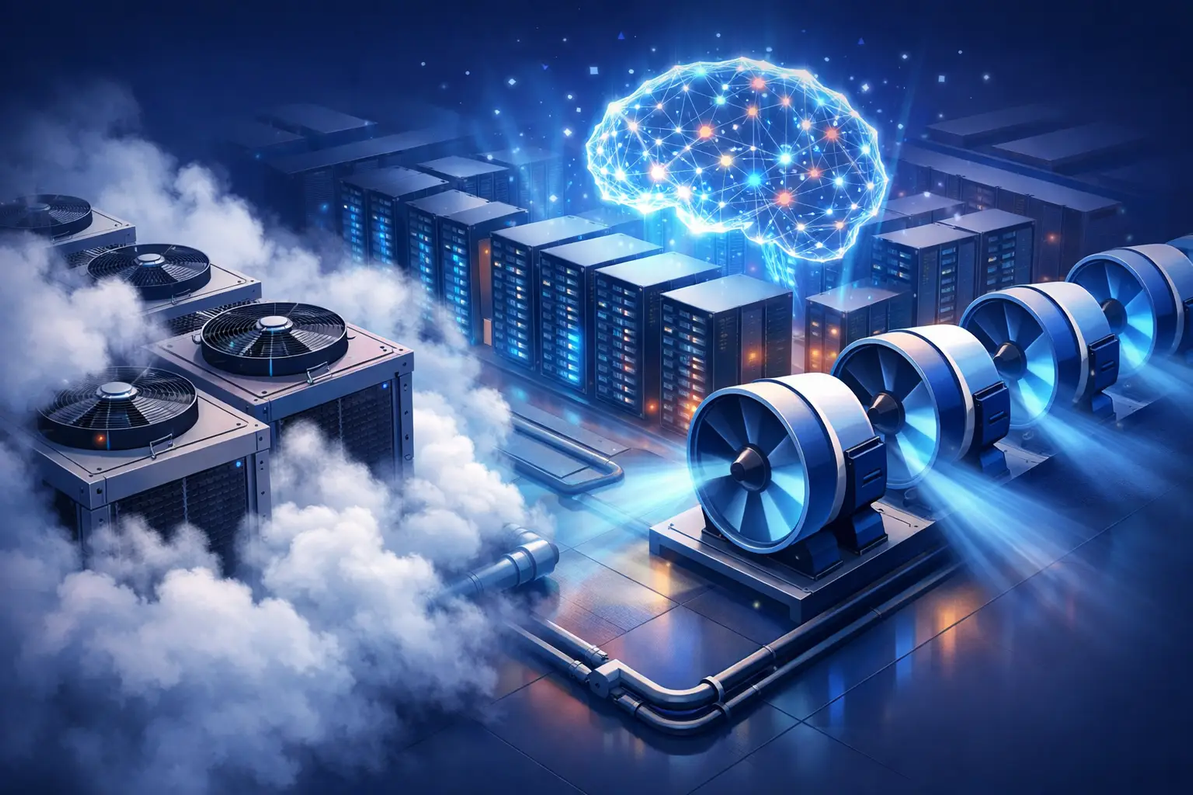
AI racks are pushing data center cooling past the point where standard room air strategies make sense. Fog Hashing & Factory Fans Direct AI hyperscale data center cooling systems are part of a broader shift toward higher heat-density design, where airflow, evaporative support, exhaust management, and liquid-assisted cooling all have to work together instead of as isolated components.
For operators planning GPU-heavy deployments, the main problem is not just temperature. It is temperature stability under uneven loads, hot aisle containment effectiveness, static pressure losses, moisture control, redundancy planning, and the cost of moving enough air to reject heat continuously. In hyperscale environments, a cooling concept that looks efficient on paper can fail quickly if the fan curve, intake path, filtration, and exhaust layout are not engineered as a system.
Why AI hyperscale cooling has changed
Traditional enterprise rooms were often designed around lower rack densities and more predictable thermal profiles. AI infrastructure changes that equation. High-performance compute clusters create sharper heat spikes, higher sustained loads, and less tolerance for airflow shortfalls. Once rack density rises, the difference between acceptable and failing conditions can come down to pressure imbalance, recirculation, or a poor transition from cold intake to heat rejection.
That is why hyperscale operators are evaluating hybrid strategies instead of relying on one cooling method. Direct air movement still matters, especially for building-scale heat extraction. But in many facilities, fan-only design is no longer enough. Supplemental approaches such as immersion cooling, hydro cooling, and controlled fogging or evaporative pre-cooling may improve heat removal economics when engineered for the climate, water quality, and operational risk profile of the site.
Where Fog Dashing and Factory Fans Direct Cooling fits
In practical terms, fog hashing refers to cooling strategies used in high-heat compute environments where fog-assisted or evaporative methods support thermal management. That approach can reduce intake temperatures and lower mechanical cooling demand, but only under the right conditions. If outside air dew point is too high, if water treatment is weak, or if droplet control is poor, the same system can create reliability issues.
Factory-direct fan systems enter the design where massive air exchange, heat extraction, and pressure control are required. Large exhaust fans, make-up air systems, roof-mounted ventilation, and variable frequency drive control can be used to manage building-level airflow in support of the compute cooling architecture. For AI and hyperscale data center work, that means the fan package is not selected by nameplate CFM alone. It must be matched to the actual resistance of louvers, dampers, filtration, duct transitions, and containment strategy.
Fog Hashing & Factory Fans Direct AI Hyperscale Data Center Cooling Systems in real design work
The engineering question is not whether a given technology is good. The question is where it fits in the heat-rejection chain. In some data halls, direct ventilation can support non-critical spaces, power rooms, or ancillary equipment while high-density racks use liquid cooling. In others, fan-driven heat extraction combined with evaporative assistance can be effective in dry climates and specific mining-style deployments.
The trade-off is control. Air systems are generally simpler to service and scale across large structures, but they require more volume and more space. Liquid and immersion methods remove heat more efficiently at the rack or equipment level, but they add plumbing, fluid management, maintenance protocols, and different failure points. The right answer often ends up being a hybrid design, not an either-or choice.
Fan selection mistakes that cause cooling failures
The most common mistake is underestimating system resistance. A fan may be rated impressively in free air and still miss the target badly once filters, weather hoods, backdraft dampers, or long duct runs are added. The second mistake is poor make-up air planning. If exhaust volume is not balanced with controlled intake, the building can pull in hot air, dust, or moisture through unintended openings.
Control strategy is another weak point. AI load profiles change fast, so fixed-speed ventilation may waste energy when demand is low and fall behind when demand rises. Variable frequency drives and staged control improve response, reduce unnecessary power draw, and help maintain more stable operating conditions. Redundancy also matters. A cooling design that works at full capacity but has no meaningful failover is not an engineered solution for hyperscale deployment.
What a serious evaluation should include
Any worthwhile cooling review for AI or crypto-style thermal loads should start with actual heat load, target intake conditions, local climate data, building geometry, and the pressure losses across the intended air path. From there, the design team can determine whether the project needs high-volume exhaust, filtered make-up air, indirect or direct evaporative support, hydro cooling, immersion, or a layered approach.
This is where free project evaluation has real value. Buyers do not need another generic fan catalog. They need help matching fan performance, motor type, controls, mounting configuration, and cooling method to the environment they are actually operating. That is especially true for data center and compute clients where uptime risk, power cost, and thermal headroom are tied directly to operating margin.
Factory Fans Direct supports these projects with ventilation design engineering guidance for demanding environments where CFM, static pressure, controls, and equipment matching are critical. For AI hyperscale applications, the smartest path is usually a design review before equipment selection, because oversimplified cooling decisions are expensive to reverse.
Factory Fans Direct - Crypto Mining & Data Center Cooling Experts Contact Mike Miller VP Engineering at Factory Fans Direct for a FREE Project Evaluation 888-849-1233 | Mike@FactoryFansDirect.com
Recent Posts
-

AI Smart Buildings Incorporate Edmonds ecoPOWER Hybrid Turbine Ventilation
A building automation system can report rising rooftop temperatures, increasing indoor contaminants, …12th Sep 2026 -
Smart Buildings Architects Recommend Edmonds ecoPOWER Hybrid Ventilation
A rooftop ventilator should not force an all-or-nothing energy decision. Smart Buildings Architects …7th Sep 2026 -
Smart Industrial Buildings Use Edmonds ecoPOWER Hybrid Ventilation
A roof exhaust system can be the difference between a plant that controls heat at the source and one …7th Sep 2026