Factory Fans Direct Warehouse & Industrial Buildings Ventilation Experts
Hot aisles, stagnant air, condensation, forklift exhaust, and uneven temperatures are not minor comfort issues in a warehouse or industrial building. They are operating problems that affect labor productivity, product quality, equipment life, and energy cost. That is where Factory Fans Direct Warehouse & Industrial Buildings Ventilation & Cooling Experts stand apart - not as a generic fan seller, but as a ventilation design resource that helps match airflow equipment to real building conditions.
In commercial and industrial facilities, ventilation failures usually come from bad assumptions. A building owner may assume bigger fans will solve heat buildup. A contractor may focus on CFM without accounting for static pressure, inlet air path, roof geometry, process heat, or the difference between spot cooling and true air exchange. In practice, a warehouse with high ceilings, dock doors, pallet racking, and internal heat loads behaves very differently from a manufacturing plant, a distribution center, or a packaging facility.
Why warehouse ventilation design is rarely simple
A proper ventilation plan starts with heat load and air movement requirements, not product preference. If your building has welding stations, compressors, process equipment, battery charging, or warm-season solar gain through the roof deck, the ventilation strategy has to address both heat removal and air replacement. Exhausting air without enough make-up air can create negative pressure, pull in dust, affect door operation, and reduce fan performance.
This is why experienced warehouse and industrial ventilation specialists ask technical questions early. What is the cubic volume of the building? What is the desired air change rate? Are you trying to reduce temperature, remove fumes, control humidity, or improve occupant comfort at floor level? Are there louvers, ridge vents, wall openings, or roof curbs already in place? The right answer depends on the application.
Factory Fans Direct Warehouse & Industrial Buildings Ventilation & Cooling Experts
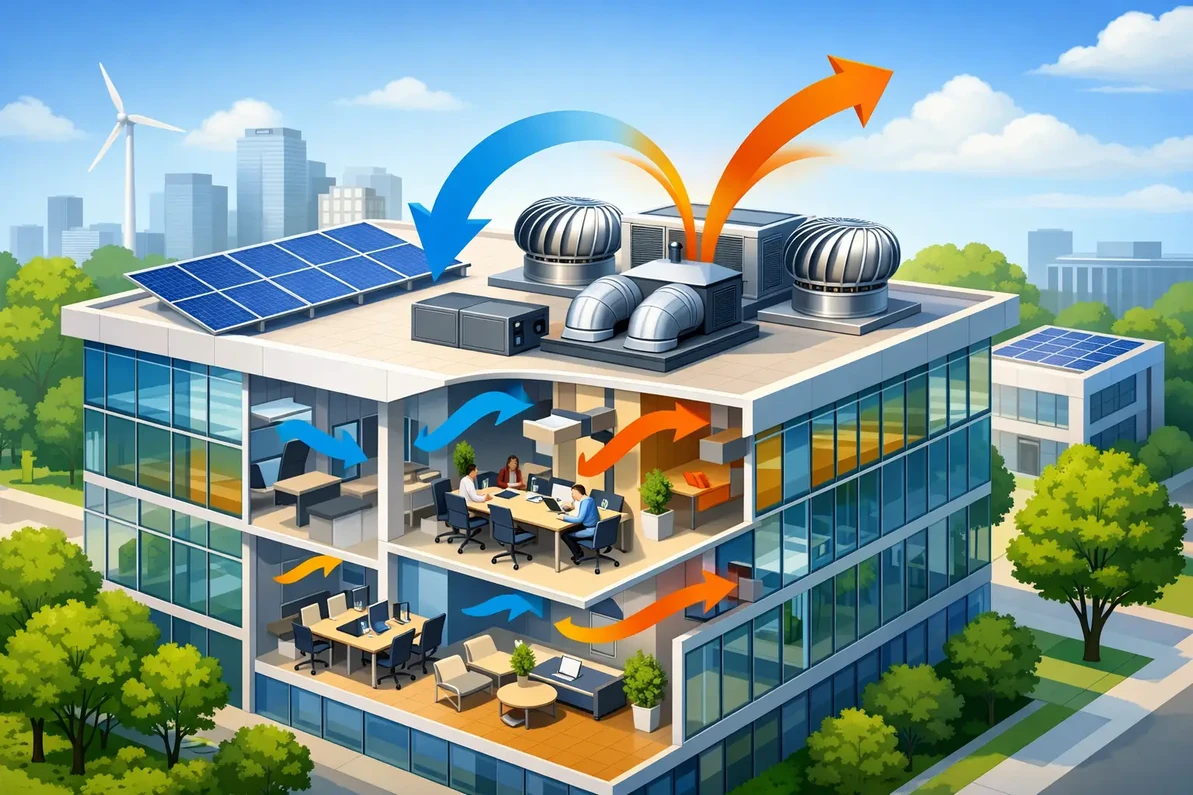
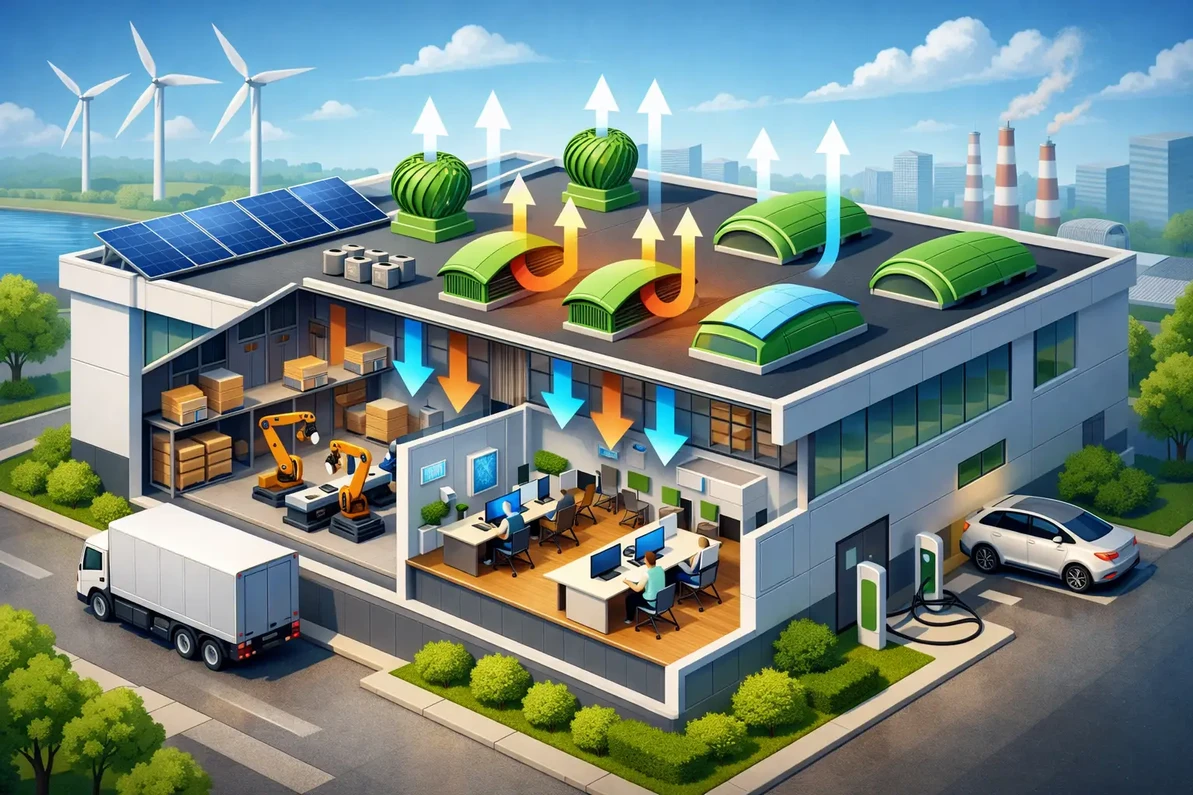
The practical advantage of working with a ventilation-focused engineering team is equipment matching. Not every industrial building needs the same solution. Some facilities need high-capacity wall exhaust fans paired with gravity shutters and make-up air. Others benefit more from HVLS fans that destratify heat and move large volumes of air with lower operating cost. In tighter buildings, roof-mounted exhaust, powered supply air, and controller integration may be necessary to maintain balanced airflow.
For warehouses, one of the most common mistakes is trying to solve all cooling issues with circulation alone. Air movement absolutely improves perceived comfort, but it does not remove trapped heat unless the system also provides effective exhaust and replacement air. On the other hand, relying only on exhaust can leave hot and cold zones if the building lacks internal air mixing. The best-performing systems often combine ventilation and circulation in a way that fits the structure, occupancy, and process load.
Industrial environments add another layer of complexity. Motor type, fan blade design, corrosion resistance, washdown requirements, voltage, control strategy, and duty cycle all matter. A fan that works in a general storage warehouse may be a poor fit for a high-dust manufacturing area or a facility with elevated ambient temperatures. This is where cut-sheet review, fan curve analysis, and application-specific sizing become more than technical extras. They protect the project from costly underperformance.
What matters most in industrial ventilation and cooling
Three performance factors usually determine whether a system works as intended: air volume, pressure capability, and airflow path. CFM matters, but only in context. If the air cannot enter freely, move through the occupied or heat-producing zone, and exit at the correct rate, the nameplate airflow will not translate into field performance.
That is also why product category matters. Wall exhaust fans, roof ventilators, HVLS fans, make-up air systems, evaporative cooling options, variable frequency drives, and hybrid ventilation products each solve different problems. There is no single best fan for every industrial building. There is only the best configuration for the building you actually have.
Facility managers and engineers also need to think beyond summer heat. In colder climates, aggressive exhaust without controlled intake can create comfort complaints, pressure imbalance, and heating penalties. In humid regions, moisture management may be just as important as temperature reduction. In production spaces, worker comfort may compete with contamination control or process ventilation priorities. Good design balances those realities instead of ignoring them.
The strongest approach is to evaluate the building as a system. Roof height, insulation levels, process equipment, occupancy pattern, and desired temperature outcome all influence equipment selection. That is why free project evaluation has real value when it comes from people who understand warehouse and industrial airflow, not just catalog listings.
If you are planning ventilation upgrades for a warehouse, factory, manufacturing plant, or distribution facility, start with performance targets and building conditions first. The right fan package is the one that delivers measurable airflow, manageable operating cost, and dependable service life under your actual load conditions.
Factory Fans Direct - Commercial & Industrial Ventilation & Cooling Experts | Contact Mike Miller VP Engineering at Factory Fans Direct for a FREE Project Evaluation 888-849-1233 | Mike@FactoryFansDirect.com
Recent Posts
-

AI Smart Buildings Incorporate Edmonds ecoPOWER Hybrid Turbine Ventilation
A building automation system can report rising rooftop temperatures, increasing indoor contaminants, …12th Sep 2026 -
Smart Buildings Architects Recommend Edmonds ecoPOWER Hybrid Ventilation
A rooftop ventilator should not force an all-or-nothing energy decision. Smart Buildings Architects …7th Sep 2026 -
Smart Industrial Buildings Use Edmonds ecoPOWER Hybrid Ventilation
A roof exhaust system can be the difference between a plant that controls heat at the source and one …7th Sep 2026