
Factory Exhaust Fan Selection That Works
A factory that feels hot, dusty, or stagnant usually does not have a fan problem first. It has a system problem. Factory exhaust fan selection only works when the fan is matched to the building load, the process, and the air path feeding replacement air back into the space. If you size by square footage alone, you can end up with impressive nameplate CFM and disappointing real-world performance.
That is where many projects go sideways. A fan may look right on paper, but once it sees filters, louvers, shutters, long duct runs, roof caps, or a negative-pressure building with poor make-up air, delivered airflow drops. The result is persistent heat, uneven ventilation, nuisance maintenance, and higher operating cost.
What factory exhaust fan selection should start with
The first question is not which fan model to buy. It is what the fan must accomplish. In most factory environments, the objective falls into one or more categories: remove heat, capture fumes, evacuate dust-laden air, control humidity, or maintain a target number of air changes per hour. Each goal drives a different selection approach.
If the facility has process heat from ovens, weld cells, presses, compressors, or packaging equipment, the fan needs to move enough air to carry that heat out while replacement air keeps pace. If the concern is airborne contaminants, the design has to account for source capture, code requirements, and the path contaminants take before they reach employees or equipment. A warehouse-style air exchange strategy may be fine for general heat, but it is not a substitute for proper capture in a fume-heavy application.
This is why experienced ventilation design starts with load and resistance, not just fan diameter. The key inputs are total required CFM, estimated static pressure, operating temperature, contaminant type, duty cycle, mounting location, power availability, and noise expectations.
CFM alone is not enough
A common buying mistake is selecting a fan by free-air CFM. That rating can be useful for comparison, but it does not tell you what the fan will deliver once the system adds resistance. In a real factory setting, static pressure matters.
Static pressure comes from anything that resists airflow - wall hoods, dampers, bird screens, louvers, duct transitions, elbows, filters, and roof weather protection. Even a relatively simple wall exhaust layout can create enough resistance to shift the correct fan type. Propeller fans perform well in low-static applications. Once resistance rises, a centrifugal or tube axial configuration may be more appropriate.
That trade-off matters. A propeller fan may have lower first cost and strong airflow in an open wall application, but it can fall off quickly if the system is more restrictive than expected. A centrifugal fan can maintain performance better under pressure, but it usually comes with higher cost, different mounting requirements, and a different sound profile.
Match fan type to the application
No single exhaust fan style is best for every factory. The right selection depends on how the air moves through the building and what the fan has to overcome.
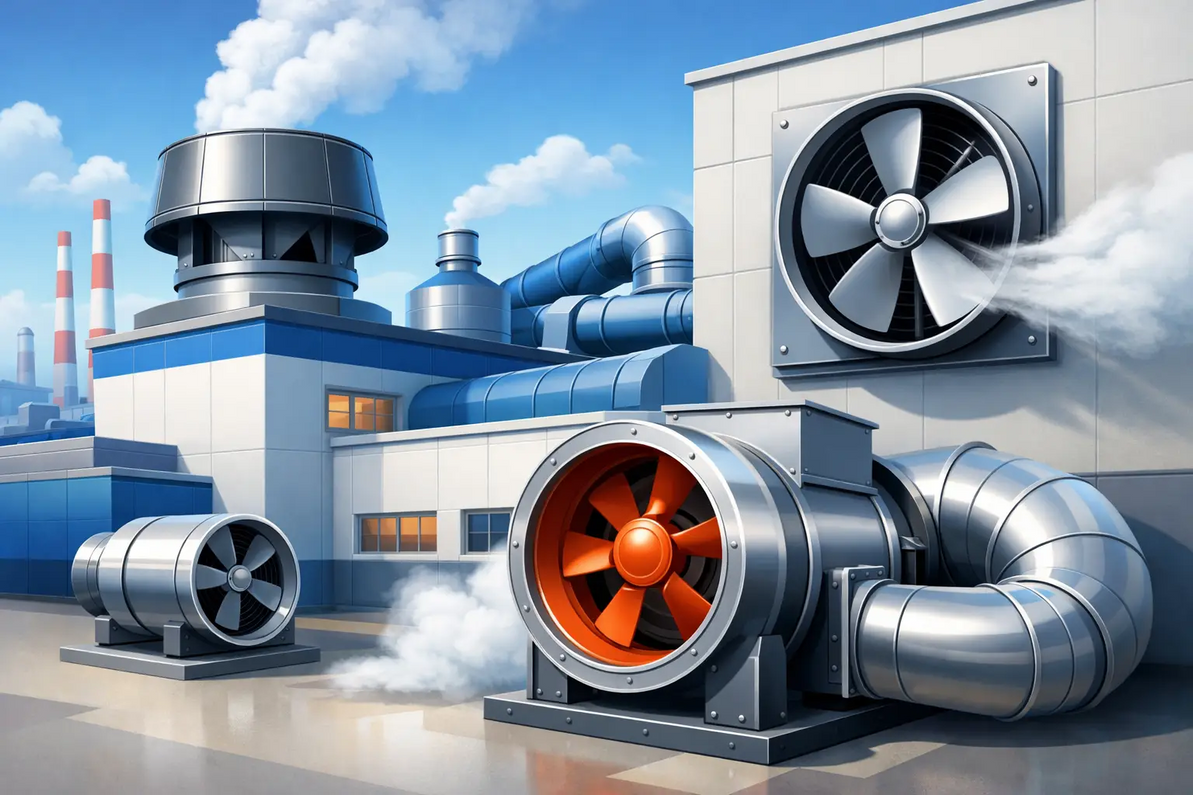
Wall-mounted propeller fans are often a practical fit for broad air exchange in manufacturing, warehouses, and agricultural processing spaces where static pressure is low and large CFM is needed. They are straightforward, cost-effective, and well suited for direct exhaust through exterior walls.
Roof exhaust fans are useful when heat stratifies and needs to be pulled from the upper building envelope. They can work well in facilities with roof-mounted discharge points, but the roof curb, weather cap, and backdraft damper all affect resistance and service access.
Centrifugal upblast or utility-set fans are a better fit when the system includes ductwork, filtration, grease-laden air, or higher static pressure. In tougher applications, they provide more dependable delivered airflow than a simple direct-drive prop fan.
Tube axial fans sit between those categories in many industrial projects. They can support higher pressure than a basic panel fan while still moving strong volumes of air. In process cooling or equipment-room ventilation, they are often worth evaluating.
Factory exhaust fan selection and make-up air
Exhaust without make-up air is one of the fastest ways to create a bad system. If you pull 40,000 CFM out of a building and do not provide a controlled path for 40,000 CFM to come back in, the building will find that air somewhere. Doors get harder to open, conditioned zones get disrupted, combustion equipment can backdraft, and the exhaust system underperforms.
This is especially important in plants with seasonal operation. In summer, outside air may help with sensible heat removal. In winter, uncontrolled make-up air can create cold drafts, production issues, and employee discomfort. In many facilities, the right answer is not just an exhaust fan. It is an exhaust-and-make-up-air strategy using motorized dampers, intake louvers, or tempered make-up air equipment.
The fan selection process should always account for where replacement air enters, how fast it enters, and whether it needs filtration or heating. A good exhaust layout paired with a poor intake layout still produces poor results.
Motor, drive, and controls matter more than buyers expect
The fan wheel and housing get most of the attention, but the motor and controls determine how well the equipment lives in the field. Direct-drive fans are simpler and reduce belt maintenance, which is attractive in many commercial and light industrial applications. Belt-drive fans allow more performance adjustment and can be useful where fine-tuning is needed, though they add maintenance points.
Motor selection should reflect ambient conditions, voltage, phase, washdown needs, and hours of operation. A factory with heat, dust, or corrosive air may need upgraded motor protection or specialized coatings. An inverter-duty motor paired with a VFD can add meaningful control, especially in facilities with varying production loads.
Variable speed control is not a luxury feature in many environments. It allows the ventilation rate to track actual operating conditions rather than forcing the fan to run at full output all day. That can reduce energy use, improve pressure control, and extend equipment life. But VFD selection should be coordinated with the motor, controller location, and environment.
Do not ignore sound, maintenance, and installation reality
The best fan on a submittal sheet is not always the best fan for the plant. Sound can become a serious issue near workstations, office-adjacent production areas, or neighborhood-facing walls. Maintenance access matters too. If shutters cannot be serviced easily or belts require awkward roof access, routine upkeep gets deferred.
Installation conditions often change the recommendation. Available wall structure, roof framing, curb size, weather exposure, electrical service, and forklift access for maintenance can all influence what is practical. That is one reason cut sheets and fan curves need to be reviewed in the context of the actual building, not in isolation.
This is also where oversizing becomes a problem. Buyers sometimes assume a larger fan creates a safety margin. In practice, too much exhaust can create severe negative pressure, wasted energy, excessive noise, and poor air balance. The better approach is selecting for the real load and controlling the system properly.
A practical way to evaluate your selection
If you are working through factory exhaust fan selection, start with a basic engineering snapshot of the space. Document building dimensions, ceiling height, process heat sources, contaminant sources, desired air changes, intake locations, operating hours, and any ductwork or accessories that add resistance. Note the power available, mounting preferences, and whether the fan will run continuously or cycle with production.
Then compare that information against actual fan performance curves at the estimated static pressure, not just catalog free-air numbers. Review motor data, amp draw, sound levels, shutter or damper options, and weather protection details. If the application is heat heavy, check whether exhaust alone can solve the issue or whether circulation, HVLS, or make-up air equipment should be part of the plan.
For more complex facilities, a free project evaluation from a ventilation specialist can save time and prevent expensive rework. At Factory Fans Direct, that kind of technical review is often what separates a fan purchase from a functioning ventilation system.
A good factory exhaust system is not defined by how much metal you hang on the wall or roof. It is defined by what happens on the floor after startup - lower heat, cleaner air, stable building pressure, and equipment that performs the way the fan curve said it would. If your application has process heat, static pressure, or air-balance complications, slow down and size it like an engineered system. That is where the real performance comes from.
Factory Fans Direct - Commercial & Industrial Ventilation & Cooling Experts | Contact Mike Miller VP Engineering at Factory Fans Direct for a FREE Project Evaluation 888-849-1233 | Mike@FactoryFansDirect.com
Recent Posts
-

Smart Buildings Architects Recommend Edmonds ecoPOWER Hybrid Ventilation
A rooftop ventilator should not force an all-or-nothing energy decision. Smart Buildings Architects …7th Sep 2026 -
Smart Industrial Buildings Use Edmonds ecoPOWER Hybrid Ventilation
A roof exhaust system can be the difference between a plant that controls heat at the source and one …7th Sep 2026 -
Smart Commercial Buildings Use Edmonds Hybrid Ventilation
A rooftop exhaust fan that only performs when the wind blows is not a complete ventilation strategy. …7th Sep 2026