
Energy Saving Warehouse Fans That Pay Off
A warehouse that feels 10 to 15 degrees hotter on the floor than it does at the thermostat is usually not a fan problem. It is a design problem. Energy saving warehouse fans work when the fan type, throw pattern, control strategy, ceiling height, rack layout, and heat load all match the building. If they do not, you can spend money on airflow equipment and still end up with hot aisles, dead spots, and power bills that do not move the way they should.
What energy saving warehouse fans actually do
The phrase gets used loosely, so it helps to define it in practical terms. An energy-saving fan is not just a fan with a high-efficiency motor. In warehouse applications, it is a fan system that moves the required air volume with the lowest reasonable watt draw while supporting the larger HVAC or ventilation objective.
Sometimes that means destratifying heat from the ceiling in winter so the heating system runs less. Sometimes it means increasing air movement across workers and packaged goods so the space feels cooler at a higher thermostat setpoint. In non-conditioned buildings, it can mean supporting air exchange and exhausting heat so interior temperatures track closer to ambient conditions instead of climbing well above them.
That distinction matters because the cheapest fan to buy is often not the lowest-cost fan to operate. The wrong diameter, the wrong blade design, or an on-off control strategy instead of a variable speed approach can erase the savings you expected.
Why warehouses waste energy on airflow
Most facilities do not have a single airflow issue. They have several smaller issues stacked together. Heat collects near the roof deck. Racking blocks horizontal throw. Loading docks create pressure shifts. Forklift traffic stirs dust but not always useful air movement. Unit heaters or rooftop systems cycle harder because the building has uneven temperature layers from floor to ceiling.
In that setting, adding random circulation fans may improve comfort in one zone while doing very little in another. We see this often in facilities with 24-foot to 40-foot ceilings. Warm air pools overhead, while employees at the floor level still report hot working conditions in summer and cold starts in winter. The building owner then assumes fans do not help, when the real issue is fan placement and performance matching.
Energy waste also shows up in fan motor selection. Older belt-drive systems, undersized exhaust fans pushed beyond their static capability, and constant-speed units running at full output all day tend to consume more power than necessary. A more efficient warehouse ventilation design usually comes from better engineering, not just newer equipment.
The best fan types for warehouse energy savings
There is no universal winner because warehouse use cases vary. A distribution center with wide-open floor area needs a different airflow strategy than a manufacturing warehouse with process heat and equipment islands.
HVLS fans for large-volume air movement
High-volume, low-speed fans are often the strongest option for energy savings in open warehouses with adequate mounting height. They move very large air columns at relatively low RPM, which allows broad floor coverage with lower wattage per square foot than many small high-speed fans.
When selected correctly, HVLS fans can support summer comfort through increased air movement and winter destratification by gently pushing trapped heat back to the occupied zone. That can reduce heating demand and help even out temperature differences between the ceiling and the floor. The benefit is strongest in facilities with tall clear heights and open layouts.
The trade-off is that HVLS fans are not ideal everywhere. Tight rack spacing, crane travel, low clearances, sprinkler constraints, or process zones with targeted cooling needs can limit where they fit.
Directional and circulation fans for targeted airflow
In warehouses with narrow aisles, packing stations, mezzanines, or dock areas, directional fans may make more sense. These fans can be aimed at problem zones and are often easier to integrate around building obstructions.
They are not always as efficient for whole-building circulation as HVLS units, but they can be more effective where the goal is to push air through specific work areas or supplement existing ventilation patterns. The key is to avoid overpopulating the building with small fans that overlap inefficiently and increase maintenance points.
Exhaust and supply fans for heat removal
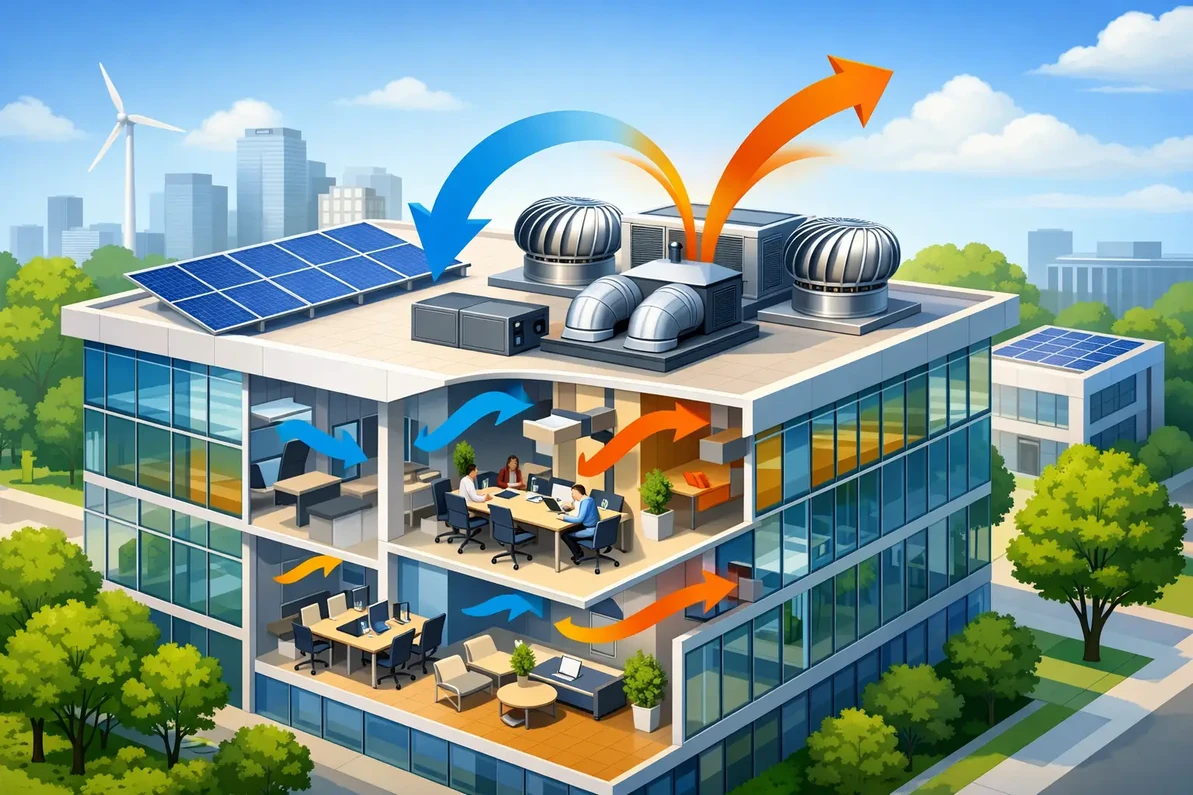
If the building is gaining heat from equipment, solar load, or process activity, circulation alone may not solve the problem. In those cases, energy saving warehouse fans often include roof exhaust, wall exhaust, and make-up air components. Removing hot air at the high point and replacing it with controlled intake air can cut indoor temperature buildup significantly.
This is especially relevant in warehouses with welding, packaging lines, battery charging, manufacturing equipment, or hybrid commercial-industrial use. The energy savings come from managing heat load before it overwhelms comfort systems.
How to evaluate energy saving warehouse fans
Buyers should look beyond fan diameter and advertised CFM. Those numbers matter, but they do not tell the full operating cost story.
Motor efficiency is a starting point. EC motors and premium efficiency motors can improve power consumption, especially when paired with variable speed controls. Blade design matters too, because it affects how effectively the fan converts input power into usable air movement. A fan with attractive top-line CFM but poor real-world throw in a rack-filled space may underperform where it counts.
Control strategy is where many savings are won or lost. Variable frequency drives and integrated speed controls let the fan run at the output the space actually needs instead of at 100 percent all day. In many warehouses, demand changes by shift, season, dock door activity, and occupancy. Matching fan speed to those conditions can reduce electrical consumption while improving comfort.
Noise, serviceability, and duty cycle also deserve attention. Warehouses are hard on equipment. Dust, temperature swings, and long operating hours punish low-grade components. A fan that saves a few watts but fails early or requires frequent service is not a real efficiency upgrade.
Sizing and layout matter more than most buyers expect
This is where warehouse fan projects either perform well or disappoint. An undersized fan array leaves dead air zones. An oversized system can create turbulence, discomfort, and unnecessary electrical load. Spacing, mounting height, blade diameter, and interaction with lighting, sprinklers, racking, and dock doors all influence the result.
A common mistake is to select fans based on square footage alone. Warehouses should be evaluated by cubic volume, ceiling height, use of the space, heat sources, existing ventilation, and whether the goal is destratification, comfort cooling, air exchange, or a mix of all three.
Static pressure also gets overlooked in exhaust applications. If louvers, shutters, filters, or long duct runs are present, the fan must be selected for the actual resistance it will see. Otherwise, rated airflow on paper may never show up in the building.
For that reason, a free project evaluation from a ventilation design team can be more valuable than a quick catalog comparison. Good fan selection is not guesswork. It is matching performance data to the building.
Where the ROI usually comes from
The payback on warehouse fans is not limited to the electric meter. In many facilities, the direct watt savings are only one part of the financial return.
Lower heating demand from destratification can be substantial in tall buildings. In summer, increased air movement can allow higher thermostat settings without reducing perceived comfort for employees. Better airflow can also support product quality in some storage conditions, reduce heat stress complaints, and improve productivity in hot work areas.
In non-conditioned warehouses, properly designed exhaust and circulation systems can keep indoor temperatures closer to outdoor ambient rather than allowing extreme heat accumulation. That can reduce the pressure to add more expensive cooling equipment later.
It depends on the building, of course. A lightly occupied storage warehouse with little internal heat gain will see a different return profile than a busy operation with long shifts and process heat. But in both cases, the strongest ROI usually comes from designing the airflow system around the actual load instead of buying fans one at a time to chase complaints.
When to upgrade an existing warehouse fan system
If your current fans run constantly, leave hot and cold bands in the building, require frequent belt maintenance, or do not integrate with controls, it is worth reassessing the system. The same goes for facilities where the HVAC equipment seems to work hard but temperatures remain uneven.
Retrofit opportunities often include replacing older inefficient fans, reducing fan count through better coverage, adding variable speed control, or rebalancing exhaust and intake air. Even a partial redesign can improve performance if the original installation was based on convenience rather than engineering.
For buyers managing multiple variables at once, Factory Fans Direct approaches these projects as ventilation design problems first and product sales second. That is typically what separates a lower operating cost system from a warehouse full of fans that simply make noise.
Energy savings in a warehouse rarely come from one magic product. They come from getting the airflow right for the building you actually have, then controlling it like the operating expense it is.
Factory Fans Direct - Commercial & Industrial Ventilation & Cooling Experts | Contact Mike Miller VP Engineering at Factory Fans Direct for a FREE Project Evaluation 888-849-1233 | Mike@FactoryFansDirect.com
Recent Posts
-

AI Smart Buildings Incorporate Edmonds ecoPOWER Hybrid Turbine Ventilation
A building automation system can report rising rooftop temperatures, increasing indoor contaminants, …12th Sep 2026 -
Smart Buildings Architects Recommend Edmonds ecoPOWER Hybrid Ventilation
A rooftop ventilator should not force an all-or-nothing energy decision. Smart Buildings Architects …7th Sep 2026 -
Smart Industrial Buildings Use Edmonds ecoPOWER Hybrid Ventilation
A roof exhaust system can be the difference between a plant that controls heat at the source and one …7th Sep 2026