Data Center Cooling: Open or Closed Loop? | Ask an Expert
Heat is not the problem in a data center. Uncontrolled heat is. That is why the real question behind Data Center Cooling | Open Loop or Closed Loop | Ask an Expert is not which system sounds better on paper. It is which approach protects uptime, matches your heat load, fits your water quality, considers water usage within the community and holds operating cost where you need it.
For most operators, the answer depends on how much thermal density you are managing, how clean your environment is, how expensive downtime would be, and whether you can tolerate water consumption, scaling, or contamination risk. Open loop and closed loop cooling can both work. They just fail for different reasons when the design assumptions are wrong.
Data Center Cooling | Open Loop or Closed Loop
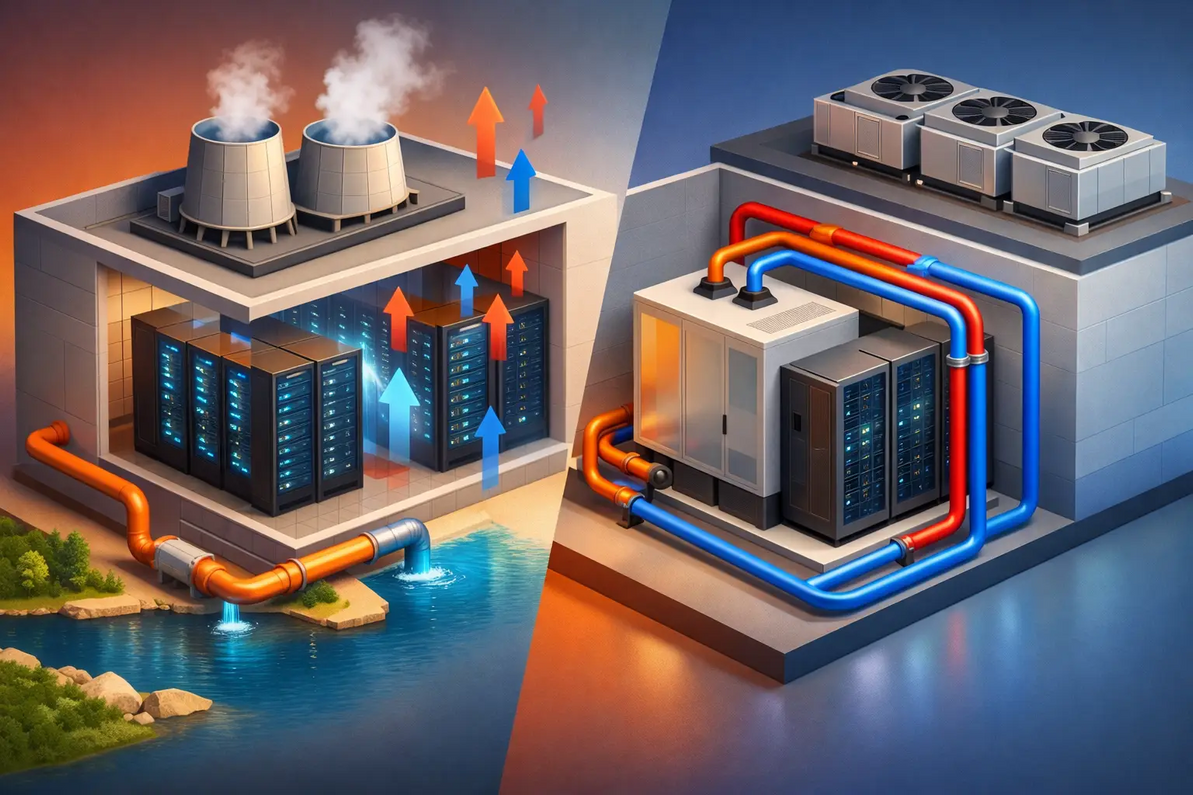
An open loop system typically uses water or another fluid that is exposed to the outside environment at some point in the cooling cycle. Cooling towers are the common example. Water rejects heat to ambient air, but evaporation, airborne debris, minerals, and biological growth all become part of the engineering equation.
A closed loop system circulates fluid through a sealed circuit. The same fluid remains inside the system and transfers heat through a heat exchanger, dry cooler, CDU, or another isolated path. That isolation is a major reason closed loop designs are increasingly favored in high-value IT rooms, immersion cooling deployments, and high-density compute environments.
The trade-off is simple. Open loop systems can deliver strong heat rejection and attractive first-cost economics in the right climate. Closed loop systems usually provide tighter control, cleaner operation, and lower contamination exposure, but they may require more heat exchange surface, more pumping control, or a higher initial capital cost.
Where open loop cooling could make sense
Open loop cooling is often considered when the project has large heat loads, a suitable water treatment program, water use does not effcet the community and a facility team prepared to actively manage maintenance. In some regions, it can be a very effective way to reject heat at scale, especially where wet-bulb conditions support efficient tower performance.
That said, open loop is rarely a set-it-and-forget-it solution. Water chemistry matters. Scale buildup on heat transfer surfaces reduces efficiency. Biological growth increases maintenance burden and can create compliance issues. Airborne contaminants can enter the system, and every one of those variables affects thermal performance over time.
For crypto mining and some industrial compute spaces, operators may accept that trade-off because they want aggressive heat rejection and are already designing around harsh operating conditions. In a traditional enterprise data center with expensive servers and strict uptime requirements, the maintenance risk profile may be harder to justify.
Why closed loop is often preferred
Closed loop systems are usually the safer engineering choice when equipment reliability, fluid cleanliness, fits within the community and predictable performance matter more than the lowest first cost. Because the fluid path is isolated, there is less exposure to dirt, oxygen ingress, mineral contamination, and biological activity. That means more stable long-term heat transfer and less maintenance volatility.
This matters even more as rack densities rise. Once you move into liquid-assisted cooling, rear-door heat exchangers, direct-to-chip cooling, or immersion-supported designs, fluid quality is no longer a side issue. It is directly tied to system longevity and serviceability.
Closed loop also gives engineers more control over approach temperatures, component selection, and redundancy strategy. If your facility requires N+1 planning, strict leak detection, monitored pumping, and tight integration with make-up air or exhaust systems, a sealed cooling loop is usually easier to model and protect.
The real engineering trade-offs
If you are deciding between the two, do not reduce the analysis to efficiency alone. Water availability, water treatment cost, climate, redundancy expectations, maintenance staffing, and contamination sensitivity all have to be weighed together.
Open loop may look better in a narrow energy model, but if your site has poor water quality or limited maintenance resources, lifecycle cost can rise fast. Closed loop may cost more up front, but lower fouling risk and more stable thermal performance can protect both equipment and operations.
Airflow design is also part of this conversation. A cooling loop does not solve bad room ventilation. If hot aisle containment is weak, if exhaust air is recirculating, or if make-up air is undersized, the liquid side will be fighting an avoidable airside problem. We see this often in retrofit facilities where cooling equipment is upgraded but airflow paths are not engineered to match the new load.
Ask an expert before you size equipment
The worst cooling decisions usually happen when teams buy around a product category instead of designing around the actual thermal profile. You need to know sensible heat load, peak load variation, entering fluid temperatures, ambient conditions, available utilities, and failure tolerance. Without that, open loop versus closed loop is just guesswork.
For high-density data centers and crypto mining operations, the correct answer is often a hybrid strategy. Closed loop cooling may protect primary equipment while engineered exhaust, make-up air, or supplemental ventilation handles room heat and pressure control. That is where proper fan selection, static pressure analysis, and heat rejection planning become just as important as the chiller or CDU.
Factory Fans Direct works with facilities that cannot afford sizing mistakes. If you are comparing open loop and closed loop cooling for a data center, the best next step is a project-level evaluation based on load, layout, water conditions, and uptime requirements - not a generic rule of thumb.
Factory Fans Direct - Crypto Mining & Data Center Cooling Experts Contact Mike Miller VP Engineering at Factory Fans Direct for a FREE Project Evaluation 888-849-1233 | Mike@FactoryFansDirect.com
Recent Posts
-

AI Smart Buildings Incorporate Edmonds ecoPOWER Hybrid Turbine Ventilation
A building automation system can report rising rooftop temperatures, increasing indoor contaminants, …12th Sep 2026 -
Smart Buildings Architects Recommend Edmonds ecoPOWER Hybrid Ventilation
A rooftop ventilator should not force an all-or-nothing energy decision. Smart Buildings Architects …7th Sep 2026 -
Smart Industrial Buildings Use Edmonds ecoPOWER Hybrid Ventilation
A roof exhaust system can be the difference between a plant that controls heat at the source and one …7th Sep 2026