
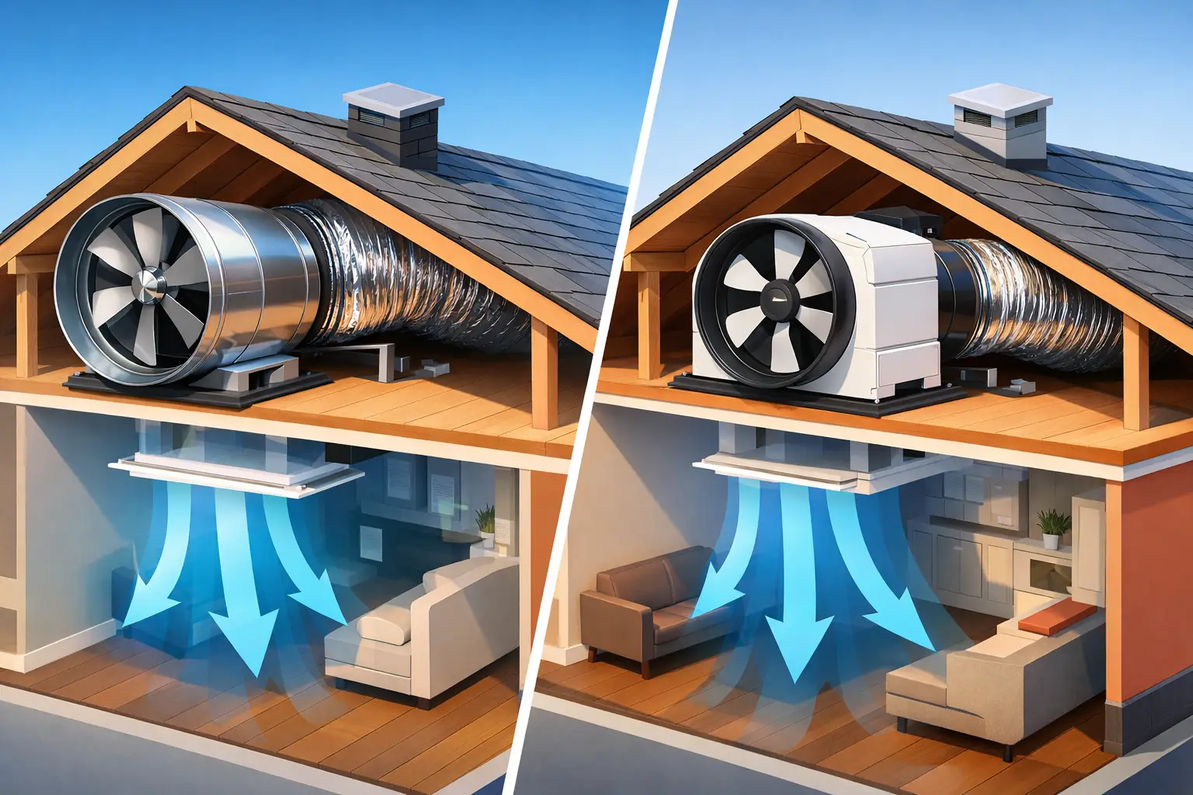
Compare Centric Air Whole House Fans to QuietCool
Most homeowners start this comparison with one question: which fan moves enough air to cool the house without sounding like a shop exhaust system. If you need to compare Centric Air Whole House Fans to Quiet Cool, the real answer is not just brand preference. It comes down to airflow per watt, installed design, grille style, sound transfer, attic conditions, and how much control you want over the system.
Both brands are well known in the residential ventilation market, but they take slightly different approaches. Centric Air has built a strong reputation around high-efficiency ECM motor technology, insulated dampers, strong airflow, and quiet operation with a direct, engineered feel. QuietCool is a recognized name with broad market penetration and multiple product lines, including systems designed around flexible duct runs that help isolate fan noise from the living space.
Compare Centric Air Whole House Fans to Quiet Cool on design
The biggest design distinction is how each system handles air movement and sound management. QuietCool commonly uses a suspended fan mounted away from the ceiling grille with insulated flex duct between the grille and the fan housing. That approach reduces direct sound transfer into occupied rooms and has helped the brand earn its name recognition.
Centric Air systems are engineered with a different focus. Their units are known for efficient airflow, well-built housings, tight-sealing insulated doors, and ECM-driven performance. In practical terms, that means you are often looking at a fan package designed to move high CFM with lower power consumption and controlled operating noise, without giving up cooling performance.
For homeowners who care about equipment quality, motor efficiency, and long-term operating cost, Centric Air often stands out. For buyers who prioritize a remote-mounted fan layout as a primary acoustic strategy, QuietCool may appeal more quickly at first glance.
Airflow and cooling performance
Whole house fan performance starts with CFM, but CFM alone is not enough. A 2,500 square foot home with high ceilings, restrictive intake paths, or poor attic exhaust may not perform well even with a large fan. That is why experienced ventilation selection should look at house volume, attic free vent area, grille placement, and expected nighttime temperature drop.
Centric Air is often favored by technically minded buyers because the airflow-to-watt relationship is strong. You are not just buying a fan that moves air. You are buying a system that can produce meaningful air exchange while keeping electrical consumption in check. That matters if the fan will run frequently during shoulder seasons or in dry climates where whole house cooling can offset air conditioning use.
QuietCool also offers solid airflow options across multiple sizes. In many homes, it can perform very well when properly matched to the structure. The catch is that installation quality matters a great deal. Duct routing, attic mounting, and venting conditions can affect actual delivered performance.
Sound levels are not just about the fan
Homeowners often reduce the comparison to this: which one is quieter. The better question is where the sound comes from. Noise in a whole house fan system can come from the motor, the blade, air turbulence at the grille, vibration transfer, or attic resonance.
QuietCool has an advantage in perception because its remote fan mounting strategy can reduce direct sound at the ceiling opening. That said, a poorly installed remote system can still produce noticeable airflow noise.
Centric Air is also designed for quiet operation, but its real strength is balanced performance rather than marketing around one single attribute. In a well-designed installation, many homeowners find Centric Air exceptionally quiet while still delivering aggressive ventilation. If you want low sound and stronger engineering emphasis on motor efficiency and sealed damper design, Centric Air deserves serious attention.
Efficiency, insulation, and winter performance
This is where details matter. A whole house fan creates a large ceiling opening, so damper quality is critical. If the system does not seal well, you can lose conditioned air in summer and heat in winter.
Centric Air is frequently praised for insulated gravity doors and tighter closure design. That can be a meaningful advantage in climates with colder winters or hotter summers where thermal leakage matters. QuietCool models vary by series, and buyers should review the damper configuration carefully rather than assuming every model performs the same way.
On motor efficiency, Centric Air generally compares very well because of its ECM-based approach. Lower watt draw for the amount of airflow delivered is a real operating benefit, not just a spec-sheet talking point.
Installation and application fit
Neither brand should be selected by square footage alone. Ceiling layout, attic access, truss spacing, vent area, and homeowner expectations all affect the right choice.
QuietCool can be attractive where installers prefer ducted remote systems and where homeowners want the fan physically separated from the ceiling grille. Centric Air can be especially attractive where buyers want premium efficiency, solid construction, and a system that feels more engineered than mass marketed.
If the attic does not have enough exhaust vent area, neither fan will perform correctly. That is one of the most common design mistakes in residential ventilation. The fan may move air, but pressure buildup in the attic can reduce cooling effectiveness and create unwanted stress on the system.
Which one is the better value?
If value means lowest upfront price, QuietCool may win in some comparisons depending on model and installer preference. If value means long-term efficiency, damper performance, and premium build quality, Centric Air often makes the stronger case.
For homeowners who want a technical recommendation instead of a generic retail answer, the right move is to size the fan to the house and attic system first, then compare model families. That is where an engineered selection process saves money and avoids oversizing, undersizing, or poor attic vent matching.
Factory Fans Direct - Whole House Fans Experts | Contact Mike Miller at Factory Fans Direct for a FREE Home Evaluation 888-849-1233 and a $50 discount Coupon and Live Support on the Centric Air Whole House Fans.
Recent Posts
-

AI Smart Buildings Incorporate Edmonds ecoPOWER Hybrid Turbine Ventilation
A building automation system can report rising rooftop temperatures, increasing indoor contaminants, …12th Sep 2026 -
Smart Buildings Architects Recommend Edmonds ecoPOWER Hybrid Ventilation
A rooftop ventilator should not force an all-or-nothing energy decision. Smart Buildings Architects …7th Sep 2026 -
Smart Industrial Buildings Use Edmonds ecoPOWER Hybrid Ventilation
A roof exhaust system can be the difference between a plant that controls heat at the source and one …7th Sep 2026