Cannabis Light Deprivation Ventilation Guide
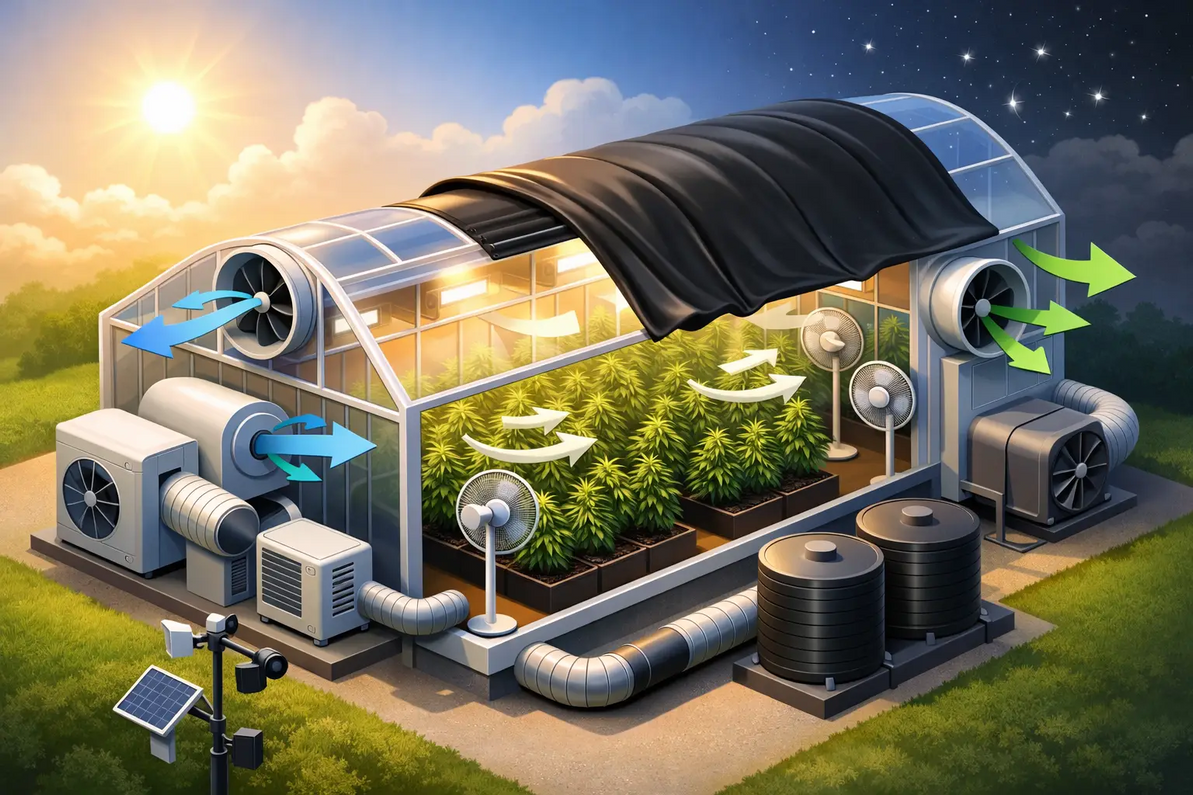
Blackout systems solve one production problem and create three more: heat buildup, humidity spikes, and airflow restriction. A proper Cannabis Light Deprivation Ventilation Guide starts there, because once curtains close, the room or greenhouse behaves like a sealed heat and moisture box. If the ventilation design does not account for static pressure, light traps, crop transpiration, and staged exhaust control, plant stress shows up fast in temperature swings, VPD drift, condensation, and disease pressure.
Why light deprivation changes the ventilation equation
Light dep greenhouses and darkened cultivation structures are not ventilated like standard greenhouses. During blackout periods, natural air exchange drops sharply, solar gain can still load the structure, and transpiration continues even when outside conditions are less favorable. The result is a higher latent load at the exact time many growers think the crop is "resting."
That is why fan sizing based only on greenhouse square footage usually misses the mark. The real design target is total heat and moisture removal under blackout conditions, not just nominal air changes per minute. You also have to account for pressure losses through intake hoods, shutters, evaporative components, and especially light traps. Every restriction lowers delivered CFM.
Cannabis Light Deprivation Ventilation Guide: what matters most
The first priority is maintaining enough airflow through a light-tight path. That sounds simple, but light traps add resistance, and resistance changes fan performance. A fan rated at a certain CFM in free air may deliver far less once it is pulling through louvers and light-blocking baffles. This is where many installations underperform. The equipment is not always wrong, but the applied fan curve is.
The second priority is humidity control. In cannabis cultivation, moisture removal is often the limiting factor during blackout hours. Plants continue releasing water vapor, and if exhaust volume or supplemental dehumidification lags behind, relative humidity rises quickly. Once leaf surface moisture and stagnant zones develop, botrytis, powdery mildew, and uneven flower development follow.
The third priority is pressure balance. Light dep spaces need controlled intake and exhaust so curtains stay functional, doors remain operable, and unfiltered leaks do not create odor, pest, or contamination issues. Too much negative pressure can distort structures or pull curtains inward. Too little movement leaves dead air pockets across the canopy.
Fan selection is about static pressure, not just CFM
For light deprivation applications, growers should evaluate fans at actual operating static pressure. This includes the resistance of light traps, insect screens, motorized shutters, intake assemblies, and duct transitions if used. A direct-drive exhaust fan that looks adequate on paper can fall short badly once system pressure climbs.
In many projects, the better solution is a matched system with exhaust fans, intake air openings, and light traps engineered together. Variable speed control also matters. Conditions change from early veg to late flower, and outside air temperature changes across the day. A fixed-output fan strategy often wastes energy in mild conditions and underperforms during peak load.
This is also why staged ventilation works better than one oversized on-off cycle. Multiple fans or VFD-controlled units allow growers to ramp airflow as blackout heat and humidity build. That gives tighter control over canopy temperature and reduces abrupt environmental swings.
Dehumidification and ventilation need to work together
A common mistake is expecting exhaust fans alone to solve every blackout issue. Ventilation is excellent for sensible heat removal when outside air is favorable, but it is less effective when outdoor humidity is high or when odor control limits how much air can be exchanged. In those cases, mechanical dehumidification has to share the load.
The trade-off is operating cost. More outside air can reduce compressor runtime, but only if incoming air is drier and cooler than the grow space. If outside conditions are hot and wet, aggressive exhaust may add load rather than remove it. This is where a climate-specific design matters. A system in coastal California should not be copied into Oklahoma, Florida, or a mixed-humidity indoor greenhouse build.
Air distribution across the canopy still matters
Even when the exhaust package is sized correctly, poor internal air movement can leave microclimates inside dense plant rows. Horizontal airflow fans, circulation fans, and proper aisle layout help equalize leaf temperature and reduce stagnant humidity layers under blackout conditions. Exhaust and intake deal with room-level exchange. Circulation deals with plant-level uniformity. You need both.
Placement matters as much as equipment count. If intake air short-circuits directly to exhaust, the crop sees less benefit. If fans are mounted without considering curtain positions, support framing, and bench layout, airflow may bypass the canopy entirely. Good ventilation design is not just selecting products from a catalog. It is matching fan type, placement, and control strategy to the structure and crop density.
Control strategy separates average systems from reliable ones
The best-performing light dep systems use environmental controls tied to temperature and humidity setpoints, not simple timers alone. Timers manage blackout schedules. Sensors manage plant conditions. When fans, shutters, circulation equipment, and dehumidifiers are coordinated, the environment stays more stable through transition periods.
For growers planning a new build or retrofitting an underperforming house, the smartest move is to evaluate the full load: structure dimensions, blackout curtain type, light trap resistance, target temperature range, outside design conditions, and irrigation-driven humidity peaks. That is where Factory Fans Direct typically adds value - not by selling a random fan, but by helping match airflow equipment to real cultivation loads and pressure conditions.
Factory Fans Direct - Greenhouse, Cannabis & Hemp Ventilation & Cooling Experts | Contact Mike Miller VP Engineering at Factory Fans Direct for a FREE Project Evaluation 888-849-1233 | Mike@FactoryFansDirect.com
Recent Posts
-

AI Smart Buildings Incorporate Edmonds ecoPOWER Hybrid Turbine Ventilation
A building automation system can report rising rooftop temperatures, increasing indoor contaminants, …12th Sep 2026 -
Smart Buildings Architects Recommend Edmonds ecoPOWER Hybrid Ventilation
A rooftop ventilator should not force an all-or-nothing energy decision. Smart Buildings Architects …7th Sep 2026 -
Smart Industrial Buildings Use Edmonds ecoPOWER Hybrid Ventilation
A roof exhaust system can be the difference between a plant that controls heat at the source and one …7th Sep 2026