
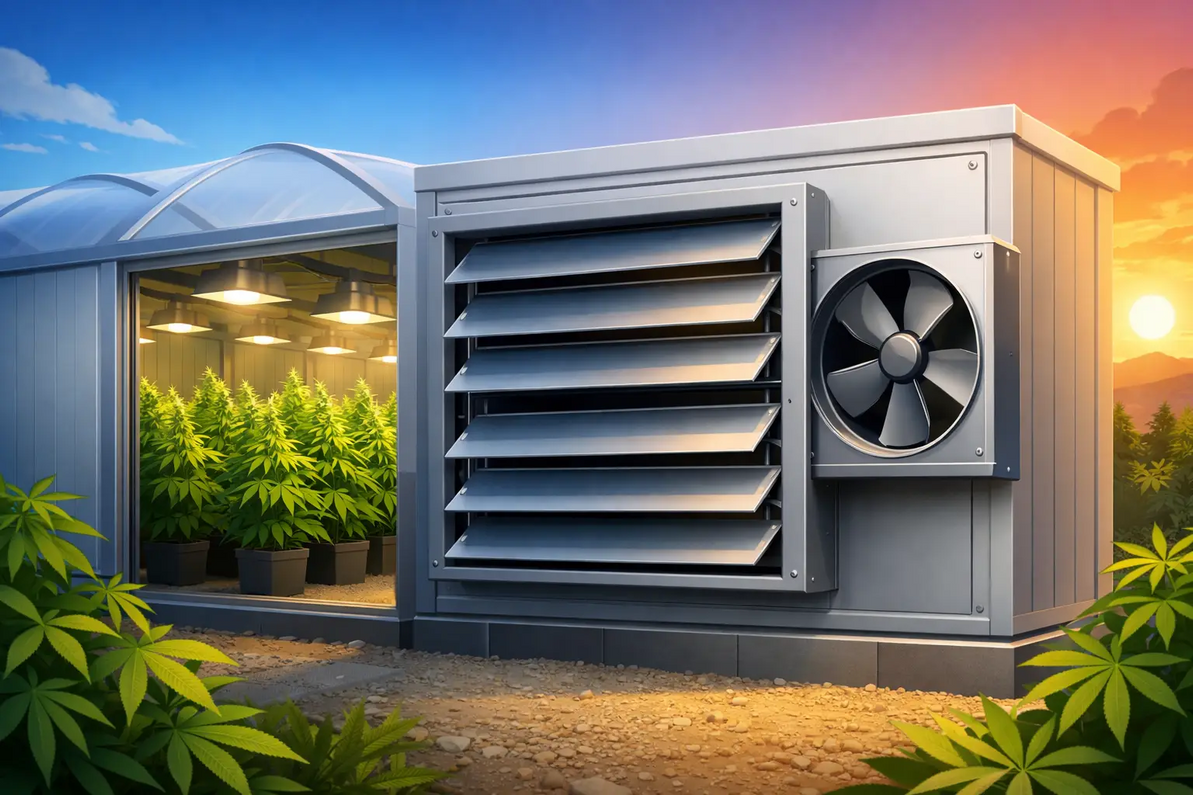
Cannabis Light Deprivation Intake Shutters
Blackout failure in a light dep greenhouse usually starts at the air intake, not the curtain. Cannabis light deprivation intake shutters have one job that sounds simple but is technically demanding: move the required air volume while preventing light leaks that can interrupt flowering, stress plants, and reduce yield consistency.
For commercial cannabis and hemp cultivation, intake shutter selection is not just a hardware decision. It affects static pressure, fan performance, room balance, climate uniformity, and the success of the entire light deprivation strategy. If the shutter is undersized, poorly baffled, or mismatched to the exhaust system, growers usually see higher heat load, uneven negative pressure, and operational instability during critical dark-cycle periods.
Why intake shutters matter in light deprivation rooms
A standard intake opening may work in a basic greenhouse, but light dep cultivation changes the design criteria. During blackout cycles, even minor light intrusion can create photoperiod disruptions. At the same time, plants still require air exchange to manage temperature, humidity, and CO2 balance. That creates a narrow engineering window: enough free area for airflow, but enough internal shielding to block direct and reflected light paths.
This is where intake shutters, light traps, and shutter-baffle combinations become essential. The shutter is not only opening and closing for ventilation control. It is also part of the environmental control envelope. In many cannabis applications, the intake assembly must resist corrosion, cycle reliably, seal well when closed, and work with the actual pressure profile of the building.
Sizing Cannabis Light Deprivation Intake Shutters correctly
The most common mistake is sizing shutters by rough opening dimensions instead of effective airflow capacity. A 36-inch shutter does not automatically deliver the free area or low-pressure performance needed for a high-CFM cultivation space. Blade design, frame depth, light trap geometry, and screen resistance all matter.
Growers should start with total exhaust CFM, then calculate intake area based on acceptable inlet velocity. If inlet velocity is too high, static pressure rises and fan efficiency drops. That means the fan may move less air than its rated capacity, especially once filters, shutters, and duct transitions are added. In cultivation, that can quickly turn into excess canopy temperature and uneven humidity control.
As a practical rule, light dep structures often need more intake area than operators expect because light-blocking components add resistance. A system that looks adequate on paper can underperform badly if the intake shutter and light trap are treated as separate accessories rather than one airflow assembly.
Light control and airflow are always a trade-off
The tighter the light-blocking path, the greater the airflow resistance. That trade-off is real, and it should be engineered, not guessed. Deep baffles, dark interior finishes, and multiple turning paths improve blackout performance, but they also increase pressure drop. The right design depends on whether the facility is using passive intake, fan-assisted intake, evaporative cooling, or a hybrid greenhouse ventilation strategy.
In hot climates, this becomes even more critical. A cultivation room may need aggressive air exchange during blackout hours to keep leaf surface temperatures in range. If the intake shutter system is too restrictive, the exhaust fans work harder, energy use rises, and indoor conditions drift away from setpoint. In some cases, the grower blames the fan bank or control package when the actual bottleneck is the intake side.
What to look for in intake shutters for cannabis cultivation
The best intake shutter for a cannabis light deprivation project is usually the one that matches the building pressure, fan selection, and blackout requirements as a complete system. Material quality matters because high-humidity cultivation environments can shorten equipment life. Blade action matters because sticking or delayed opening changes intake performance. Seal quality matters because small light leaks can become crop risks.
Most commercial buyers should evaluate five things before purchasing:
- Free area and rated airflow under realistic static pressure
- Light-blocking performance of the full intake assembly
- Corrosion resistance in humid, fertilizer-exposed environments
- Compatibility with exhaust fan capacity and control strategy
- Serviceability for cleaning, inspection, and replacement
For engineered grow facilities, cut sheets and fan curves should be reviewed together. Intake shutters should never be selected in isolation from exhaust fans, circulation strategy, or greenhouse cooling equipment.
Installation problems that cause poor performance
Even a well-selected shutter can fail in the field if the installation is loose, misaligned, or undersupported. Light leaks often come from perimeter gaps, warped mounting surfaces, or poor transitions between the shutter and the blackout structure. Airflow losses commonly come from screens clogging with debris, added field modifications, or framing that reduces the net free opening.
Another frequent issue is uneven intake distribution. If one side of the greenhouse has lower resistance than the other, air will favor that path. The result is inconsistent temperature and humidity across zones. In cannabis, that can show up as non-uniform plant development, disease pressure in dead-air areas, and quality variation from one section of the room to another.
When growers should ask for engineering help
If the project includes multiple exhaust fans, evaporative cooling, automated blackout systems, or large-scale greenhouse bays, intake shutter sizing should be reviewed as part of the full ventilation design. That is especially true when the crop has strict photoperiod sensitivity and the facility cannot tolerate trial-and-error corrections after installation.
Factory Fans Direct works with growers, contractors, and facility teams that need ventilation equipment matched to actual operating conditions, not generic catalog assumptions. On cannabis projects, that usually means reviewing CFM targets, pressure losses, intake velocity, and light-control requirements before equipment is ordered.
The right intake shutter does more than open and close. It protects the dark cycle, supports stable airflow, and keeps the rest of the ventilation package working where it should.
Factory Fans Direct - Greenhouse, Cannabis & Hemp Ventilation & Cooling Experts | Contact Mike Miller VP Engineering at Factory Fans Direct for a FREE Project Evaluation 888-849-1233 | Mike@FactoryFansDirect.com
Recent Posts
-

AI Smart Buildings Incorporate Edmonds ecoPOWER Hybrid Turbine Ventilation
A building automation system can report rising rooftop temperatures, increasing indoor contaminants, …12th Sep 2026 -
Smart Buildings Architects Recommend Edmonds ecoPOWER Hybrid Ventilation
A rooftop ventilator should not force an all-or-nothing energy decision. Smart Buildings Architects …7th Sep 2026 -
Smart Industrial Buildings Use Edmonds ecoPOWER Hybrid Ventilation
A roof exhaust system can be the difference between a plant that controls heat at the source and one …7th Sep 2026