Cannabis Light Deprivation Exhaust Fans
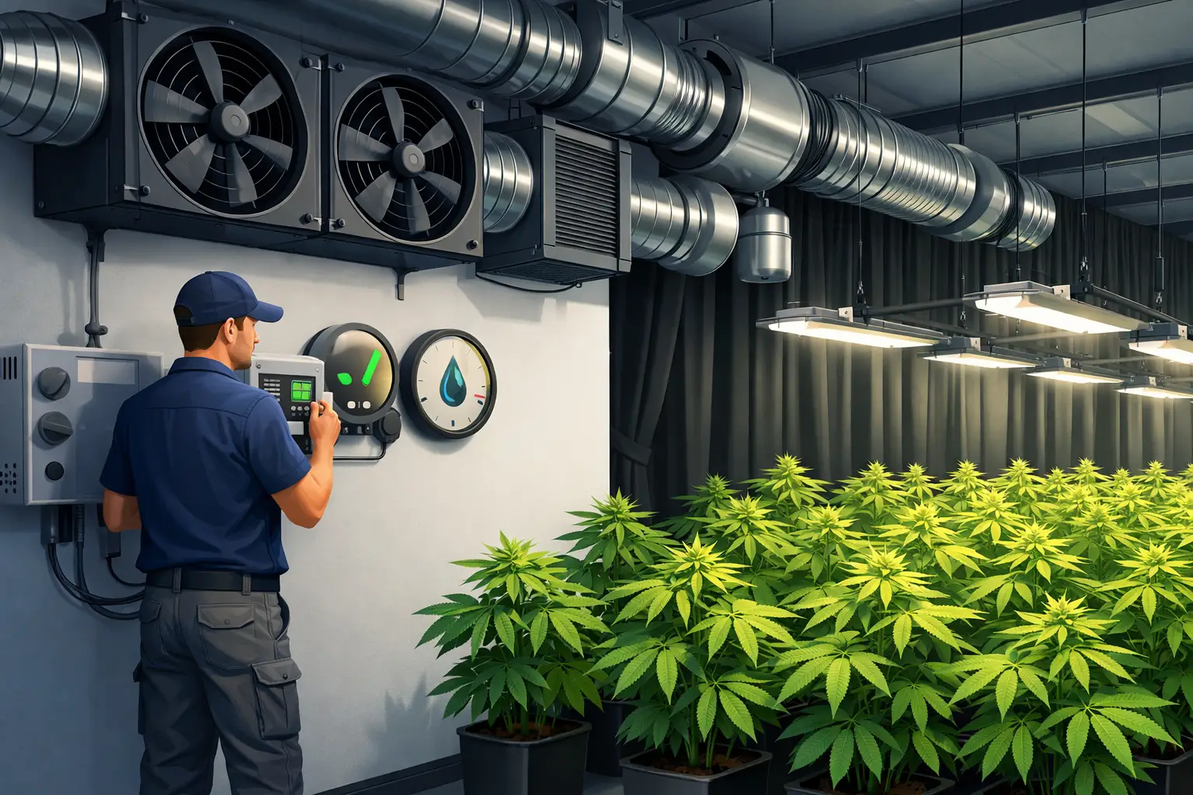
Blackout-grown cannabis can go sideways fast when heat and humidity get trapped under tarps. Cannabis Light Deprivation Exhaust Fans are not just an accessory in these rooms and greenhouses - they are a primary climate-control component that protects plant quality, stabilizes vapor pressure conditions, and keeps your light dep schedule from creating a moisture problem.
Light deprivation changes the ventilation equation because you are intentionally reducing natural airflow while adding a heat and moisture load that does not stop when the blackout cycle begins. Plants continue transpiring. Irrigation still adds latent moisture. In many cases, supplemental lighting, dehumidification, and circulation equipment add sensible heat. If exhaust capacity is undersized, the result is a fast spike in temperature, elevated leaf wetness risk, and inconsistent crop performance across zones.
Why Cannabis Light Deprivation Exhaust Fans Matter
In a standard greenhouse, passive ventilation and open-air exchange can do a large share of the work during favorable weather. In a light dep structure, that flexibility narrows. Once blackout curtains or tarps are closed, resistance increases and the fan system has to pull air through light traps, shutters, motorized dampers, and other intake restrictions without leaking light.
That is where many growers get burned. They size fans by greenhouse square footage alone and ignore static pressure. A fan that looks adequate on paper at free air may deliver much less CFM once it is connected to a real-world light dep setup. The fan curve matters. The intake path matters. The light trap pressure drop matters. If those variables are not accounted for, you can end up with a hot, wet structure even though the installed fan nameplate looked big enough.
What to Size Before You Buy
The right approach starts with total air exchange requirement, but it should not stop there. For cannabis light deprivation exhaust fans, you also need to calculate the actual resistance of the system and match the fan to that duty point.
Three factors usually drive selection. First is CFM requirement based on greenhouse volume, crop density, and the speed of heat removal needed during blackout periods. Second is static pressure created by light traps, filters if used, shutters, louvers, and duct transitions. Third is control strategy, meaning whether the fan will run single-speed, staged, or through a variable frequency drive for tighter climate management.
Motor type and service factor also deserve attention. Cultivation environments are humid, and washdown or corrosion-resistant options may be warranted depending on your sanitation program. Belt drive versus direct drive is another trade-off. Belt drive can offer flexibility in performance tuning, while direct drive can reduce maintenance points in some applications. There is no universal winner - it depends on duty cycle, access for service, and operating environment.
Exhaust Fans for Light Dep Need a System View
A fan cannot fix a poor intake design. If the intake area is too small or the light traps are too restrictive, the exhaust fan will work harder and still move less air. That increases energy use and may shorten equipment life. Balanced airflow is the goal, not just high fan horsepower.
This is why engineered layouts outperform one-off equipment purchases. Fan placement, intake placement, circulation pattern, and control integration all affect how evenly the structure vents. Dead spots near corners or dense canopy sections can stay wet even when average room readings seem acceptable. Growers often blame genetics or irrigation when the real problem is uneven air exchange.
For larger commercial houses, staged exhaust can be more effective than one oversized fan bank running full output all the time. Staging gives you better control during shoulder conditions and reduces unnecessary energy draw. In more advanced setups, exhaust can be coordinated with circulation fans, evaporative cooling, dehumidification, and motorized inlet controls to maintain a more stable environment during blackout events.
Common Mistakes With Cannabis Light Deprivation Exhaust Fans
The most common mistake is buying on diameter alone. A 36-inch or 48-inch fan tells you very little unless you know the delivered CFM at the actual static pressure. The second mistake is overlooking light trap losses. Some traps create substantial restriction, and that pressure penalty must be included in the design. The third is underestimating moisture load during lights-out or blackout cycles.
Another issue is poor control logic. Fans that short-cycle or run without coordinated intake control can create pressure swings, uneven airflow, and unnecessary wear. In some climates, aggressive exhaust without makeup air planning can also pull in unconditioned hot air, pollen, or contaminants at the wrong time. That is why application details matter more than generic fan charts.
Selecting the Right Fan Package
For commercial cannabis cultivation, the best fan package is usually one matched to the structure, not picked from a general-purpose catalog page. That means reviewing greenhouse dimensions, curtain system details, desired air changes, local climate, altitude if applicable, and the pressure drop of every major component in the airstream.
This is where a project evaluation saves money. Oversizing creates unnecessary capital and electrical cost. Undersizing creates crop risk. Properly selected cannabis light deprivation exhaust fans should give you the airflow you need at the pressure your system actually sees, with controls that support the cultivation strategy instead of fighting it.
Factory Fans Direct works with growers, contractors, and facility teams that need ventilation engineered around real operating conditions, including static pressure, intake restrictions, and equipment matching. If you are planning a new light dep house or correcting a problem installation, it makes sense to review the fan curve, light trap data, and control sequence before buying hardware.
Factory Fans Direct - Greenhouse, Cannabis & Hemp Ventilation & Cooling Experts | Contact Mike Miller VP Engineering at Factory Fans Direct for a FREE Project Evaluation 888-849-1233 | Mike@FactoryFansDirect.com
Recent Posts
-

AI Smart Buildings Incorporate Edmonds ecoPOWER Hybrid Turbine Ventilation
A building automation system can report rising rooftop temperatures, increasing indoor contaminants, …12th Sep 2026 -
Smart Buildings Architects Recommend Edmonds ecoPOWER Hybrid Ventilation
A rooftop ventilator should not force an all-or-nothing energy decision. Smart Buildings Architects …7th Sep 2026 -
Smart Industrial Buildings Use Edmonds ecoPOWER Hybrid Ventilation
A roof exhaust system can be the difference between a plant that controls heat at the source and one …7th Sep 2026