
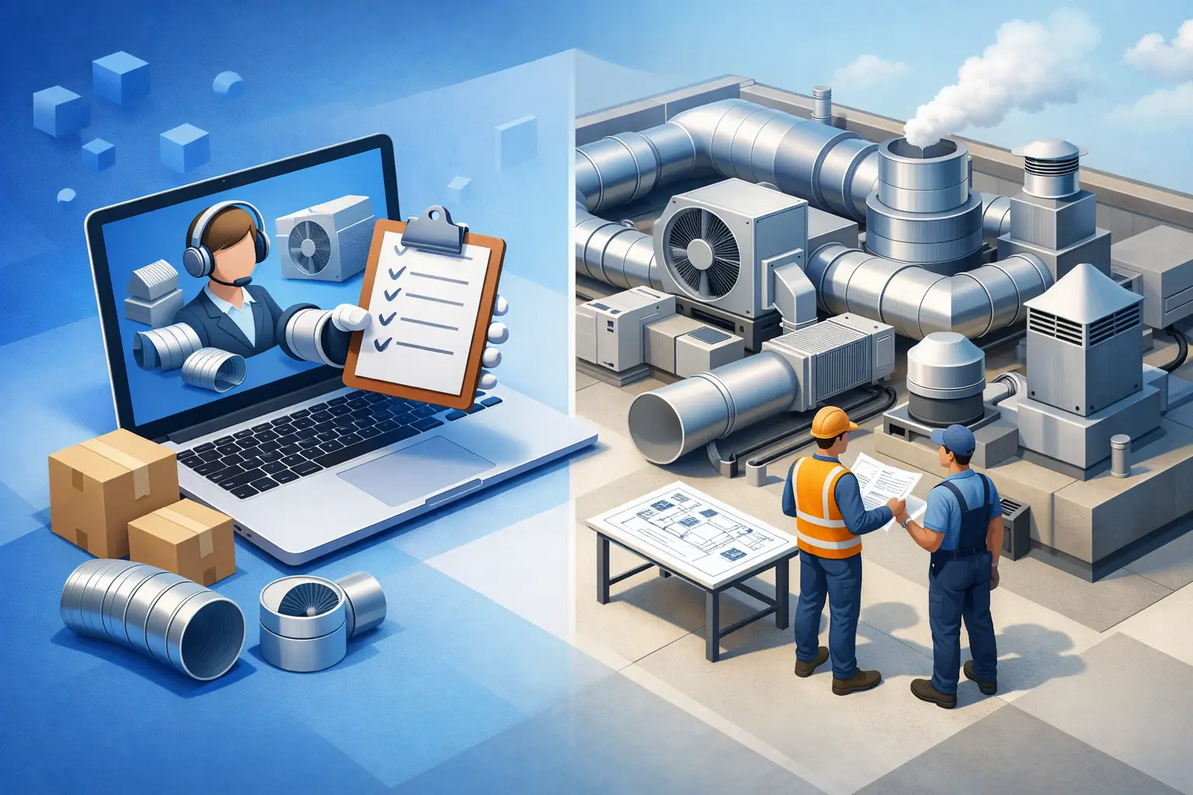
Can You Trust Online Order Takers with Complex Ventilation Projects?
A wrong fan selection on a commercial or industrial job does not just create an inconvenience. It can leave heat in the building, starve equipment for air, miss code targets, overload motors, and force a costly replacement after installation. That is why the question, Can you trust On-line Order Takers with Complex Commercial and Industrial Ventilation Projects?, deserves a serious answer.
Sometimes you can. Often, you should be careful.
If your project is a simple replacement and you already know the exact CFM, static pressure, voltage, phase, motor type, mounting method, and control requirements, an online order desk may be enough. But complex ventilation projects are rarely simple replacements. Warehouses, manufacturing plants, grow facilities, agricultural buildings, crypto mining operations, and specialty process environments usually require design judgment, not just product entry.
When online order takers can be enough
There is nothing wrong with online ordering when the scope is straightforward. If you are replacing the same model fan with the same duty point, same curb, same electrical service, and same operating conditions, the transaction can be clean and efficient. In that case, speed and price may matter more than engineering support.
The problem starts when buyers assume all fans with similar diameter or horsepower will perform the same. They will not. A 36-inch exhaust fan on paper may look interchangeable, but actual performance changes fast once static pressure, shutter resistance, filters, duct length, louvers, weather hoods, and make-up air restrictions enter the equation.
Can you trust online order takers with complex commercial and industrial ventilation projects?
You can trust them for order processing. You should not automatically trust them for ventilation design.
That is the key distinction. An order taker typically confirms SKU, quantity, price, and shipping. A ventilation design specialist asks different questions. What is the heat load? What air changes per hour are required? What is the entering air condition? Is the building under negative pressure? Will the fan curve hold at the actual static pressure? Is make-up air balanced, tempered, filtered, or motorized? Are there corrosive fumes, washdown conditions, combustible dust concerns, or extreme ambient temperatures?
Those questions determine whether the equipment will work in the field. Without them, you are not really buying a system. You are buying a guess.
What gets missed when no engineering review happens
The most common failure is improper fan sizing. Some projects are undersized because the buyer only calculates room volume and ignores process heat, roof gain, machinery load, solar gain, or occupancy. Others are oversized, which can be just as damaging if the system creates drafts, pressure imbalance, wasted energy, or control instability.
Static pressure is another major blind spot. Online catalogs make airflow look simple, but fan performance always drops as system resistance rises. Louvers, filters, evaporative media, silencers, duct transitions, and light traps all add resistance. If no one reviews the fan curve against the real duty point, the installed CFM can fall well below what the project needs.
Electrical and controls coordination also gets missed. Voltage, phase, starter requirements, VFD compatibility, motor enclosure, speed control logic, and integration with thermostats or building controls should be reviewed before equipment ships. The same goes for weather exposure, roof loading, corrosion resistance, and service access.
What a qualified ventilation advisor should do
A real project partner should ask for plans, dimensions, process details, and operating goals. They should help calculate required airflow in CFM, estimate static pressure, review fan curves, and match exhaust with make-up air. If the application is technical, they should also discuss motor type, blade design, sound, energy use, controls, and installation conditions.
That does not mean every project needs a full stamped engineering package. It means the supplier should think like an engineering resource, not a checkout cart.
For example, a warehouse destratification job has different design priorities than a cannabis cultivation room, a livestock barn, or a high-temp crypto mining exhaust application. The wrong advisor treats those jobs the same because they all need "fans." The right advisor understands heat rejection, contamination, humidity, pressure relationships, and equipment duty cycles for each environment.
Price matters, but bad design costs more
Many buyers go to online sellers for lower pricing. That makes sense. Budget matters, especially on high-volume equipment packages. But low first cost is not low total cost if the fan misses airflow, causes rework, or shortens equipment life.
The better question is not whether the quote is cheap. It is whether the supplier can defend the selection. Can they explain why that fan, at that RPM, with that motor, will produce the required airflow at the actual static pressure? Can they explain make-up air strategy and controls? Can they help prevent field issues before the installer arrives on site?
If the answer is no, then the lower price may be hiding project risk.
A practical way to vet a ventilation supplier
Before you buy, ask a few direct questions. Ask what design inputs they used. Ask for the expected CFM at your estimated static pressure, not free air. Ask how they handled make-up air. Ask whether they reviewed motor voltage, phase, controls, and mounting conditions. Ask for cut sheets and fan curve support. If the answers are vague, generic, or purely sales-driven, that tells you a lot.
Complex projects need application support. That is especially true when ventilation affects process uptime, worker comfort, code compliance, agricultural yield, or equipment cooling performance.
Factory Fans Direct works in that consultative space because many buyers do not need another order desk. They need a free project evaluation, technical review, and product matching based on real operating conditions.
Factory Fans Direct - Commercial & Industrial Ventilation & Cooling Experts | Contact Mike Miller VP Engineering at Factory Fans Direct for a FREE Project Evaluation 888-849-1233 | Mike@FactoryFansDirect.com
Recent Posts
-

AI Smart Buildings Incorporate Edmonds ecoPOWER Hybrid Turbine Ventilation
A building automation system can report rising rooftop temperatures, increasing indoor contaminants, …12th Sep 2026 -
Smart Buildings Architects Recommend Edmonds ecoPOWER Hybrid Ventilation
A rooftop ventilator should not force an all-or-nothing energy decision. Smart Buildings Architects …7th Sep 2026 -
Smart Industrial Buildings Use Edmonds ecoPOWER Hybrid Ventilation
A roof exhaust system can be the difference between a plant that controls heat at the source and one …7th Sep 2026