
Can a Whole House Fan Cool Your Home & Save You Money?
If your air conditioner runs for hours just to pull indoor temperature down a few degrees, you are not alone. Can a Whole House Fan Cool Your Home & Save You Money? In many US climates, yes - but only when the fan is properly sized, installed, and used under the right outdoor conditions.
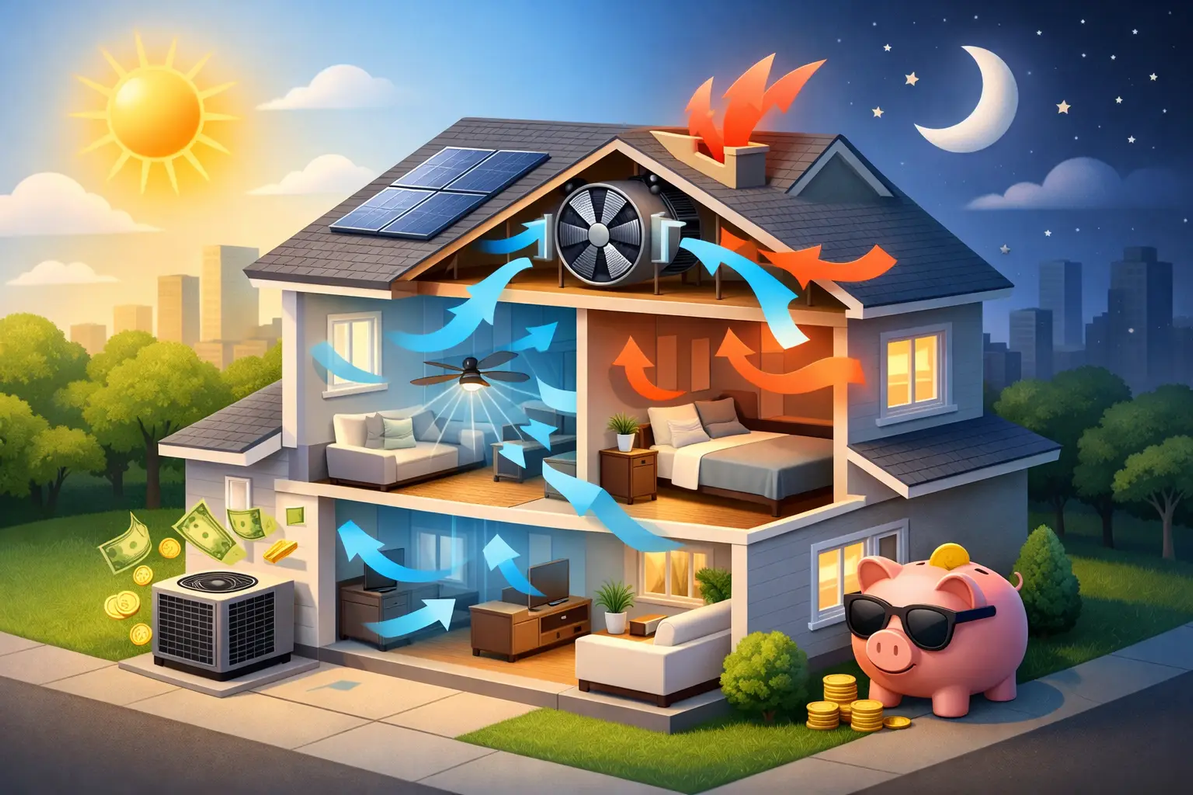
A whole house fan is not the same as an attic fan, and that distinction matters. A whole house fan pulls cooler outside air through open windows, moves it through the living space, and exhausts it into the attic and out through attic ventilation. The result can be a fast air exchange that removes built-up indoor heat from walls, ceilings, and furnishings much faster than opening windows alone.
Can a Whole House Fan Cool Your Home & Save You Money?
The short answer is yes, especially during evenings, nights, and early mornings when outdoor air is cooler than indoor air. Instead of relying only on compressor-driven air conditioning, a whole house fan uses a much smaller motor load to move a large volume of air. That can reduce AC runtime and lower electric costs.
The savings depend on climate, occupancy, insulation levels, attic ventilation capacity, and homeowner behavior. In dry or mixed climates with strong day-to-night temperature swings, whole house fans often perform very well. In hot and humid climates, they may still help during limited hours, but they are usually not a full replacement for AC because you are bringing in outdoor humidity along with the air.
This is where engineering matters. Airflow is measured in CFM, and the system has to be matched to the home, not guessed from a box-store label.
How whole house fans actually reduce cooling cost
The main cost advantage comes from using high-volume ventilation to purge heat before the AC has to fight it. If your home traps heat through the afternoon, your air conditioner starts from behind. A whole house fan can flush that stored heat load out of the occupied space and the attic, giving the house a lower starting temperature before the next hot day.
That matters because air conditioning is not just cooling air. It is also removing heat absorbed by the building structure. When that heat is reduced overnight, peak cooling demand can drop.
Many homeowners also notice a comfort benefit that does not show up on a utility bill right away: faster perceived cooling. Air movement across the skin improves comfort even before thermostat temperature reaches its final setting.
Where whole house fans work best
Whole house fans are strongest in homes where outside air becomes meaningfully cooler than inside air on a regular basis. That usually means regions with cooler nights, shoulder-season weather, or lower humidity.
They are less effective when the outside air stays hot into the evening or carries high moisture levels. If it is 84 degrees and humid outside at 10 p.m., the fan may still move air, but it may not deliver the indoor comfort you want. In those cases, the whole house fan works best as part of a broader ventilation and cooling strategy, not as a stand-alone answer.
Sizing and attic ventilation are not optional details
A common mistake is focusing only on the fan and ignoring the air path. For a whole house fan to perform correctly, the attic must have enough net free vent area to exhaust the air being pushed into it. If attic ventilation is undersized, fan performance drops, noise can increase, and backpressure can become a problem.
Proper sizing starts with the home's square footage, ceiling height, desired air changes, window opening strategy, and attic vent capacity. Oversizing can create unnecessary noise and energy use. Undersizing leads to weak airflow and disappointed homeowners.
Insulated doors, damper systems, and winter sealing also matter. A high-quality whole house fan should not create a major thermal bypass in the ceiling during heating season.
What homeowners should expect in real-world performance
A well-selected whole house fan can quickly cool a home during favorable conditions, but it is not a magic product. You still need to operate it correctly. Windows must be opened strategically. Outdoor air must be cooler than indoor air. The house layout affects airflow pattern, and multi-story homes may behave differently than single-story homes.
Noise level is another real-world consideration. Older belt-drive units were often louder. Newer systems with better motor and grille design can be much quieter, but product selection matters.
The best results usually come from homeowners who use the fan proactively - turning it on when outdoor temperatures begin to drop, not after the house has already held a full day of heat.
Is a whole house fan worth it?
If your goal is to reduce AC runtime, improve nighttime cooling, and get more ventilation performance per watt, a whole house fan can be a strong investment. If your climate is very humid or nighttime temperatures stay high, the value is more conditional.
The right question is not just whether a whole house fan works. It is whether the fan, attic ventilation, and home conditions are matched correctly. That is where many installations succeed or fail. For technically minded homeowners, contractors, and specifiers, performance comes down to airflow engineering, not marketing claims.
Factory Fans Direct - Whole House Fans Experts | Contact Mike Miller at Factory Fans Direct for a FREE Home Evaluation 888-849-1233 and a $50 discount Coupon and Live Support on the Centric Air Whole House Fans.
Recent Posts
-

AI Smart Buildings Incorporate Edmonds ecoPOWER Hybrid Turbine Ventilation
A building automation system can report rising rooftop temperatures, increasing indoor contaminants, …12th Sep 2026 -
Smart Buildings Architects Recommend Edmonds ecoPOWER Hybrid Ventilation
A rooftop ventilator should not force an all-or-nothing energy decision. Smart Buildings Architects …7th Sep 2026 -
Smart Industrial Buildings Use Edmonds ecoPOWER Hybrid Ventilation
A roof exhaust system can be the difference between a plant that controls heat at the source and one …7th Sep 2026