
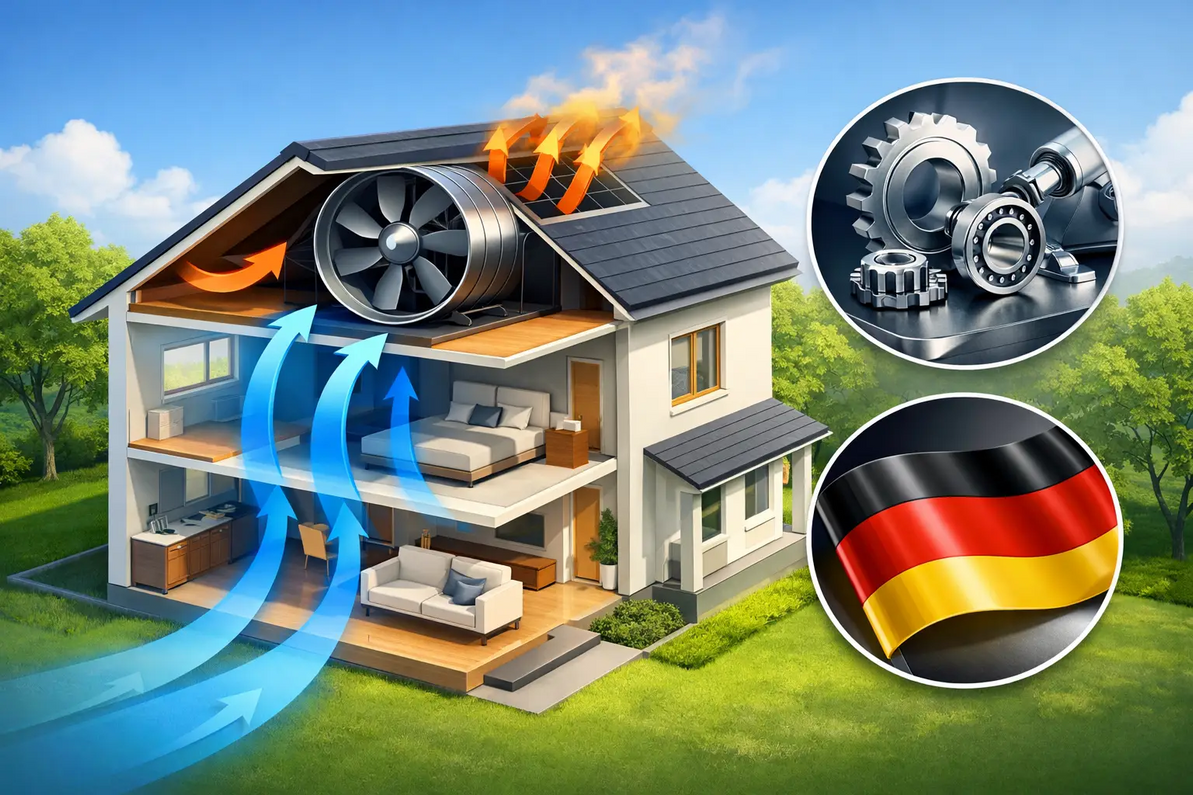
Best Whole House Fan with German Engineering
A whole house fan can make a cool evening feel like an open-window night without leaving every window wide open. But the Best Whole House Fan with German Engineering is not simply the unit with the highest advertised CFM. It is the system that delivers the required airflow at low sound levels, uses efficient motor technology, and fits the home’s attic and relief-ventilation capacity.
For technically minded homeowners, German engineering usually points to disciplined motor design, efficient electronics, tight manufacturing tolerances, and long-term reliability. Those qualities matter because a whole house fan is a large air-moving system. A poor match can be loud, underperform in upstairs rooms, or pressurize the attic because the existing vents cannot exhaust the fan’s airflow.
What German Engineering Should Mean in a Whole House Fan
Treat the phrase as a performance standard, not a marketing shortcut. Ask what components and specifications support the claim. A quality system should publish real airflow data, motor wattage, speed settings, sound information, and installation requirements. If the product literature only provides a single peak CFM number, it does not give enough information to compare operating efficiency.
The motor is central. High-efficiency electronically commutated, or EC, motors typically use less power than conventional permanent split capacitor motors while allowing variable-speed control. That gives the homeowner useful operating range: a lower, quieter setting for routine nighttime cooling and higher airflow when indoor heat has built up. A well-designed control package should make those settings easy to use rather than forcing the system to run at full output every time.
German-engineered motor and control technologies have a strong reputation in demanding ventilation applications. Still, the correct buying question is not just where a component was engineered. It is whether the complete fan system has the airflow, acoustic design, damper assembly, controls, and support needed for your specific home.
Size the Fan and the Attic Together
A whole house fan moves indoor air into the attic, where it must leave through soffit, ridge, roof, gable, or other approved exhaust openings. This is why fan selection cannot be separated from attic ventilation. A powerful fan connected to an undersized attic relief path can create backpressure, increase noise, and reduce actual delivered airflow.
Start with the home’s conditioned square footage, ceiling heights, floor plan, climate, and how the home is used. Bedrooms at the far end of a hallway, two-story layouts, closed doors, and restrictive window openings all affect air movement. CFM per square foot is a useful starting point, but it is not a final design calculation.
As a practical rule, the attic needs substantially more net free ventilation area than it would need for passive attic ventilation alone. Intake and exhaust paths both matter. Screens, louvers, bird guards, and vent geometry reduce effective free area, so nominal vent dimensions are not enough. An engineering review should account for the actual net free area and identify whether additional exhaust ventilation is required before installation.
Compare Airflow, Watts, Sound, and Controls
When comparing models, look at performance as a package. Higher CFM may be appropriate for a large or open home, but it is not automatically better for a smaller house or a homeowner who expects to run the fan near bedrooms. Review the fan’s operating speeds and watts at each speed. That comparison shows how much cooling flexibility the unit provides, not just its maximum output.
Sound is equally important. Ducted systems with insulated flexible duct can place the fan farther from the ceiling grille and reduce perceived noise in living areas. Direct-mount fans can be simpler in some attic layouts, but their sound and vibration characteristics deserve closer attention. Neither arrangement is universally best. Attic clearance, truss configuration, access, ceiling location, and the homeowner’s noise tolerance determine the right approach.
Controls should support real operating conditions. Multiple speeds, timers, wall controls, remote operation, and smart-home compatibility can improve usability. In humid climates, however, outdoor temperature alone is not the full story. Bringing in warm, humid air can increase indoor moisture load. Whole house fans work best when outdoor air is genuinely cooler and suitable for ventilation, not merely when the sun goes down.
Installation Details That Protect Performance
The fan needs a properly framed ceiling opening, safe electrical supply, and a sealed insulated damper system. The damper is not an accessory. When the fan is off, it should limit unwanted heat transfer between the attic and conditioned space. This matters in both hot summers and cold winters.
Installers should also verify combustion safety. Homes with naturally drafted fireplaces, water heaters, or furnaces may need special consideration because high airflow can affect building pressure. A qualified installer can evaluate those conditions, confirm window-opening requirements, and make sure the selected unit is appropriate for the home.
The strongest purchase decision comes from matching published motor efficiency and CFM data with an attic-relief calculation and a realistic noise expectation. That is how a German-engineered whole house fan becomes a dependable cooling system rather than an expensive attic opening.
Factory Fans Direct - Whole House Fans Experts | Contact Mike Miller at Factory Fans Direct for a FREE Home Evaluation 888-849-1233 and a $50 discount Coupon and Live Support on the Centric Air Whole House Fans.
Recent Posts
-

Smart Buildings Architects Recommend Edmonds ecoPOWER Hybrid Ventilation
A rooftop ventilator should not force an all-or-nothing energy decision. Smart Buildings Architects …7th Sep 2026 -
Smart Industrial Buildings Use Edmonds ecoPOWER Hybrid Ventilation
A roof exhaust system can be the difference between a plant that controls heat at the source and one …7th Sep 2026 -
Smart Commercial Buildings Use Edmonds Hybrid Ventilation
A rooftop exhaust fan that only performs when the wind blows is not a complete ventilation strategy. …7th Sep 2026