
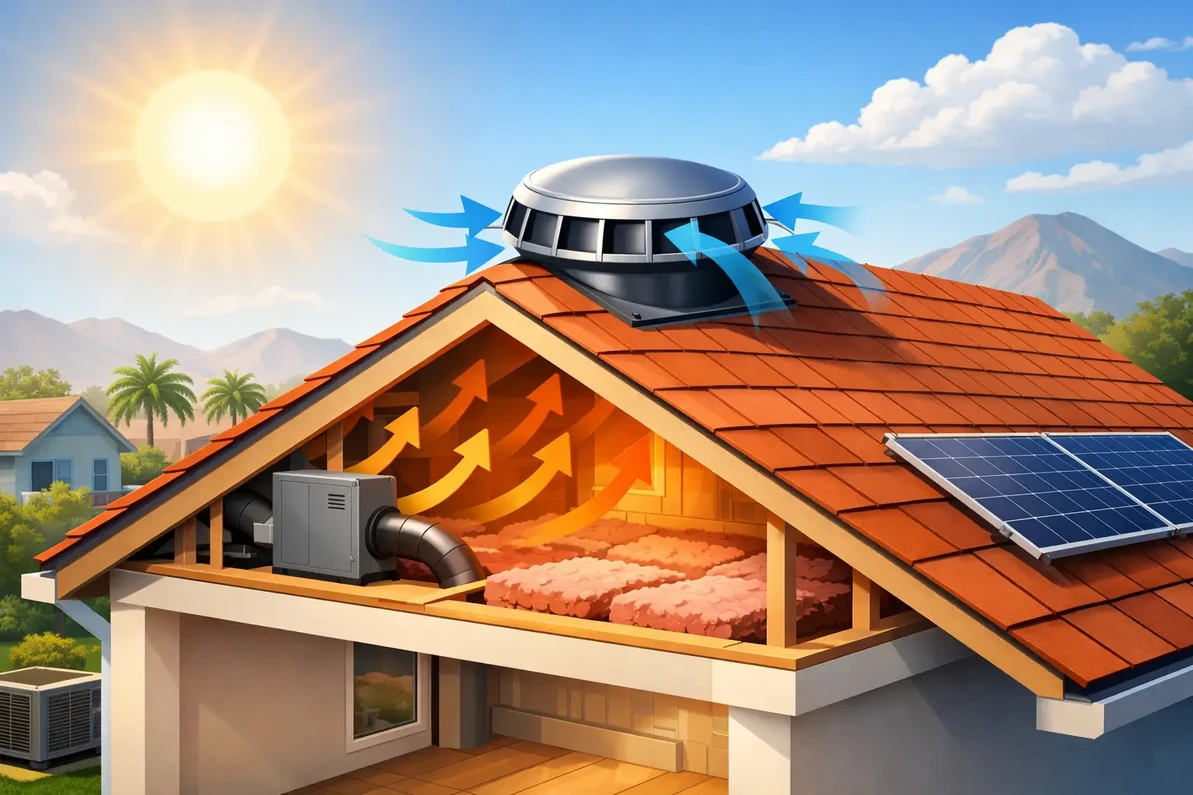
Best Attic Fan for Hot Climate Homes
By midafternoon in a hot region, attic temperatures can push well past 130 degrees. That heat does not stay politely above the ceiling. It drives up HVAC runtime, stresses roofing materials, and turns second-floor rooms into the part of the house everyone avoids. Choosing the best attic fan for hot climate conditions is less about picking a popular model and more about matching fan capacity, motor type, attic volume, and intake ventilation to the actual heat load.
What makes the best attic fan for hot climate performance
In mild weather, almost any powered attic ventilator can move some hot air out. In a hot climate, that is not enough. The fan has to operate reliably for long stretches, often through months of high ambient temperatures, intense solar gain, and little overnight relief.
That changes what matters. Airflow has to be adequate, not just advertised. The motor has to be designed for sustained duty. The housing needs to tolerate UV exposure and roof heat. Just as important, the attic needs enough intake vent area so the fan is not fighting negative pressure and pulling conditioned air from the living space.
This is where many installations go wrong. Buyers compare CFM ratings, install the largest unit that fits, and expect a dramatic temperature drop. If the soffit venting is undersized or blocked, or if the attic floor has leakage around can lights, pull-down stairs, and duct penetrations, the fan can end up pulling expensive cooled air out of the house instead of exhausting attic heat efficiently.
Start with sizing, not brand
The best attic fan for hot climate applications is usually the one that is correctly sized for the structure, not the one with the biggest marketing claim. A small, tight attic with good intake venting may perform well with a modest CFM rating. A large roof deck with dark shingles in Arizona, Texas, Nevada, or inland California may need substantially more airflow and better controls.
As a starting point, fan sizing is often based on attic square footage and roof slope, then adjusted for climate severity, roof color, insulation level, and existing passive vent area. In hotter regions, it is common to lean toward higher airflow because solar heat gain is more aggressive and the cooling season is longer.
But bigger is not always better. Oversizing can create pressure imbalance if intake ventilation does not keep pace. It can also increase noise and power consumption without delivering proportional improvement. The right question is not, "What is the biggest attic fan I can buy?" It is, "What airflow can my attic use effectively?"
A quick sizing reality check
If your attic already has ridge vents and soffit vents, a powered fan should be evaluated as part of the full vent system, not as a standalone fix. If your attic has very limited intake vent area, adding a stronger fan may underperform until venting is corrected. In technical terms, system resistance matters. The fan can only move the air the envelope allows.
Roof-mount vs gable-mount in hot climates
For most hot climate homes, the first real equipment decision is roof-mount versus gable-mount. Both can work, but the house design usually makes the choice for you.
A roof-mount attic fan tends to give more direct exhaust from the hottest part of the attic, since heat accumulates high under the roof deck. That often makes it the more effective option on homes without usable gable end openings. It is common on modern rooflines and can deliver strong vertical exhaust if installed correctly and flashed properly.
A gable-mount fan can be a good solution when the attic has a large gable opening and access is simpler. It may be easier to service and can avoid an additional roof penetration. In some installations, it also has a cleaner appearance from the street. The trade-off is that airflow path matters more. If the fan is mounted at one end of a long attic, dead zones can remain unless intake and cross-flow are well managed.
For hot climates, roof geometry and attic layout should drive this choice. A complex attic with multiple compartments, valleys, or separated sections may need more than a single fan location can handle.
Motor type matters more than most buyers expect
In extreme heat, motor quality is not a minor detail. It is one of the main reasons one attic fan lasts and another fails after a few summers.
Direct-drive motors are common and efficient, with fewer moving parts than belt-driven systems. For residential attic ventilation, they are usually the practical choice. What matters is whether the motor is rated for continuous or heavy-duty use and whether the fan is engineered for high-temperature environments.
Hot climates are also where cheap thermostat controls show their weakness. A fan that cycles improperly, starts late, or runs inconsistently leaves performance on the table. Thermostat and humidistat controls should be reliable and appropriately adjustable. In dry hot climates, temperature control is often the main concern. In mixed hot-humid regions, humidity control can still matter, particularly where moisture buildup affects insulation performance or roof decking.
Solar attic fans are appealing because they offset electrical use, and in strong sun they can align nicely with peak attic heat. But there is a trade-off. Solar-only fans may deliver less consistent airflow than line-voltage units, especially if capacity is limited or weather shifts. In very high heat loads, a hybrid or electric-powered unit may provide more dependable performance.
Intake ventilation is not optional
This is the part many online roundups skip. A powered attic fan is an exhaust device, not a complete ventilation system. If there is not enough intake air entering through soffit or low-mounted vents, performance will be restricted.
In a properly designed attic ventilation system, the fan pulls outdoor air in low and pushes superheated air out high. That airflow sweep is what removes heat effectively. Without it, the fan may pull from recessed lights, attic hatch gaps, bathroom fan leaks, or duct openings. That can raise energy costs and create comfort issues indoors.
For technically minded homeowners, contractors, and installers, this is the checkpoint that separates a good result from a callback. Before specifying fan capacity, verify net free vent area, inspect soffits for blockage, and evaluate whether insulation is choking off airflow at the eaves.
Features worth paying for in a hot climate
The best attic fan for hot climate use usually includes a short list of features that have real field value. Not luxury extras - performance features.
An all-metal housing generally holds up better under heat and UV exposure than lighter-duty alternatives. A quality thermostat gives you tighter operating control. A higher-capacity motor with known duty ratings is worth more than a flashy top-end CFM number. If wildfire ember exposure or wind-driven rain is a concern in your region, the weather protection details matter too.
Noise is another practical issue. In a detached warehouse, fan noise may be irrelevant. In a residence with bedrooms near the attic plane, it matters. A well-balanced fan with solid mounting and proper system design will usually sound better than an oversized unit working against poor intake conditions.
When a powered attic fan is the wrong fix
There are cases where an attic fan is not the first thing to change. If the attic floor is poorly air sealed, if ductwork is leaking into the attic, or if insulation levels are far below code expectations for the region, ventilation alone will not solve the heat problem.
In those homes, the fan can still help, but it should be part of a broader correction plan. Air sealing, insulation upgrades, radiant barriers in some assemblies, and duct improvements may produce a larger performance gain than fan replacement by itself.
This is especially true when homeowners say, "My second floor is hot," as if the attic fan alone must solve it. Sometimes the issue is attic heat. Sometimes it is duct loss, under-insulated ceilings, west-facing glass, or an undersized air conditioning system. Good ventilation design starts with diagnosis.
How to choose the right unit without guessing
If you want the best attic fan for hot climate conditions, evaluate the house like a system. Measure attic square footage. Look at roof color and sun exposure. Confirm whether there is usable soffit intake. Identify existing ridge, gable, or roof vents. Check for compartmentalized attic sections. Then match fan type and CFM to those conditions.
For contractors and property owners managing multiple projects, that engineering-first approach prevents expensive trial and error. It also avoids the common mistake of buying a fan based on a generic square-foot chart and hoping the field conditions cooperate.
This is where experienced technical support has real value. A supplier with ventilation design knowledge can help assess airflow requirements, static limitations, motor options, and mounting configuration before equipment is ordered. That is far better than finding out after installation that the attic needed more intake vent area or a different fan location. Factory Fans Direct approaches these projects with that kind of practical design support, especially when heat load and performance expectations are high.
A hot attic is not just a comfort problem. It is a building performance problem. Get the airflow right, and the fan becomes a useful piece of the system instead of a noisy accessory on the roof.
Factory Fans Direct - Whole House Fans Experts | Contact Mike Miller at Factory Fans Direct for a FREE Home Evaluation 888-849-1233 and a $50 discount Coupon on the Centric Air Whole House Fans.
Recent Posts
-

AI Smart Buildings Incorporate Edmonds ecoPOWER Hybrid Turbine Ventilation
A building automation system can report rising rooftop temperatures, increasing indoor contaminants, …12th Sep 2026 -
Smart Buildings Architects Recommend Edmonds ecoPOWER Hybrid Ventilation
A rooftop ventilator should not force an all-or-nothing energy decision. Smart Buildings Architects …7th Sep 2026 -
Smart Industrial Buildings Use Edmonds ecoPOWER Hybrid Ventilation
A roof exhaust system can be the difference between a plant that controls heat at the source and one …7th Sep 2026