
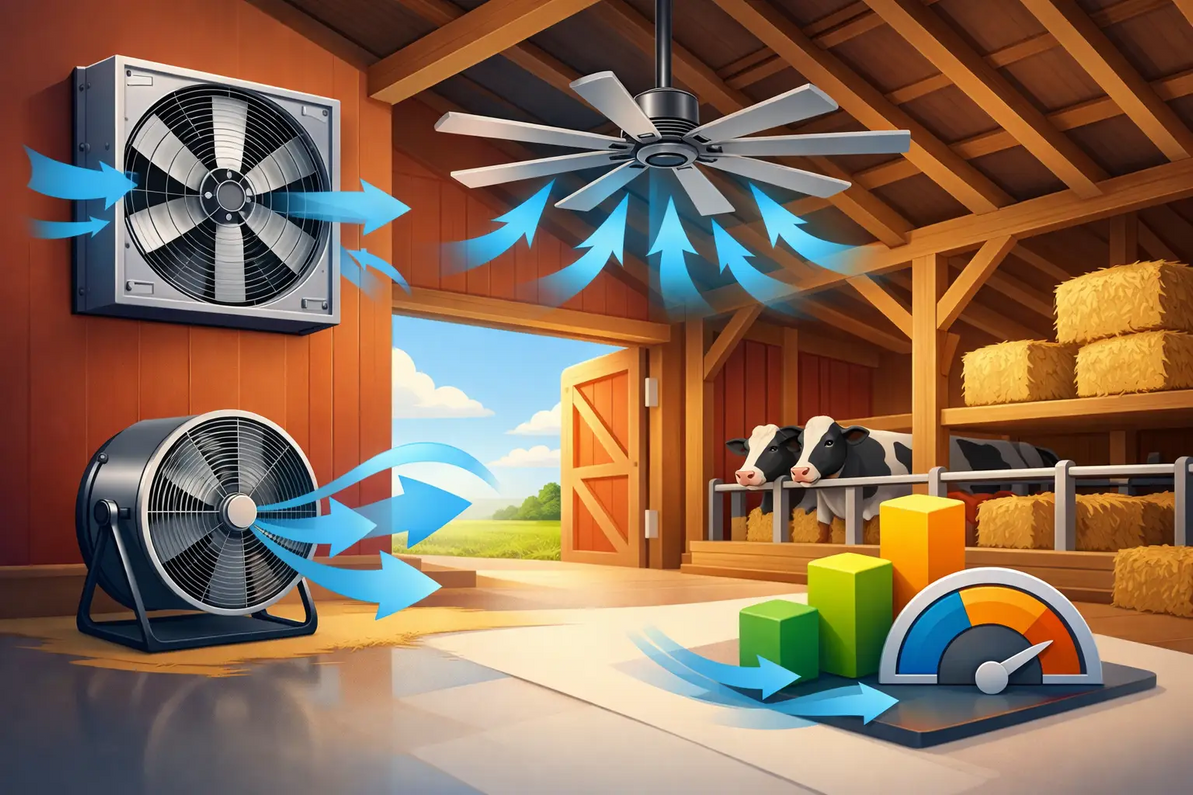
Barn Fan Sizing Chart for Proper Airflow
Hot barns fail quietly at first. Cows bunch up, horses get restless, bedding stays damp longer than it should, and ammonia starts to hang in the air. A barn fan sizing chart helps prevent that by turning a vague airflow goal into actual fan diameter, CFM, and spacing decisions that fit the building and the animals inside it.
For most buyers, the mistake is not buying a bad fan. It is buying the wrong amount of fan. Barn ventilation has to match heat load, building width, ceiling height, stocking density, moisture conditions, and whether the goal is air exchange, spot cooling, or full circulation. That is why sizing should be treated as an engineering exercise, not a guess based on what worked in a neighbor's building.
How to read a barn fan sizing chart
A barn fan sizing chart usually starts with the two numbers that matter most - fan diameter and estimated airflow in CFM. From there, the chart may also suggest mounting height, throw distance, and spacing between units. Those numbers are useful, but only if you understand what they are solving for.
If you are ventilating a livestock barn, CFM is the real performance number. Fan diameter matters because it often correlates with airflow, but two 36-inch fans can perform very differently depending on blade design, motor efficiency, guard restriction, and static pressure conditions. A sizing chart is a starting point, not a substitute for fan curve data or application matching.
For example, a small horse barn aisle may need air movement for comfort, while a dairy holding area may need much more aggressive cooling to reduce heat stress. Both may use circulation fans, but the target airspeed and total CFM requirement will not be the same. That is where many off-the-shelf charts become too simplistic.
Barn fan sizing chart by common fan diameter
The table below gives a practical starting range for circulation-style barn fans in open or semi-open barn applications. Actual performance varies by motor, blade pitch, shutter or guard design, and installation height.
| Fan Diameter | Typical CFM Range | Common Use Case |
|---|---|---|
| 18 inch | 2,500-4,000 CFM | Small stalls, tack rooms, wash areas |
| 24 inch | 4,000-6,500 CFM | Small pens, feed areas, narrow aisles |
| 30 inch | 6,500-9,000 CFM | Medium stalls, horse barns, calf areas |
| 36 inch | 9,000-13,000 CFM | Aisles, open livestock areas, cross ventilation |
| 48 inch | 15,000-24,000 CFM | Larger barns, dairy, equine, broader coverage |
| 52-54 inch | 20,000-30,000 CFM | High-volume circulation in larger open zones |
| 72 inch HVLS style | 25,000+ CFM with wide coverage | Large-span barns with fewer mounting points |
This chart is helpful for rough planning, but not for final equipment selection. A 48-inch fan in a low-ceiling horse barn may create uncomfortable velocity if mounted incorrectly. The same fan in a dairy barn with high trusses may be exactly right. The building geometry changes everything.
What you actually need to size a barn fan correctly
The first question is whether you need air exchange or air circulation. Air exchange removes heat, moisture, dust, and gases by replacing stale air with fresh air. Air circulation moves air within the space to improve animal comfort and reduce stagnant zones. Many barns need both, and they are not solved by the same fan type.
If your barn already has good natural inlet and outlet pathways, circulation fans may be enough to improve perceived cooling. If moisture, odor, or ammonia are persistent, you may need exhaust capacity added to the design. Using only circulation fans in a poorly ventilated barn can move bad air around without fixing the root issue.
The next inputs are square footage and volume. A 40 foot by 100 foot barn with a 12 foot average ceiling has very different ventilation needs than the same footprint with a 20 foot peak and enclosed sidewalls. Volume matters when you are targeting air changes per hour. Floor area matters more when you are trying to create airspeed across occupied zones.
Then there is livestock type. Horses, dairy cattle, beef cattle, poultry, and small ruminants all respond differently to heat, humidity, and air velocity. A fan layout for horses often prioritizes stall comfort and aisle coverage. A dairy barn may prioritize consistent airflow over resting and holding areas. Poultry applications are even more sensitive to pressure, directional flow, and control strategy.
A practical sizing method for most barns
For a quick circulation estimate, start by identifying the occupied zone where cooling is needed. That is usually the stall front, bedding area, feed line, or central aisle rather than the entire cubic volume of the building. Then estimate how much usable fan throw you need and how much overlap is required to avoid dead spots.
In many open barns, circulation fans are spaced so their effective airflow patterns slightly overlap rather than leaving gaps. That usually means fan spacing is driven by throw distance, mounting angle, and obstructions such as posts, partitions, or trusses. If fans are spaced too far apart, the barn looks ventilated on paper but performs poorly in the actual occupied zone.
For exhaust sizing, many designers use air changes per hour or a CFM-per-animal approach, depending on the application. General minimum ventilation may be much lower than summer heat relief ventilation. That is why one fixed chart rarely works year-round. Winter moisture control and summer heat stress are different design conditions.
Barn fan sizing chart limitations that matter on real projects
The biggest limitation of a generic barn fan sizing chart is that it assumes the fan delivers rated airflow under real conditions. In practice, shutters, guards, dirty blades, voltage drop, and static pressure can all reduce delivered CFM. If the barn has tight sidewalls, evaporative cooling pads, ducts, or restrictive openings, the fan must be selected against actual resistance, not free-air performance.
Mounting height is another common issue. A fan that performs well at 10 feet may be ineffective at 18 feet if the air stream dissipates before reaching the animals. The opposite can also happen. Mounting too low may create drafts, interfere with equipment, or produce excessive velocity in one zone while leaving the rest of the barn stagnant.
Noise and power draw also deserve attention. Higher-speed fans can deliver strong local airflow, but they may not be ideal in every equine application where noise sensitivity matters. Larger-diameter, lower-speed fans can improve coverage and reduce turbulence, but they require adequate clearance and structural mounting support.
Matching fan type to barn use
Basket fans and panel fans are often a good fit for spot cooling, aisles, and targeted circulation. They are straightforward to mount and can be aimed where air movement is needed most. That makes them popular in horse barns, calf barns, and washdown areas.
Larger circulation fans are better when broad coverage matters more than targeted velocity. In a wide open livestock building, fewer large fans may outperform many small fans if the mounting geometry is right. HVLS fans can also work well in large-span structures, especially where gentle, continuous air movement is preferred over concentrated jets of air.
Exhaust fans belong in the conversation when odor, humidity, and heat buildup are tied to poor air exchange. In enclosed barns, ridge vents, wall inlets, and exhaust capacity have to work together. A high-CFM fan without adequate intake area will not deliver the expected result.
When the chart says one thing but the barn says another
This is where engineering support saves money. If a chart suggests six 36-inch fans but the barn has low trusses, partial partitions, and only limited electrical capacity, that recommendation may not be practical. You may be better served by fewer larger fans, a mixed intake and exhaust strategy, or variable-speed control to handle changing seasonal loads.
Retrofits are especially tricky. Existing barns often have structural constraints, uneven airflow paths, and legacy equipment that affects placement. A textbook layout can fall apart once you account for doors, feed systems, lighting, sprinkler lines, and stall fronts. That is why cut sheets and CFM tables should be read alongside an actual layout review.
At Factory Fans Direct, this is typically where a free project evaluation has the most value. Sizing a fan from a chart is easy. Matching airflow to a real barn, real animals, and real operating conditions is the part that determines whether the investment performs.
What to have ready before selecting a fan
If you want a useful recommendation instead of a guess, gather the barn length, width, and average ceiling height, along with photos or a sketch of the interior. Note the livestock type, head count, sidewall condition, ridge or roof vent details, and whether the goal is circulation, exhaust, or both. It also helps to know the available voltage, mounting points, and any concerns about washdown, corrosion, dust, or noise.
Those details make it possible to move beyond a generic barn fan sizing chart and toward a ventilation plan that actually works. The right fan is not just the one with the biggest CFM number. It is the one that delivers usable airflow where the animals live, rests within your electrical and structural limits, and supports the way the barn operates day after day.
If your barn has hot spots, damp air, or inconsistent airflow, treat the chart as the first filter, not the final answer. Good ventilation pays back in animal comfort, building condition, and fewer mistakes during installation.
Factory Fans Direct - Commercial & Industrial Ventilation & Cooling Experts | Contact Mike Miller VP Engineering at Factory Fans Direct for a FREE Project Evaluation 888-849-1233 | Mike@FactoryFansDirect.com
Recent Posts
-

AI Smart Buildings Incorporate Edmonds ecoPOWER Hybrid Turbine Ventilation
A building automation system can report rising rooftop temperatures, increasing indoor contaminants, …12th Sep 2026 -
Smart Buildings Architects Recommend Edmonds ecoPOWER Hybrid Ventilation
A rooftop ventilator should not force an all-or-nothing energy decision. Smart Buildings Architects …7th Sep 2026 -
Smart Industrial Buildings Use Edmonds ecoPOWER Hybrid Ventilation
A roof exhaust system can be the difference between a plant that controls heat at the source and one …7th Sep 2026