
Attic Fan vs Whole House Fan | Ask the Expert
If your second floor stays hot long after sunset, the attic feels like an oven, or your AC runs hard through mild evenings, the attic fan vs whole house fan question is not academic. It affects comfort, operating cost, attic temperature, and how your house actually breathes. These two systems are often lumped together, but they solve different problems and move air in very different ways.
Attic fan vs whole house fan: the core difference
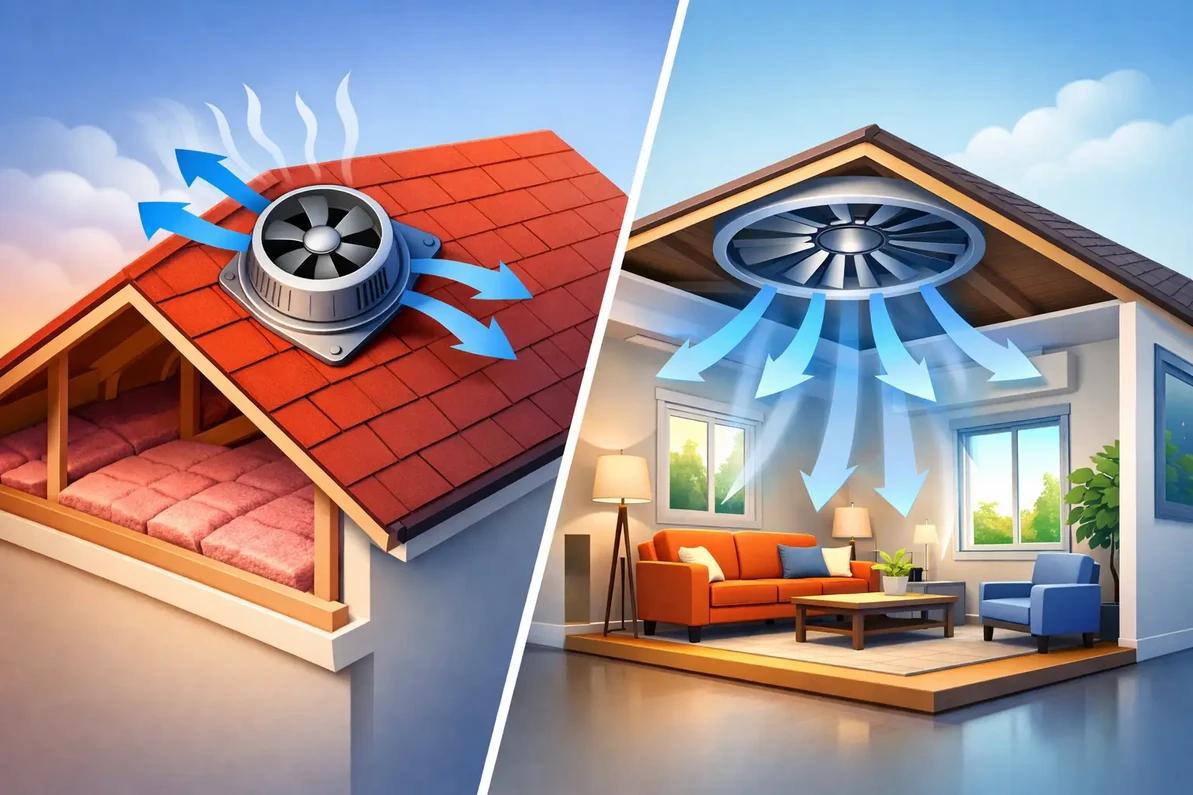
An attic fan is designed to ventilate the attic space. Its job is to remove superheated air from the attic and, depending on the design, pull replacement air in through soffit vents, gable vents, or other intake openings. It does not intentionally cool the occupied living space directly.
A whole house fan is designed to cool the living area by pulling air from open windows through the house and exhausting it into the attic, where that air then exits through attic venting. In plain terms, an attic fan treats the attic. A whole house fan treats the house first, then uses the attic as a path to discharge air outdoors.
That difference matters because many homeowners buy one expecting the performance of the other. If the goal is lower attic temperature and reduced heat load on insulation and ductwork, an attic fan may be the right tool. If the goal is to flush heat out of the home during cool mornings and evenings and reduce AC runtime, a whole house fan is typically the better match.
What an attic fan does well
Attic fans are most often used to reduce peak attic temperatures. In hot climates, attic air can climb well above outdoor ambient conditions, especially under dark roofing materials and limited passive vent area. That trapped heat radiates downward into the ceiling plane, warms ductwork, and increases the load on the air conditioning system.
A properly selected attic fan can help lower that heat buildup. It can also support moisture control when designed correctly, particularly in shoulder seasons when attic humidity becomes a problem. Roof-mount, gable-mount, solar attic fans, and hybrid models all exist, and each has application-specific advantages tied to roof geometry, vent area, weather exposure, and available power.
The trade-off is that attic fans are not a direct occupied-space cooling system. They may reduce the burden on the AC by lowering attic temperature, but they will not create the dramatic air changes inside the home that a whole house fan delivers. There is also a critical design issue: if attic intake venting is inadequate, the fan can pull conditioned air from the house through ceiling penetrations, recessed lights, attic hatches, and other leakage paths. That can work against efficiency rather than improve it.
What a whole house fan does well
A whole house fan is a high-airflow ventilation system, usually installed in the ceiling between the living space and attic. When outdoor conditions are cooler than indoor conditions, the fan pulls fresh air in through open windows and rapidly exhausts warm indoor air into the attic. The result is a fast whole-home air exchange that can cool framing, drywall, furnishings, and interior surfaces far more quickly than simply opening windows.
This is why homeowners often describe a whole house fan as delivering relief that feels immediate. Air movement is strong, stale heat is flushed out, and overnight cooling can reduce or delay the need for compressor-based air conditioning. In dry or mixed climates with cool evenings, whole house fans can provide substantial energy savings and a very noticeable comfort improvement.
The trade-off here is operating condition. A whole house fan is most effective when outdoor air is meaningfully cooler than indoor air. If the outside air is hot and humid late into the evening, the benefit narrows. The system also depends on adequate attic exhaust venting. If the attic cannot release the airflow the fan pushes into it, performance drops and pressure issues can develop.
Airflow, CFM, and why sizing is where mistakes happen
In the attic fan vs whole house fan comparison, CFM is not just a catalog number. It determines whether the fan can handle the application without excessive noise, poor performance, or wasted energy.
Attic fan sizing is generally tied to attic square footage, roof configuration, solar heat gain, insulation level, and existing passive vent area. More fan is not always better. Oversizing without enough intake venting can create negative pressure in the attic and increase the chance of drawing air from the conditioned envelope.
Whole house fan sizing is usually based on the living area and the desired air changes per hour or minute. Some homeowners want a gentle evening purge. Others want aggressive cooling with a strong breeze through open windows. Those are two different operating targets. A serious evaluation should account for home layout, ceiling height, number and placement of windows, attic free vent area, and sound expectations.
This is where technically minded homeowners and contractors can save themselves trouble by treating fan selection like an airflow design problem rather than a simple appliance purchase. Vent area, grille size, motor type, control strategy, and discharge path all matter.
Energy use and operating cost
If you compare motor wattage alone, both systems can look efficient relative to air conditioning. But they do not produce the same result, so the comparison has to be honest.
An attic fan can help reduce AC load indirectly by lowering attic heat. Its energy savings depend on how much attic heat was affecting the building in the first place. Homes with poorly insulated ducts in hot attics may see more measurable benefit than homes with sealed ducts, heavy insulation, and already effective passive ventilation.
A whole house fan can reduce AC runtime more directly because it cools the occupied space when outdoor conditions cooperate. In the right climate and with disciplined operation, it can offset evening and overnight compressor use in a meaningful way. But if windows are not opened properly, or if the fan is run during hot humid periods, the result may be disappointing.
Neither fan should be sold as a universal cure-all. Performance depends on climate, envelope leakage, venting, and how the home is actually used.
Installation and code-related considerations
Attic fans are generally simpler to understand but not always simpler to install well. Roof penetrations, flashing details, weather resistance, wiring, thermostat or humidistat controls, and structural placement all need attention. Gable fans may avoid roof penetration but require a suitable wall location and proper airflow path across the attic.
Whole house fans raise a different set of issues. The ceiling opening, attic access, control wiring, insulation strategy, and winter sealing all matter. Modern insulated damper systems have improved performance significantly compared with older loose-shutter designs, but product quality varies. Sound levels also vary widely depending on fan type, ducting approach, and installation quality.
Both systems should be evaluated with combustion safety in mind. Any device that changes pressure relationships in a home can affect atmospherically vented appliances. If a house has gas-fired equipment, fireplaces, or other combustion systems, pressure and backdrafting concerns should be assessed before installation.
Which one is better for your house?
If your main complaint is a superheated attic, hot upstairs ceilings, stressed ductwork, or roof-deck heat buildup, an attic fan may be the better fit. It is a targeted solution for attic ventilation, especially when paired with proper intake venting and realistic expectations.
If your main complaint is that the house holds heat into the evening and you want fast cooling with outside air, a whole house fan is usually the stronger option. It provides large-volume air exchange and can transform comfort during favorable outdoor conditions.
Some homes can justify both, but that is not automatic. In certain designs, a well-engineered whole house fan system with sufficient attic exhaust venting may already address the needed airflow path. In others, attic ventilation and whole-house ventilation serve separate operating goals. The right answer depends on the home, not on a generic rule.
The most common buying mistake
The biggest mistake is choosing based on product name rather than performance objective. Homeowners hear the word fan and assume all ventilation fans cool the house. Contractors sometimes inherit projects where a fan was installed without enough vent area, without pressure-path planning, or without any real load evaluation.
A better approach is to define the problem first. Are you trying to reduce attic heat, purge indoor heat, lower AC runtime, improve overnight comfort, or address all of the above? Once that is clear, the fan type, CFM range, venting requirements, and control package become much easier to match correctly.
Factory Fans Direct works with homeowners and installers who want that decision made on engineering logic, not guesswork. If you are comparing fan options, the best results usually come from looking at square footage, attic vent area, climate conditions, and airflow path before you buy.
The right fan is the one that solves the actual heat problem in your home without creating a new one in the process.
Factory Fans Direct - Whole House Fans Experts | Contact Mike Miller at Factory Fans Direct for a FREE Home Evaluation 888-849-1233 and a $50 discount Coupon and Live Support on the Centric Air Whole House Fans.
Recent Posts
-

AI Smart Buildings Incorporate Edmonds ecoPOWER Hybrid Turbine Ventilation
A building automation system can report rising rooftop temperatures, increasing indoor contaminants, …12th Sep 2026 -
Smart Buildings Architects Recommend Edmonds ecoPOWER Hybrid Ventilation
A rooftop ventilator should not force an all-or-nothing energy decision. Smart Buildings Architects …7th Sep 2026 -
Smart Industrial Buildings Use Edmonds ecoPOWER Hybrid Ventilation
A roof exhaust system can be the difference between a plant that controls heat at the source and one …7th Sep 2026