
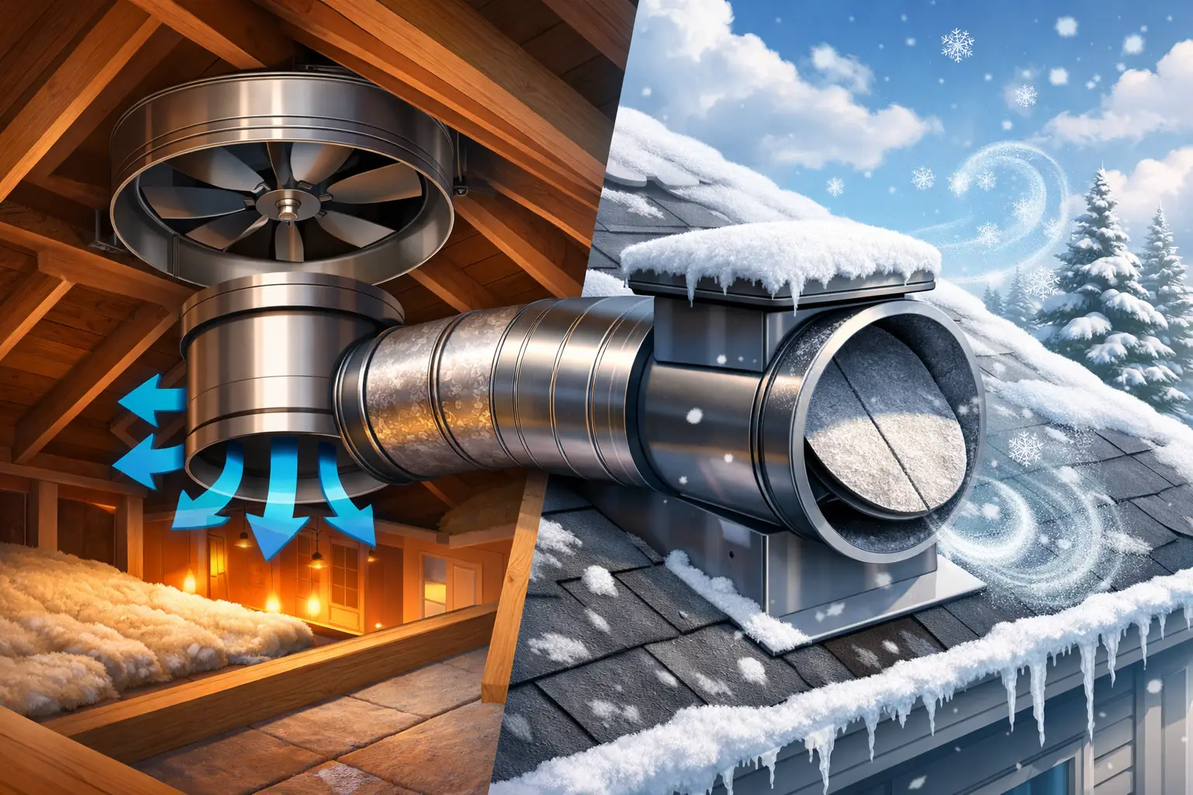
Are R50 Power Dampers Needed in Cold Weather Environments? | Whole House Fans
Cold-weather whole house fan installs fail for one simple reason more often than most homeowners expect - uncontrolled air leakage. If you are asking, Are R50 Power Dampers needed for Cold Weather Environments, the short answer is often yes in colder climates, especially where winter heat loss, attic backdraft, and comfort complaints matter.
An R50 power damper is not just an accessory. It is a control component designed to close off the ceiling opening when the whole house fan is not operating. In warm regions, a basic insulated door or gravity damper may be acceptable. In cold-weather applications, that same setup can become a weak point in the building envelope.
Why cold weather changes the answer
In a heating-dominated climate, every unsealed or poorly insulated opening between conditioned living space and the attic works against system efficiency. A whole house fan opening is larger than many other ceiling penetrations, so even small leakage around the shutter, box, or grille can translate into noticeable heat loss.
That is why the question, Are R50 Power Dampers needed for Cold Weather Environments, should be treated as a building-performance question, not just a fan accessory decision. If the home sees freezing temperatures, heavy furnace runtime, stack-effect pressure, or snow-season attic temperature swings, a high-R-value motorized closure can significantly reduce unwanted air movement.
The main benefit is not just insulation value on paper. It is the combination of insulation plus positive closure. That matters because cold-weather discomfort usually comes from both conductive heat transfer and air infiltration. An insulated damper with poor sealing still leaks. A tight-sealing damper with low insulation still allows heat transfer. The better R50 assemblies address both problems together.
When an R50 power damper is worth it
The strongest case for an R50 power damper is in northern and mixed climates where the home is heated for long periods of the year. It is also a smart choice in homes with finished ceilings below unconditioned attics, higher energy costs, or rooms where occupants are sensitive to drafts.
It becomes even more important when the whole house fan opening is large, the fan is centrally located over a hallway or stairwell, or the home already has pressure-related comfort issues. In those cases, winter stack effect can pull cold attic air through weakly sealed shutters even when the fan is off.
For homeowners and installers, the practical test is simple. If you would not leave an uninsulated ceiling hatch open all winter, you should not ignore the whole house fan opening either. The larger the opening, the more valuable a well-sealed insulated damper becomes.
Cases where it may not be strictly necessary
There are exceptions. In mild climates with very limited heating demand, an R50 power damper may be more of a premium upgrade than a requirement. The same is true in homes where the fan system already includes a well-engineered insulated door assembly with verified low leakage performance.
Budget also matters. If the project is balancing fan size, attic venting upgrades, electrical work, and controls, the damper decision may come down to lifecycle value. In colder regions, that value usually supports the upgrade. In warmer regions, the payback may be slower.
This is where a lot of online advice falls short. The right answer depends on climate zone, attic condition, ceiling construction, usage pattern, and the exact fan model being installed. A generic yes or no is not enough.
Performance issues an R50 power damper helps prevent
A properly selected R50 power damper can reduce winter heat loss, limit cold-air dumping from the attic, and improve occupant comfort in rooms below the fan. It may also help control condensation risk around the fan opening by reducing warm interior air leakage into a cold attic cavity.
That last point is often overlooked. In cold weather, warm moist indoor air escaping into attic spaces can contribute to condensation on cold framing or roof decking. While the whole ventilation system must be evaluated as a complete assembly, a tighter insulated closure is one part of preventing moisture migration.
Noise control can also improve. Many homeowners notice that powered insulated dampers provide a more substantial barrier than lightweight shutters, which can help reduce sound transfer between attic and living space.
The real decision is system matching
The better question is not only Are R50 Power Dampers needed for Cold Weather Environments. It is whether the fan, damper, attic ventilation, and ceiling opening have been matched correctly.
If the fan is oversized, attic venting is inadequate, or the installation leaves bypass gaps around the frame, even a high-quality damper will not fully solve comfort and efficiency problems. This is why professional evaluation matters. CFM, vent free area, attic static pressure, and climate exposure all influence final performance.
For contractors, architects, and technically minded homeowners, the specification should focus on more than advertised R-value. Review the closing method, seal design, motorized operation, control integration, and installed assembly details. Field performance depends on installation quality as much as product rating.
In most cold-weather whole house fan applications, an R50 power damper is a justified upgrade and, in many homes, the right engineering choice. It protects the thermal boundary, improves comfort, and helps the fan system perform like a seasonal ventilation tool instead of a year-round energy penalty.
Factory Fans Direct - Whole House Fans Experts | Contact Mike Miller at Factory Fans Direct for a FREE Home Evaluation 888-849-1233 and a $50 discount Coupon and Live Support on the Centric Air Whole House Fans.
Recent Posts
-

AI Smart Buildings Incorporate Edmonds ecoPOWER Hybrid Turbine Ventilation
A building automation system can report rising rooftop temperatures, increasing indoor contaminants, …12th Sep 2026 -
Smart Buildings Architects Recommend Edmonds ecoPOWER Hybrid Ventilation
A rooftop ventilator should not force an all-or-nothing energy decision. Smart Buildings Architects …7th Sep 2026 -
Smart Industrial Buildings Use Edmonds ecoPOWER Hybrid Ventilation
A roof exhaust system can be the difference between a plant that controls heat at the source and one …7th Sep 2026