
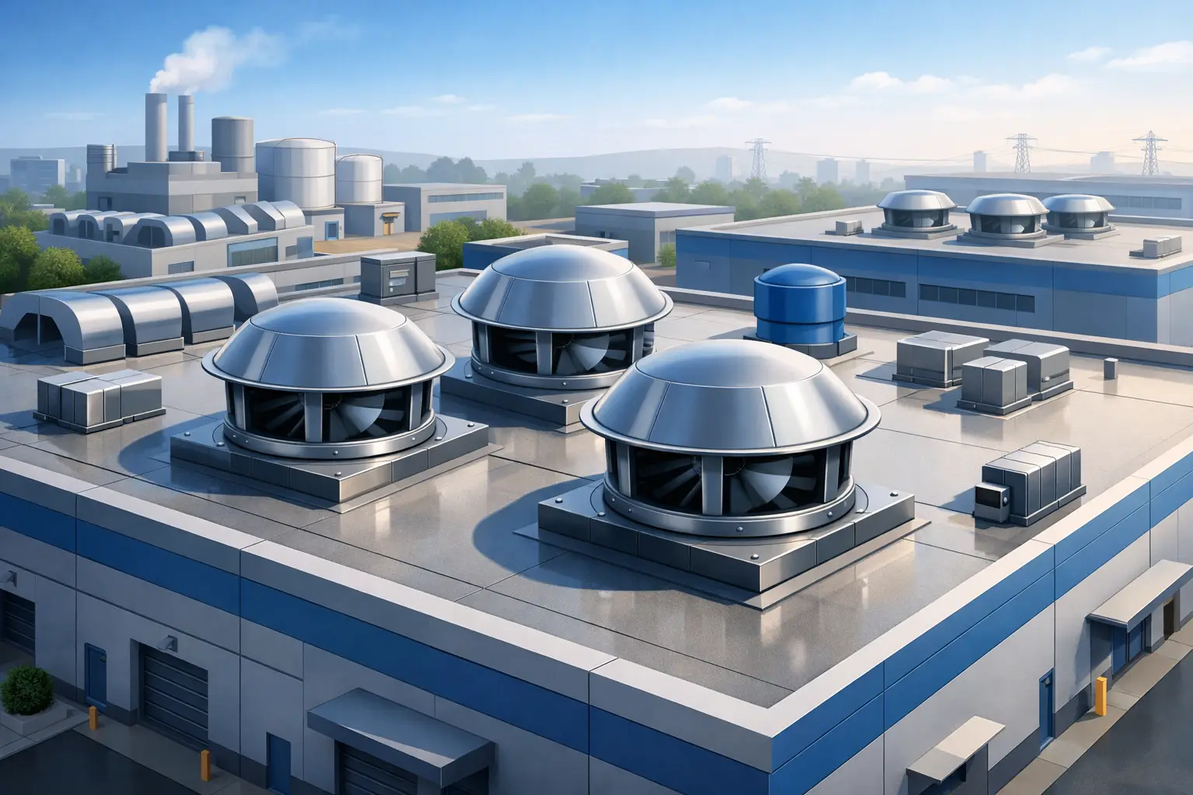
Aerovent Exhaust Fans for Industrial Buildings
A fan that moves the right CFM on a catalog page can still underperform once it is connected to louvers, ductwork, hoods, filters, and a building under negative pressure. Aerovent Exhaust Fans for Industrial Building applications should be selected as part of an air-moving system, not as an isolated piece of equipment. That distinction affects worker comfort, heat removal, contaminant capture, energy consumption, and the service life of the fan motor.
Start With the Actual Airflow Problem
Industrial exhaust is usually tasked with one or more jobs: removing process heat, clearing welding fumes or dust, controlling odors, exhausting moisture, or maintaining a target air-change rate. These requirements are related, but they are not interchangeable. A warehouse with hot roof-level air needs a different strategy than a manufacturing line generating localized smoke or a room containing heat-producing equipment.
Start with the heat load, contaminant source, room volume, operating schedule, and available intake area. For general heat removal, the required airflow depends on the temperature difference you can accept between indoor and outdoor air. For source capture, hood geometry, capture velocity, duct velocity, and the contaminant itself become primary design inputs. An exhaust fan cannot compensate for a poorly designed capture point located too far from the process.
Aerovent Exhaust Fans for Industrial Buildings: Read the Fan Curve
CFM is only half of the selection. The other half is static pressure. Every restriction in the exhaust path adds resistance: guards, shutters, bird screens, louvers, duct elbows, transitions, dampers, filters, roof curbs, and discharge caps all matter. A fan rated for high free-air airflow may deliver far less air at the static pressure of the installed system.
Fan curve review identifies where the operating point falls at the required CFM and static pressure. It also helps verify brake horsepower, motor sizing, sound levels, and whether the fan is operating in a stable portion of its curve. Selecting near the edge of a curve can create inconsistent airflow, elevated noise, or a system that loses performance as filters load.
For ducted industrial exhaust, centrifugal and mixed-flow arrangements are often considered when pressure is significant. Propeller and axial fans can be effective for high-volume, low-static wall or roof exhaust applications. The correct configuration depends on the resistance of the system, discharge requirements, available mounting location, and the air stream being handled.
Do Not Exhaust Air Without Planning for Replacement Air
A common field issue is a powerful exhaust fan paired with inadequate makeup air. As the building depressurizes, airflow drops and doors become difficult to open. Combustion appliances can be affected, conditioned air may be pulled through unplanned openings, and the fan may never reach its intended operating point.
Makeup air should be sized and located to support the exhaust path. In hot facilities, it may be introduced at lower elevations so incoming air sweeps through occupied or process areas before rising toward roof exhaust. In colder climates, untempered makeup air can create comfort and freeze-protection concerns. A dedicated makeup air unit, controlled intake louvers, or a balanced supply-and-exhaust strategy may be necessary.
Match Materials and Construction to the Air Stream
Not every industrial air stream is ordinary building air. Moisture, fertilizer residue, chemicals, salt exposure, grease, abrasive dust, and elevated temperatures can shorten the life of standard components. The wheel, housing, shaft, bearings, coatings, fasteners, belts, and motor enclosure should be evaluated for the actual environment.
If the exhaust stream is combustible, corrosive, greasy, or hazardous, the design may require specialized equipment and code review. Spark-resistant construction, explosion-proof electrical components, grease-rated equipment, or corrosion-resistant materials are application-specific decisions. They should not be assumed from the fan nameplate alone.
Controls Protect Performance and Operating Cost
A fan that runs at one speed around the clock is simple, but it is not always the best operating strategy. Variable frequency drives can reduce airflow during light-load periods, stage ventilation as temperature rises, and support pressure control. This can lower energy use and reduce unnecessary conditioned-air loss.
Controls must still respect the motor, fan curve, and application limits. Very low speed can reduce cooling airflow around some motors or create poor system response. For process exhaust, control logic should prioritize safety and capture performance over energy savings. Interlocks with equipment operation, door switches, thermostats, pressure sensors, and building automation systems should be planned before installation.
Specify the Installation Details Before Ordering
The fan is only one line item in the project. Confirm roof curb dimensions, wall opening size, mounting orientation, electrical voltage and phase, disconnect requirements, access for service, weather protection, and discharge clearances. For roof-mounted exhaust, verify structural support, curb compatibility, and whether backdraft dampers or motorized dampers are needed.
Call are team at 888-849-1233 before an undersized intake or overlooked pressure loss turns a fan purchase into a ventilation problem. Factory Fans Direct National Aerovent Distributor
Factory Fans Direct - Commercial & Industrial Ventilation & Cooling Experts | Contact Mike Miller VP Engineering at Factory Fans Direct for a FREE Project Evaluation 888-849-1233 | Mike@FactoryFansDirect.com
Recent Posts
-

Smart Buildings Architects Recommend Edmonds ecoPOWER Hybrid Ventilation
A rooftop ventilator should not force an all-or-nothing energy decision. Smart Buildings Architects …7th Sep 2026 -
Smart Industrial Buildings Use Edmonds ecoPOWER Hybrid Ventilation
A roof exhaust system can be the difference between a plant that controls heat at the source and one …7th Sep 2026 -
Smart Commercial Buildings Use Edmonds Hybrid Ventilation
A rooftop exhaust fan that only performs when the wind blows is not a complete ventilation strategy. …7th Sep 2026