Will AI Change LEED and Net-Zero Ventilation Specifications?
A ventilation schedule can look efficient on paper and still waste energy every operating hour. Exhaust fans selected for peak design conditions may run at fixed speed through mild weather, changing occupancy, varying process loads, and low-demand night shifts. That gap between design intent and actual operation is where the question, Will AI change LEED and Net-Zero Ventilation Specifications, becomes practical rather than theoretical.
For architects, engineers, facility managers, and project owners, AI is unlikely to replace the core airflow, indoor air quality, and code requirements behind a ventilation design. It will, however, change how teams define controls, verify performance, document energy use, and select equipment that can respond to real conditions instead of a single design-day assumption.
AI Will Change How Ventilation Performance Is Specified
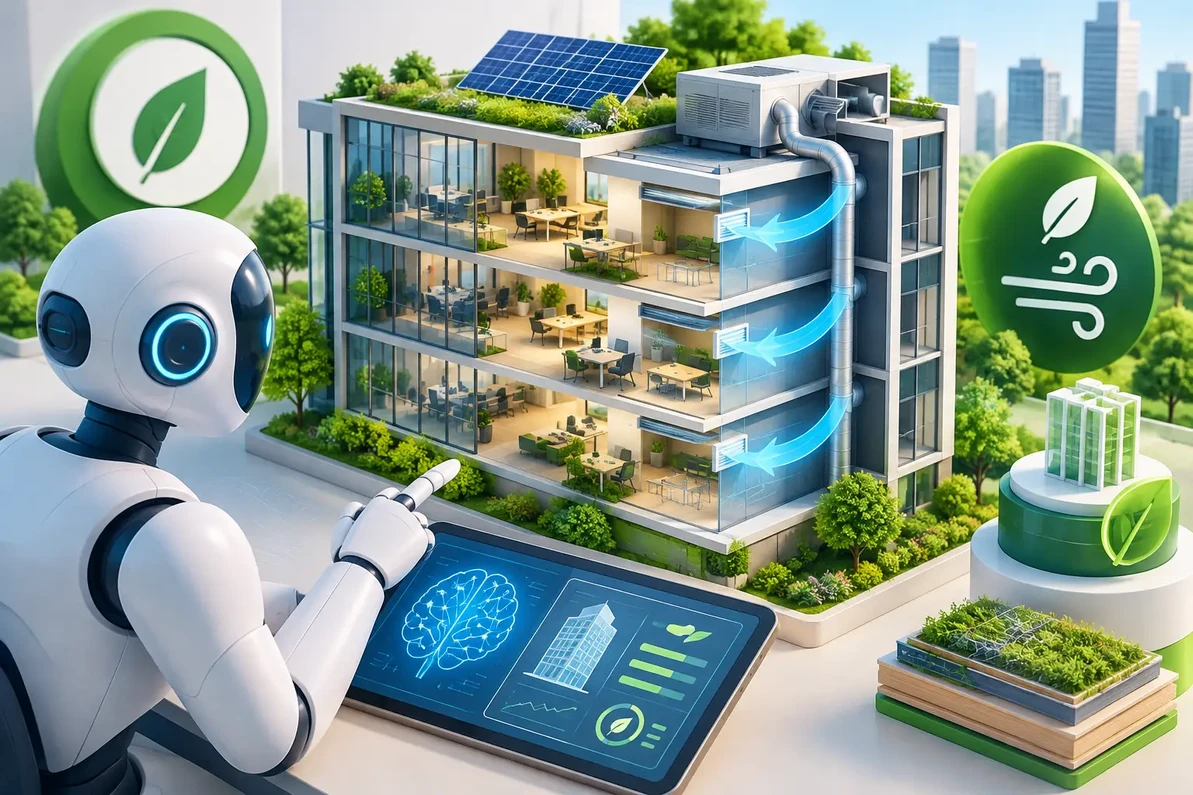
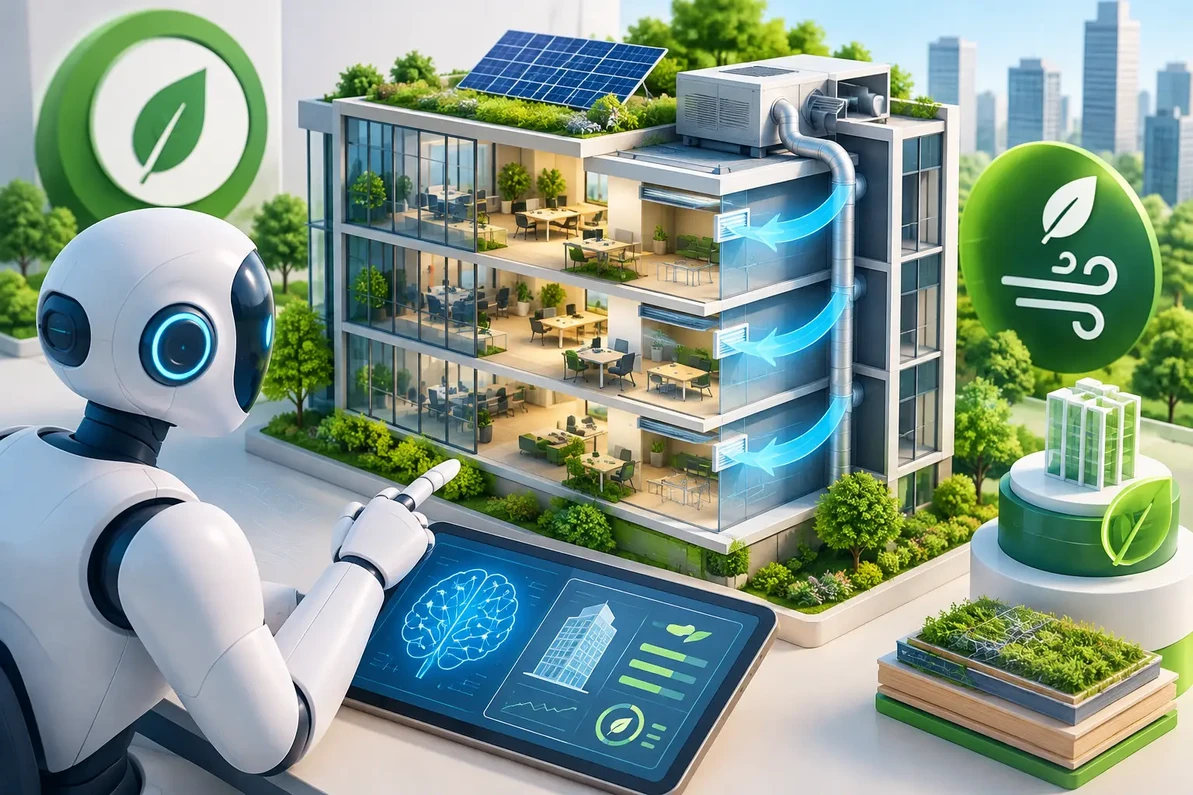
LEED and Net-Zero projects already push designers toward lower fan energy, controlled outside air, demand-based operation, energy recovery where appropriate, and measurable building performance. AI adds another layer: the system can use data from sensors, weather forecasts, building schedules, utility pricing, production activity, and equipment status to continuously improve its operating decisions.
A conventional specification might call for a roof exhaust fan with a stated CFM, static-pressure capability, motor efficiency, VFD, and a basic control sequence. An AI-ready specification should go further. It should define the required points of measurement, acceptable sensor accuracy, control priorities, trend-data retention, fault alarms, and the conditions under which a fan must override automated optimization.
That distinction matters. AI cannot correct an undersized fan, excessive duct static pressure, poor make-up air design, or an exhaust path blocked by poor roof placement. Good engineering remains the starting point. The AI layer can then reduce unnecessary fan runtime, tune airflow to actual load, identify a drifting damper, or flag a motor drawing more power than its normal operating profile.
From Design CFM to Operating CFM
The most meaningful shift may be a move from static equipment schedules to operating-performance specifications. Instead of only stating that a system must deliver 20,000 CFM at a particular static pressure, owners may require documentation showing how airflow is maintained across seasonal conditions, occupancy changes, and varying process heat loads.
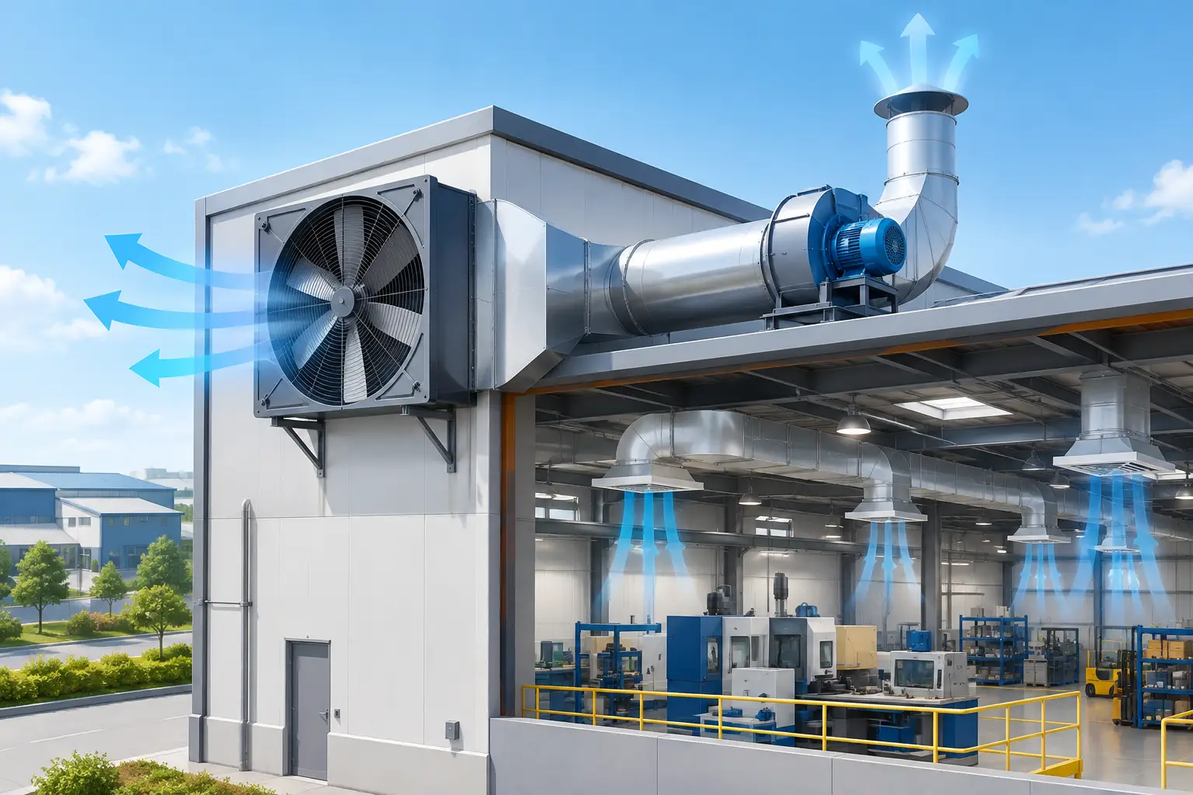
For a warehouse, that can mean adjusting exhaust and make-up air based on indoor temperature, roof heat gain, dock-door activity, and employee zones. In a manufacturing plant, it can mean balancing process exhaust with conditioned replacement air so negative pressure does not pull dust, humidity, or unconditioned outside air through every available opening.
For data centers and crypto mining facilities, the control problem is even more immediate. Heat load can shift quickly with compute activity, rack density, curtailment events, immersion cooling support requirements, and outdoor air conditions. AI-assisted controls can compare inlet and discharge temperatures, fan speed, pressure differential, and power draw to select an operating point that protects equipment without running every fan at maximum speed.
LEED Credits Will Still Need Verifiable Evidence
AI does not create a LEED point by itself. Project teams still need to meet the applicable rating-system requirements, provide calculations and documentation, and commission the installed systems. What AI can improve is the quality and continuity of operating evidence after occupancy.
Ventilation-related LEED strategies commonly depend on energy performance, indoor environmental quality, enhanced commissioning, advanced energy metering, and ongoing optimization. A well-designed AI control platform can support those goals by collecting trend data, detecting faults early, and comparing actual performance against established baselines.
But there is a trade-off. More data is useful only when the data is reliable. A carbon dioxide sensor that drifts, a failed temperature probe, or an improperly located pressure sensor can cause an AI model to make poor decisions with impressive-looking dashboards. Specifications should require sensor calibration procedures, accessible maintenance points, manual control capability, and clear responsibility for reviewing exceptions.
The best approach is not to specify "AI controls" as a vague feature. Specify what the controls must accomplish: maintain required ventilation rates, preserve building pressure targets, limit fan energy, provide alarms for abnormal airflow or temperature conditions, and produce exportable data for commissioning and operations teams.
Net-Zero Ventilation Needs a Different Equipment Conversation
Net-Zero ventilation is not simply the lowest-watt fan on a cut sheet. It is a system-level result that includes airflow path, operating hours, motor efficiency, controls, building envelope, replacement-air strategy, and the source of the electrical energy used over the year.
AI can improve the control side of that equation by reducing avoidable runtime and avoiding simultaneous heating, cooling, and excessive exhaust. It may also help facilities shift noncritical ventilation loads around utility demand peaks when indoor air quality and process conditions allow. That can lower operating cost and reduce demand stress, even when annual energy use changes only modestly.
Equipment selection still carries equal weight. EC motors, variable-speed control, low-static airflow paths, properly sized dampers, and stable fan curves give any advanced controller something useful to work with. A fixed-speed fan selected with no control margin gives the software very few options.
Hybrid ventilation can also become more relevant in Net-Zero specifications. The Edmonds ecoPOWER Hybrid Rooftop Exhaust Fan uses a high-performance EC brushless DC motor for continuous controlled operation while also operating by wind when conditions permit. It is a true hybrid ventilator that combines powered and non-powered wind operation. It is not a solar-powered turbine. For suitable applications, that operating model can reduce electrical fan use while maintaining a defined mechanical ventilation capability when natural wind energy is not enough.
Where AI Has Limits
AI is not a substitute for minimum code ventilation rates, source-capture requirements, or life-safety exhaust design. Commercial kitchens, hazardous processes, battery rooms, dust collection, chemical storage, and high-heat industrial areas require defined engineering controls and, in many cases, fail-safe operating modes.
Specifications must clearly establish the hierarchy. Life safety, contaminant control, equipment protection, and code compliance come first. Energy optimization comes after those requirements are satisfied. If sensor data is unavailable, communications fail, or the AI platform is offline, the ventilation system needs a safe fallback sequence that operators understand.
Cybersecurity and ownership of operational data also need attention. Networked controllers should be segmented appropriately, remote access should be controlled, and the owner should retain access to the trend data needed to operate and maintain the facility. A proprietary black box that cannot explain why it changed a fan command is difficult to commission and even harder to troubleshoot.
What to Put in an AI-Ready Ventilation Specification
A practical AI-ready specification starts with conventional engineering information: required CFM, external static pressure, fan curve, motor type, power supply, sound limits, materials of construction, weather protection, and make-up air requirements. Then it adds operational requirements that make intelligent control measurable rather than promotional.
The controls section should identify the sensors and required locations, including temperature, humidity when relevant, carbon dioxide or other IAQ measurements, pressure differential, fan status, VFD speed, and power consumption. It should state how often data is sampled, how long records are retained, and which alarms require operator notification.
It should also require a written sequence of operation that describes normal mode, reduced-load mode, peak-load mode, maintenance mode, emergency override, and communications-loss mode. For facilities with variable occupancy or thermal loads, require functional performance testing across more than one operating condition. Testing only at startup does not prove that a system will manage a hot afternoon, a cold morning, or a high-production shift.
Finally, require a handoff process. The contractor, controls provider, commissioning authority, and facilities team need agreement on setpoints, override authority, calibration intervals, and who responds when the dashboard identifies a fault. AI can identify a problem quickly, but it cannot climb onto the roof, inspect a belt, clear a blocked louver, or correct an installation error.
The Real Change Is Accountability After Startup
The biggest impact of AI on LEED and Net-Zero ventilation specifications will be accountability. Owners will increasingly expect ventilation systems to demonstrate how they perform after installation, not just how they were modeled during design.
That expectation is healthy for the industry. It rewards proper fan selection, accurate static-pressure calculations, effective make-up air, controllable EC and VFD equipment, and commissioning that goes beyond checking rotation and airflow direction. It also exposes poorly designed systems sooner, before high utility bills, hot work zones, humidity issues, or equipment failures become accepted as normal.
AI will not eliminate the need for ventilation design engineering. It will make the quality of that engineering more visible every day the building operates.
Factory Fans Direct/Edmonds US provides commercial and industrial ventilation evaluation for projects involving roof exhaust, hybrid ventilation, make-up air, warehouse heat relief, manufacturing airflow, and energy-focused controls. Bring the building dimensions, heat sources, roof plan, and operating schedule to the conversation - those details turn a rooftop ventilator selection into a ventilation system that can be measured and managed.
Factory Fans Direct/Edmonds US - Hybrid Commercial & Industrial Ventilation & Cooling Experts | Contact Mike Miller VP Engineering at Factory Fans Direct for a FREE Project Evaluation 888-849-1233 | Mike@FactoryFansDirect.com
Recent Posts
-

How AI Will Optimize HPC Data Center Operations
A high-performance computing facility can add megawatts of load faster than its cooling infrastructu …22nd Nov 2026 -
Will AI Change LEED and Net-Zero Ventilation Specifications?
A ventilation schedule can look efficient on paper and still waste energy every operating hour. Exha …22nd Nov 2026 -
Industrial Exhaust Fans & Industrial Ventilation Systems
A 100,000-square-foot warehouse can have plenty of fans and still trap heat at the ceiling, fumes at …21st Nov 2026