Industrial Exhaust Fans & Industrial Ventilation Systems
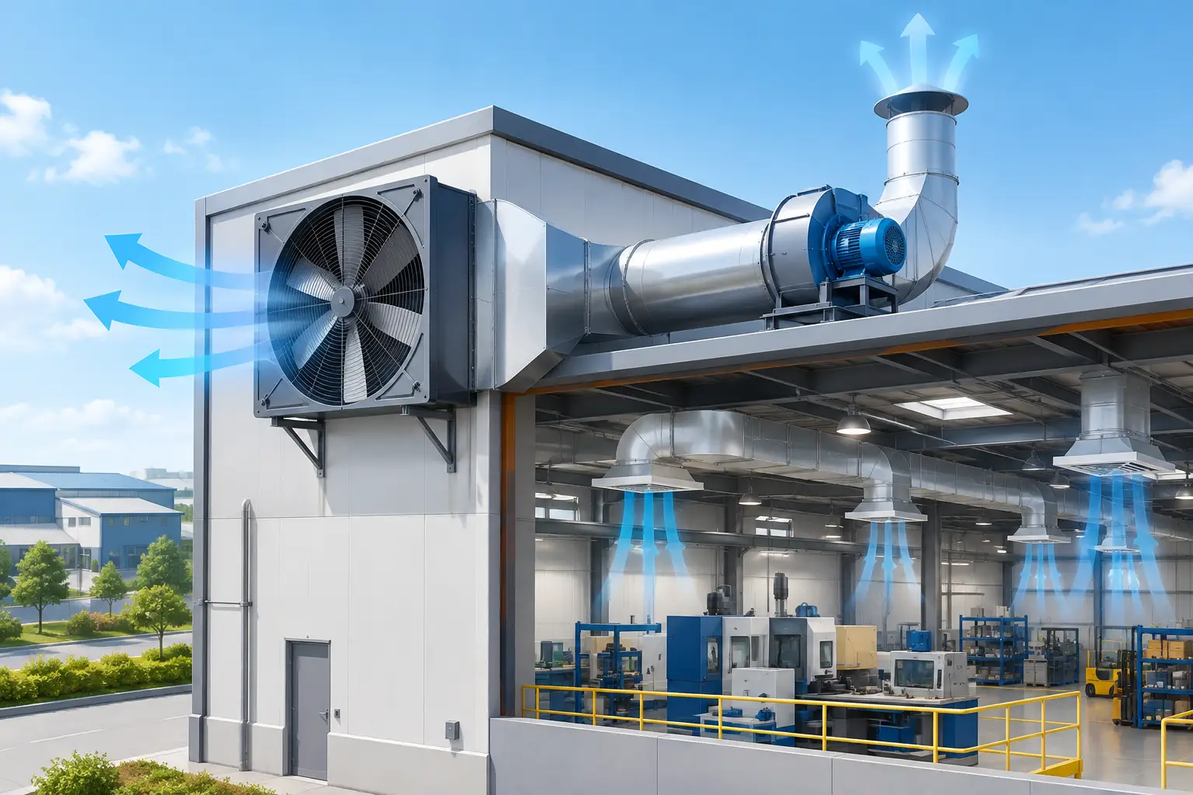
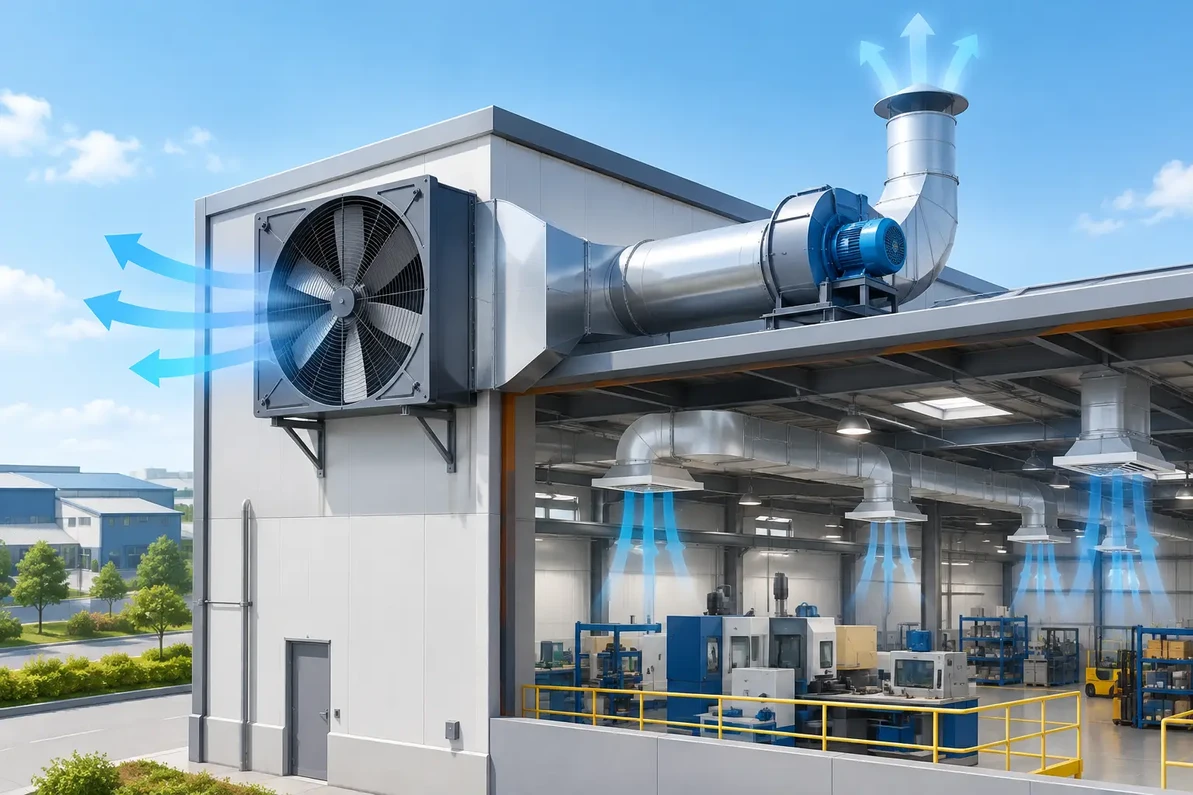
A 100,000-square-foot warehouse can have plenty of fans and still trap heat at the ceiling, fumes at the process line, and stale air in loading areas. Industrial Exhaust Fans & Industrial Ventilation Systems must be engineered as a coordinated airflow path, not purchased as individual pieces of equipment. The right system removes the actual heat, moisture, contaminants, or airborne particles generated in the building while providing a controlled path for replacement air.
For plant managers, contractors, engineers, and facility owners, the cost of getting this wrong shows up quickly: hot work zones, equipment derating, employee discomfort, condensation, uncontrolled dust migration, negative building pressure, and high electrical demand. Fan selection is only one part of the decision. Air volume, static pressure, intake strategy, discharge location, controls, and operating schedule determine whether the installation performs as specified.
Start With the Air Problem, Not the Fan
The first engineering question is simple: what must the ventilation system accomplish? General heat relief in a warehouse is different from source capture at a welding station. A packaging area may need air changes to dilute heat and odors, while a chemical process may require dedicated capture hoods, corrosion-resistant construction, and carefully designed duct velocity.
Heat-driven applications should begin with the sensible heat load. This includes process machinery, ovens, compressors, lighting, solar gain through the roof, forklift activity, and people. A high-CFM exhaust fan can move a great deal of air, but it cannot cool a space below the temperature of the incoming outdoor air unless it is paired with a cooling strategy. In many facilities, exhaust ventilation is most effective when it is used to purge accumulated heat during favorable outdoor conditions or to remove heat at its source before it spreads across the building.
Contaminant control requires more precision. Dust, vapor, smoke, mist, and fumes should be captured as close as possible to the generation point. Trying to dilute contaminants with large roof exhaust fans after they have spread through a work area is usually less effective and can require far more airflow. The process, material safety requirements, hood geometry, duct routing, and discharge point all matter.
Air Changes Are a Starting Point, Not a Design
Air changes per hour can provide an early estimate for general ventilation. Multiply the building volume by the desired air changes per hour, then divide by 60 to estimate required CFM. That calculation is useful for preliminary budgeting, but it does not account for a hot process line, a blocked intake path, duct losses, or the fact that heat rises and may remain stratified.
A better evaluation combines building volume with the real load profile. Ask where heat is generated, when it peaks, where workers are located, and whether the facility operates continuously. A distribution center with open dock doors may need a different approach than a sealed production building running three shifts. The required CFM may be similar on paper, yet the equipment layout and control sequence can be completely different.
Static Pressure Decides Whether Rated CFM Is Real
Every fan has an airflow curve. The published CFM is not a universal number. It is tied to a specific static pressure. A propeller exhaust fan moving free air through a wall opening may deliver strong airflow at low resistance. Add a louver, bird screen, backdraft damper, ductwork, elbows, filters, or a discharge cap, and system resistance increases.
At that point, the fan must be selected against the system curve. If the fan cannot overcome the static pressure, delivered airflow falls below the target. This is one of the most common causes of underperforming ventilation installations.
For low-static applications, belt-drive or direct-drive propeller fans can be cost-effective and provide large volumes of air. For ducted exhaust, high-pressure process ventilation, filtration, or complex intake and discharge paths, a centrifugal fan or mixed-flow design may be the better technical choice. The trade-off is usually higher first cost, more power demand, or greater maintenance requirements, but the system can deliver the needed CFM under resistance.
Do not assume a larger motor solves an airflow problem. Motor horsepower must match the brake horsepower required at the selected operating point. Oversizing without checking the fan curve can waste energy, increase noise, and still leave the building short of airflow if the wheel and housing are wrong for the application.
Exhaust Air Has to Be Replaced
An exhaust fan cannot continuously remove 30,000 CFM from a building unless roughly the same volume can enter. Make-up air is not an accessory. It is the other half of the ventilation system.
Without adequate intake area or powered make-up air, the building goes negative. Doors become difficult to open, combustion appliances may backdraft, unconditioned air enters through unintended cracks, and fan performance declines. In cold climates, uncontrolled infiltration can make work zones uncomfortable and raise heating costs. In hot, humid climates, it can bring in moisture that affects products, equipment, and indoor conditions.
Natural make-up air through wall louvers can work well when outdoor conditions and building use support it. The intake area must be large enough to keep velocity and pressure drop reasonable. Powered make-up air units are often appropriate where air must be tempered, filtered, distributed to a specific zone, or maintained at a controlled building pressure.
The placement matters as much as the quantity. Bringing replacement air in near the workers and exhausting it directly overhead can create short-circuiting, where air exits before it sweeps the heat or contaminants from the work zone. A proper design establishes a deliberate path from clean-air entry to contaminated-air discharge.
Select Equipment for the Environment
Industrial ventilation equipment lives in conditions that can quickly expose weak component choices. A fan installed above a foundry line faces a different duty cycle than one serving a climate-controlled assembly floor. Ambient temperature, airborne grease, corrosive vapors, moisture, dust loading, winter operation, and access for service should be specified before selecting the equipment.
For roof-mounted systems, curb dimensions, roof loading, weather protection, service access, and discharge clearance require attention. Backdraft dampers help limit unwanted reverse airflow when equipment is off, but damper pressure drop must be included in the static-pressure calculation. In cold-weather applications, insulated dampers or motorized dampers may be needed to reduce heat loss and prevent uncontrolled infiltration.
Facilities pursuing lower energy use should evaluate EC motors, variable frequency drives, staged controls, and demand-based operation. A VFD can reduce speed during lower-load periods, and fan power drops sharply as speed is reduced. However, the controls must be commissioned correctly. A fan that is permanently operated at a low speed because no one verified airflow may not meet the ventilation requirement.
For rooftop ventilation, the Edmonds ecoPOWER Hybrid ventilator offers a distinct operating approach. It uses a high-performance EC brushless DC motor for continuous powered operation and also uses wind-driven operation when conditions allow. It is a true hybrid ventilator, not a solar-powered turbine. This configuration can support LEED and Net-Zero project goals when the equipment is correctly matched to the building and operating conditions.
Use Controls to Match Real Operating Conditions
Fixed-speed exhaust is sometimes the right answer, particularly where a process requires constant capture velocity. Many industrial buildings, however, experience variable loads. Heat output changes with production schedules, outdoor temperature, occupancy, and equipment operation. Controls allow ventilation capacity to follow those conditions rather than operating at full output all day.
Temperature sensors can stage roof exhaust and make-up air for general heat relief. Differential temperature control can prevent a system from operating when outdoor air will not provide a useful benefit. Pressure sensors can maintain a target building pressure, while VFDs adjust fan speed as filters load or process conditions change. In data centers, crypto mining operations, specialty cultivation, and high-density equipment rooms, sensors and AI-enabled controls can support faster responses to thermal changes, but the control platform cannot compensate for undersized ducts, poor intake design, or insufficient fan capacity.
Controls should also include practical safeguards: motor overload protection, proof of airflow where required, damper interlocks, alarm points, and a manual override for maintenance or emergency conditions. Commissioning should verify actual amperage, rotation, pressure, airflow, and control response at startup.
Avoid the Common Design Shortcuts
Several shortcuts repeatedly create expensive corrections after installation. Selecting fans by opening size instead of the operating static pressure is one. Assuming roof exhaust alone will cool a large building is another. So is locating intake louvers wherever wall space is available without considering airflow paths, loading docks, nearby exhaust discharge, or wind exposure.
Maintenance deserves equal attention. Grease, dust, and corrosion reduce performance over time. Belts need inspection and tension adjustment. Dampers can bind. Screens can load with debris. Specify access so maintenance personnel can safely service the equipment, and establish a schedule that reflects the actual environment rather than a generic annual check.
The best industrial ventilation design is not necessarily the fan with the highest published CFM or the lowest initial price. It is the system that delivers required airflow at the installed static pressure, replaces exhausted air correctly, meets the environmental duty, and can be controlled and maintained over its service life.
Factory Fans Direct provides commercial and industrial ventilation guidance backed by more than 50 years of engineering experience. Before equipment is ordered, a free project evaluation can identify the right CFM, fan type, intake strategy, controls, and operating point for the facility. Contact Mike Miller, VP Engineering, at 888-849-1233 or Mike@FactoryFansDirect.com for a FREE Project Evaluation.
Factory Fans Direct - Commercial & Industrial Ventilation & Cooling Experts | Contact Mike Miller VP Engineering at Factory Fans Direct for a FREE Project Evaluation 888-849-1233 | Mike@FactoryFansDirect.com
Recent Posts
-

How AI Will Optimize HPC Data Center Operations
A high-performance computing facility can add megawatts of load faster than its cooling infrastructu …22nd Nov 2026 -
Will AI Change LEED and Net-Zero Ventilation Specifications?
A ventilation schedule can look efficient on paper and still waste energy every operating hour. Exha …22nd Nov 2026 -
Industrial Exhaust Fans & Industrial Ventilation Systems
A 100,000-square-foot warehouse can have plenty of fans and still trap heat at the ceiling, fumes at …21st Nov 2026