Stop Guessing on Airflow: Custom-Engineered Warehouse Cooling & Exhaust
A warehouse that feels 15 degrees hotter at the loading docks than it does near the office is not suffering from a fan shortage. It is suffering from an airflow design problem. Stop Guessing on Airflow: Custom-Engineered Warehouse Cooling & Exhaust starts with the conditions that actually drive performance: heat load, building geometry, air path, static pressure, and replacement air.
Adding large fans without calculating where heat is generated, where it collects, and how exhausted air will be replaced can create expensive disappointment. Equipment may move plenty of air on paper while leaving mezzanines, packaging lines, welding areas, and dock zones uncomfortable. Worse, an oversized exhaust package without adequate make-up air can pull doors open, disrupt combustion equipment, and reduce actual fan output.
Factory Fans Direct approaches warehouse ventilation as an engineering application, not a catalog-selection exercise. The right system is based on the facility's operating conditions and a practical review of what must be solved.
Why Warehouse Airflow Cannot Be Sized by Square Footage Alone
Square footage is useful for an initial conversation, but it is not enough to specify cooling or exhaust equipment. Two 100,000-square-foot warehouses can have radically different ventilation requirements. One may store finished goods with moderate occupancy. The other may run forklifts continuously, operate shrink-wrap lines, receive afternoon solar gain through dock doors, and hold process heat under a 36-foot roof deck.
A proper review considers building volume, ceiling height, insulation level, roof construction, local design temperatures, occupancy, equipment loads, process heat, and the hours when discomfort or heat alarms occur. It also considers whether the goal is employee comfort, contaminant removal, equipment protection, humidity control, code compliance, or all of the above.
Air changes per hour can be a starting point for general ventilation, but it is not a complete design method. Heat-producing operations often require a heat-load calculation. Localized welding fumes, battery charging gases, or process vapors may require source capture or dedicated exhaust rather than a general roof fan. A warehouse with truck traffic and open loading bays has a different air balance than a sealed fulfillment center.
The question is not simply, "How many CFM do we need?" The better question is, "What air must move, from where, to where, under what resistance, and with what replacement air?"
The Airflow Data That Determines a Working Design
Custom-engineered warehouse cooling and exhaust begins with field information. This does not always require a lengthy engineering study, but it does require better inputs than a building address and a preferred fan diameter.
Heat Load and Temperature Stratification
Every motor, compressor, conveyor drive, lighting fixture, charger, server rack, oven, and employee adds heat. Solar gain can be equally significant in facilities with dark roofing, uninsulated walls, skylights, or large west-facing doors. Heat rises until it encounters the roof deck, where it can form a high-temperature layer that radiates downward and raises the load on the occupied zone.
Destratification fans, HVLS fans, roof exhaust, and powered supply air can all help, but they serve different purposes. HVLS fans create air movement at floor level for improved perceived comfort. Destratification fans mix trapped ceiling heat downward during heating season and can reduce vertical temperature differences. Exhaust systems remove hot air from the building. These are not interchangeable solutions.
For example, a large HVLS fan may make a pick area feel better, but it will not remove process heat from a hot production zone unless an exhaust and make-up-air path are in place. Conversely, a roof exhaust fan may remove high-level heat effectively but provide little employee comfort if the occupied zone has no air movement.
Static Pressure and the Real CFM at the Fan
A fan's published CFM rating is meaningful only when matched to the system's static pressure. Louvers, bird screens, dampers, ductwork, bends, backdraft shutters, filters, light traps, and discharge caps all add resistance. A fan selected at free air may deliver far less airflow once installed.
This is especially critical for ducted exhaust, filtered make-up air, paint and finishing areas, battery rooms, and facilities where exterior wall openings are limited. Fan curves, motor horsepower, drive arrangement, and control strategy must be reviewed against the expected static pressure. A direct-drive fan may be an efficient fit for one installation, while a belt-drive unit with higher pressure capability is needed for another.
Ignoring static pressure is one of the fastest ways to install a system that is loud, underperforming, and difficult to correct after the roof penetrations are already cut.
Make-Up Air Is Not Optional
Every exhausted cubic foot of air must come from somewhere. If replacement air is not deliberately planned, the building will find it through cracks, door gaps, dock openings, and unintended pathways. That can bring in dust, humidity, unconditioned outdoor air, or cold winter drafts exactly where they are least welcome.
For moderate-temperature applications, properly sized intake louvers and controlled wall openings may be enough. For production spaces, conditioned facilities, or high exhaust volumes, a powered make-up-air unit may be necessary. Tempered make-up air can be justified when uncontrolled winter air would affect workers, product quality, freeze protection, or process stability.
The trade-off is capital cost and energy use. However, skipping make-up air to save upfront cost can reduce exhaust performance and increase operational complaints for years.
Selecting the Right Cooling and Exhaust Strategy
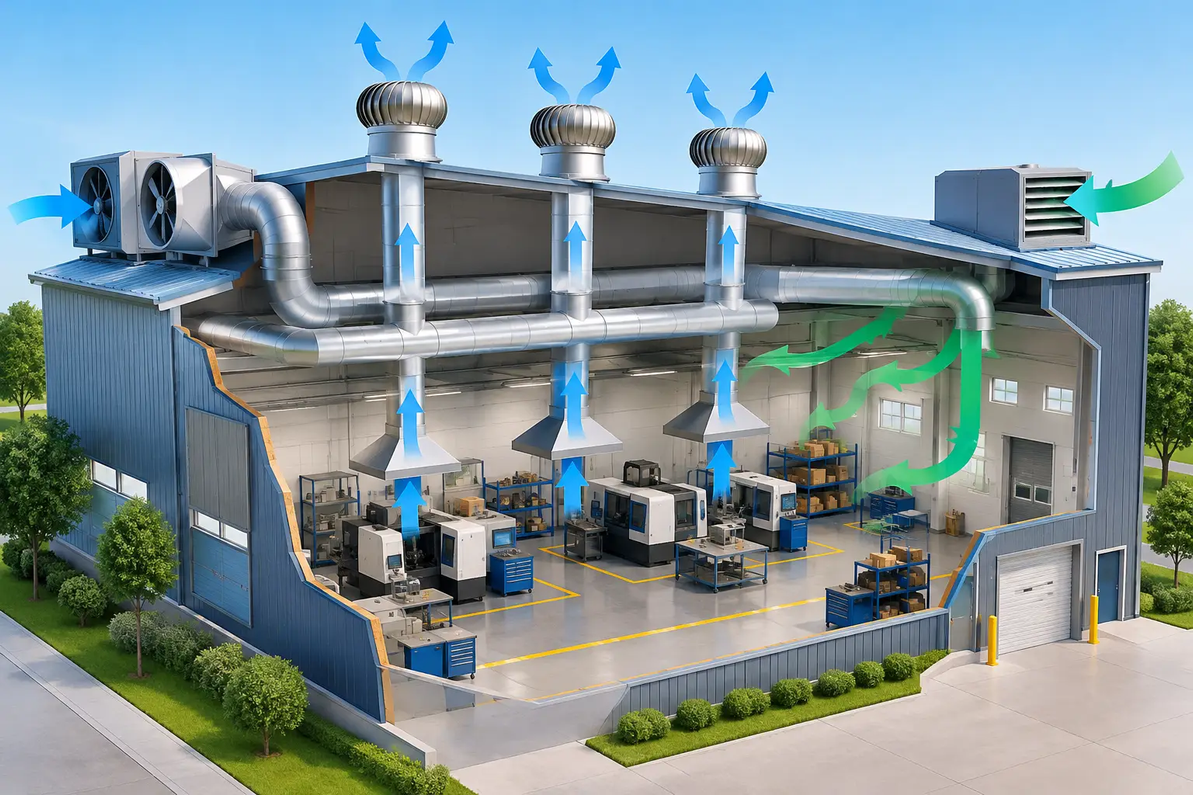
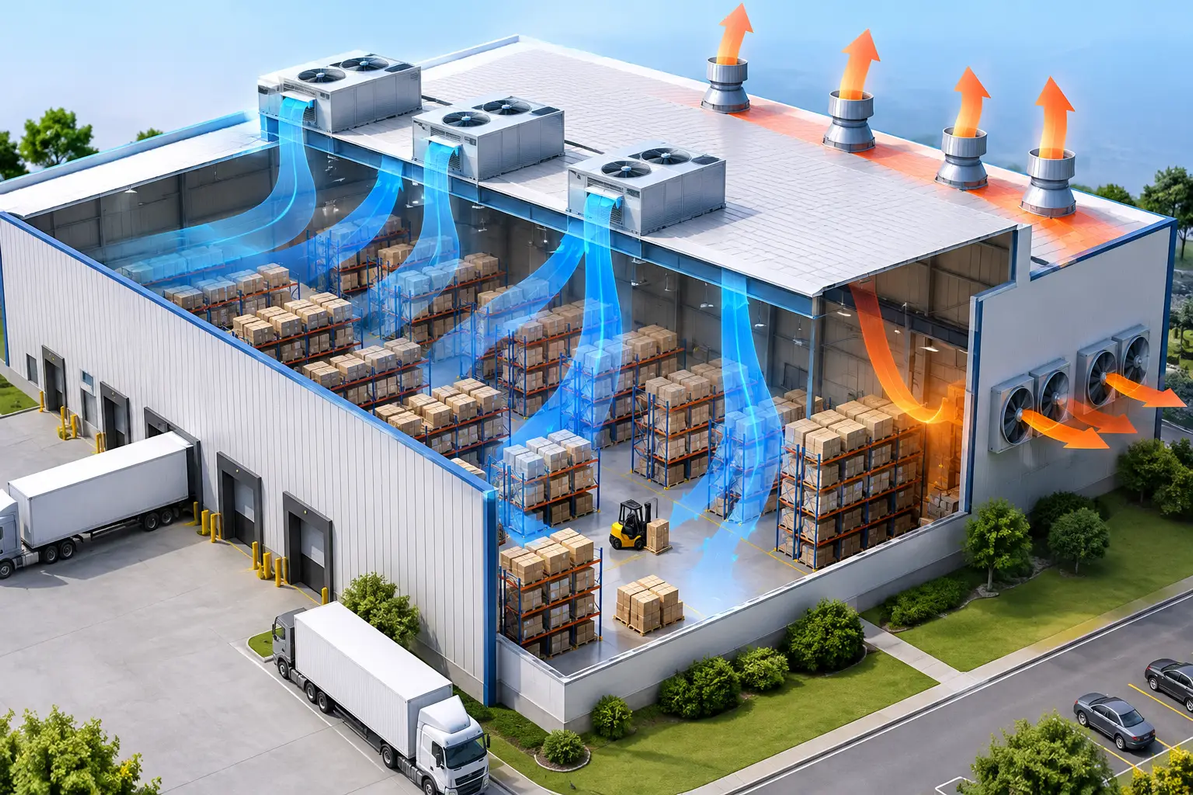
The best warehouse solution is often a coordinated system rather than one piece of equipment. It may include roof-mounted exhaust fans to remove the hottest air, intake louvers or powered supply units to establish an air path, HVLS fans for occupied-zone comfort, and controls that stage equipment as temperatures rise.
Roof-mounted equipment is a practical choice when heat naturally accumulates at the ceiling and duct runs would be excessive. Wall exhaust can work well when a defined crossflow is possible from intake to exhaust. For facilities with heat concentrated over a particular process, local high-temperature exhaust may be more effective than trying to ventilate the entire building at the same rate.
Natural and hybrid options can also fit the right building. Edmonds ecoPOWER Hybrid Rooftop ventilators combine wind-driven operation with a high-performance EC brushless DC motor for continuous powered ventilation when natural draft is not enough. They are not solar-powered units. Their value is reduced energy consumption while maintaining controllable operation, particularly in applications where steady high-level exhaust is needed without running conventional motors at full power around the clock.
Cooling strategy also depends on the climate and process. High-volume air movement can be highly effective in dry or moderate climates. Evaporative cooling may provide substantial relief where outdoor wet-bulb conditions support it, but it adds moisture and is not appropriate for every product or process. Direct mechanical cooling offers tighter temperature control, though the operating cost and infrastructure requirements are considerably higher. There is no one-size-fits-all answer.
Controls Turn Airflow Equipment Into a System
A fan that runs at full speed every hour of every day is rarely the most efficient answer. Variable frequency drives and EC motor controls allow airflow to follow actual conditions. Temperature sensors can stage exhaust fans as roof-deck temperatures climb. Differential pressure controls can help maintain desired building balance. Carbon dioxide, humidity, particulate, or process-specific sensors may be appropriate where air quality is the primary concern.
For larger facilities, AI-supported monitoring and control can identify recurring temperature patterns, compare zones, flag equipment that is not delivering expected performance, and adjust operation based on real-time conditions. This is useful for warehouses, data environments, crypto mining operations, and manufacturing sites where heat loads can change quickly.
Controls should not compensate for poor design. They should refine a system that has the correct air path, fan capacity, make-up-air provision, and equipment placement from the beginning.
Common Mistakes That Waste Fan Capacity
Several installation decisions repeatedly undermine otherwise good equipment. Exhaust fans placed too close to intake openings can short-circuit air before it reaches the occupied zone. Intake louvers located directly beside dusty truck lanes can pull contaminants into the facility. Undersized louvers create excessive face velocity, pressure loss, and noise. Closed dampers or neglected shutters can quietly reduce airflow long after commissioning.
Another frequent issue is treating every hot complaint as a whole-building problem. If only one packaging line, electrical room, mezzanine, or dock zone is overheating, targeted ventilation may solve the issue at a lower cost than adding capacity everywhere. Conversely, spot fans cannot fix a building-wide failure to exhaust roof-level heat.
Measure before and after installation. Record indoor temperatures at floor and roof levels, exterior conditions, fan amperage, damper position, and airflow where practical. These readings reveal whether the system is achieving its design intent and give facility teams a defensible basis for future expansion.
A warehouse ventilation project should leave you with more than installed fans. It should leave you with an understandable airflow plan, equipment matched to real static pressure and heat load, and controls that support the way the building actually operates.
Factory Fans Direct - Commercial & Industrial Ventilation & Cooling Experts. Contact Mike Miller, VP Engineering, for a FREE Project Evaluation at 888-849-1233. A short technical conversation before equipment is ordered can prevent a long-term airflow mistake after installation.
Factory Fans Direct - Commercial & Industrial Ventilation & Cooling Experts | Contact Mike Miller VP Engineering at Factory Fans Direct for a FREE Project Evaluation 888-849-1233 | Mike@FactoryFansDirect.com
Recent Posts
-

Discounted Quality Industrial Ventilation & Free Project Evaluation
A warehouse with hot loading docks, a manufacturing line producing process heat, and a crypto mining …20th Nov 2026 -
Industrial Exhaust, Make-Up Air & Hybrid Turbine Ventilation
A hot production floor, stagnant warehouse zone, or high-temperature equipment room rarely has a sin …20th Nov 2026 -
Stop Guessing on Airflow: Custom-Engineered Warehouse Cooling & Exhaust
A warehouse that feels 15 degrees hotter at the loading docks than it does near the office is not su …20th Nov 2026