Discounted Quality Industrial Ventilation & Free Project Evaluation
A warehouse with hot loading docks, a manufacturing line producing process heat, and a crypto mining room with concentrated equipment loads do not have the same ventilation problem. Yet too many projects start with a discounted fan catalog and end with undersized exhaust, excessive static pressure, poor make-up air, or equipment that cannot hold up under continuous duty. Discounted Quality Industrial Ventilation - Backed by Free Project Evaluation changes that sequence: establish the airflow requirement first, then match factory-direct equipment and controls to the actual operating conditions.
The lowest equipment price is only a real saving when the system moves the required CFM at the required static pressure, survives the environment, and does not create a new problem elsewhere in the building. For plant managers, contractors, engineers, and operations teams, that is the difference between purchasing a fan and buying a ventilation solution.
Why discounted industrial ventilation needs engineering support
Industrial ventilation pricing often gets reduced to one number: fan cost. That number matters, especially on multi-fan warehouse, agriculture, cultivation, and manufacturing projects. But fan price is only one part of installed and operating cost. A discounted axial exhaust fan that loses performance against louvers, guards, dampers, duct transitions, filtration, or a restrictive wall opening may deliver far less air than expected.
Every system has resistance. Static pressure is the measurement that reveals it. A fan may be rated at a high free-air CFM, but free-air performance does not describe a system with ductwork, elbows, backdraft dampers, intake louvers, light traps, evaporative cooling media, or contaminated filters. The relevant question is not simply, “How many CFM is this fan rated for?” It is, “How many CFM will it deliver in this installation?”
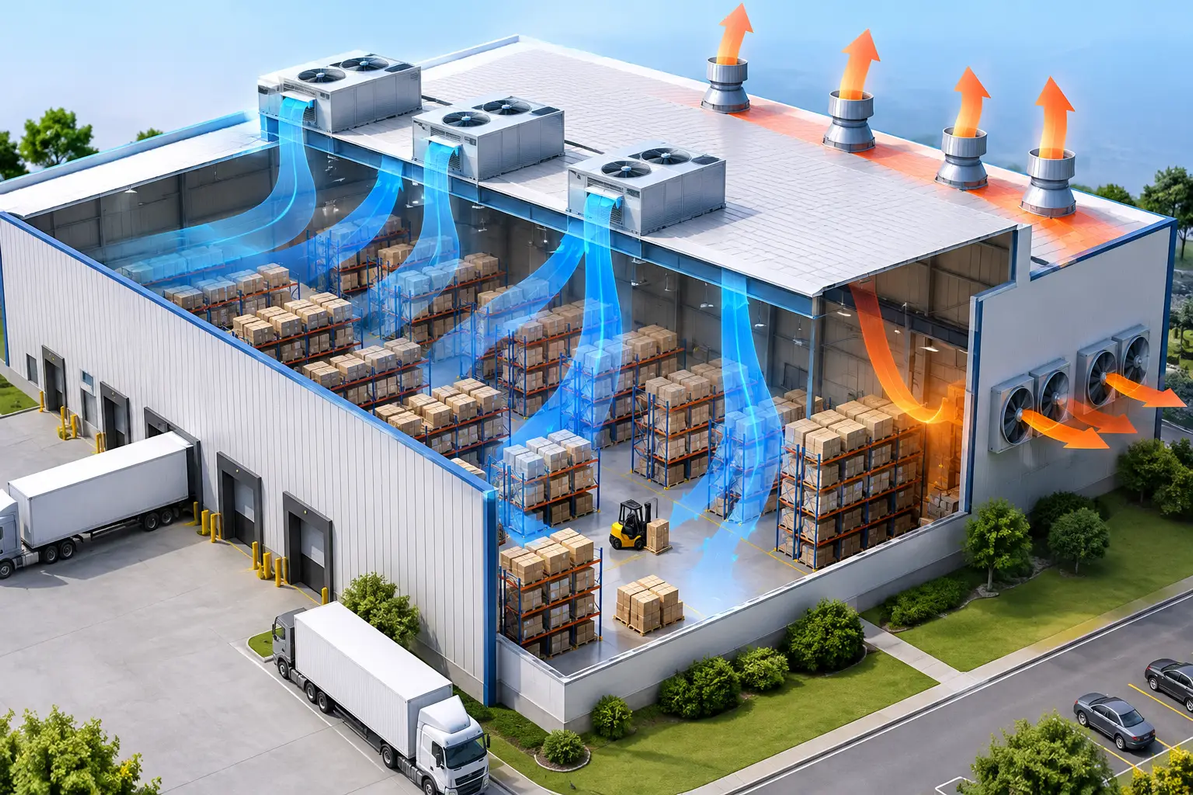
That question becomes more critical when heat loads are high or operating conditions change throughout the day. In a warehouse, dock doors may open and close repeatedly. In a processing building, machinery and people add sensible heat. In a greenhouse or cultivation room, temperature, humidity, light-trap resistance, and odor-control components all affect the design. A data center or crypto mining operation may require controlled high-temperature exhaust and carefully planned replacement air to protect equipment uptime.
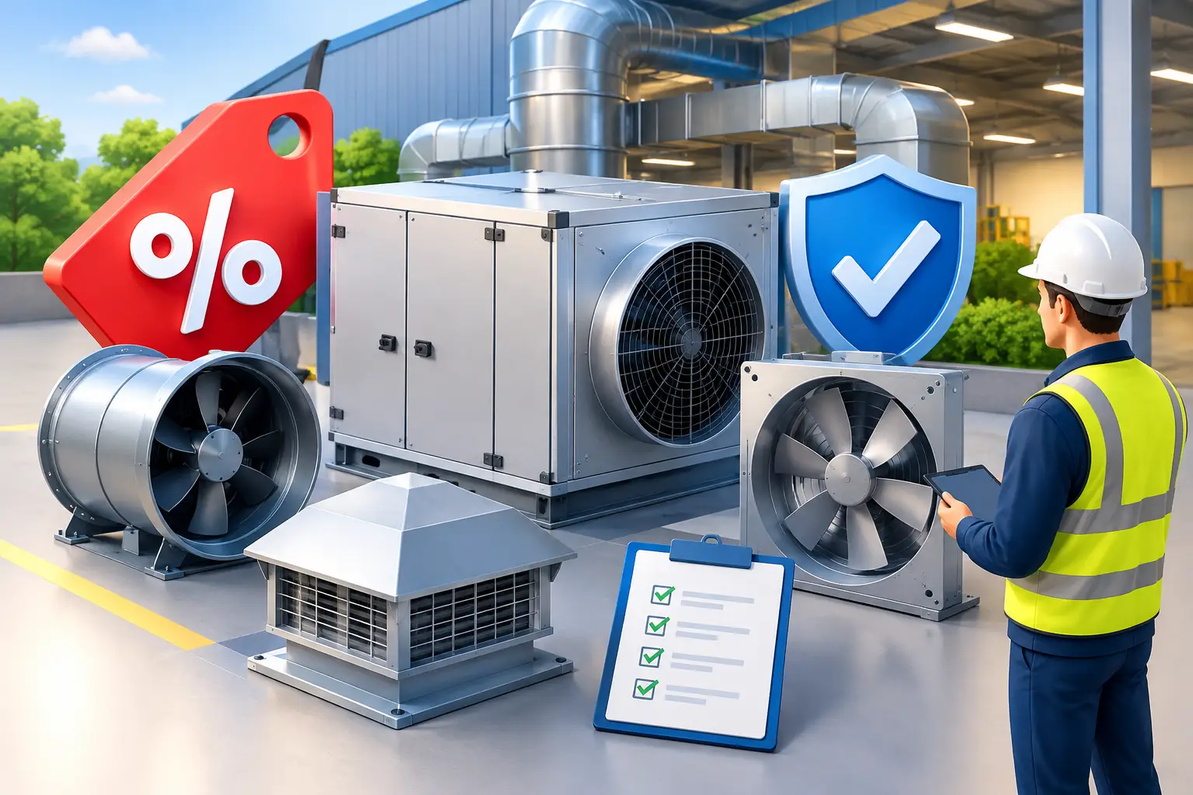
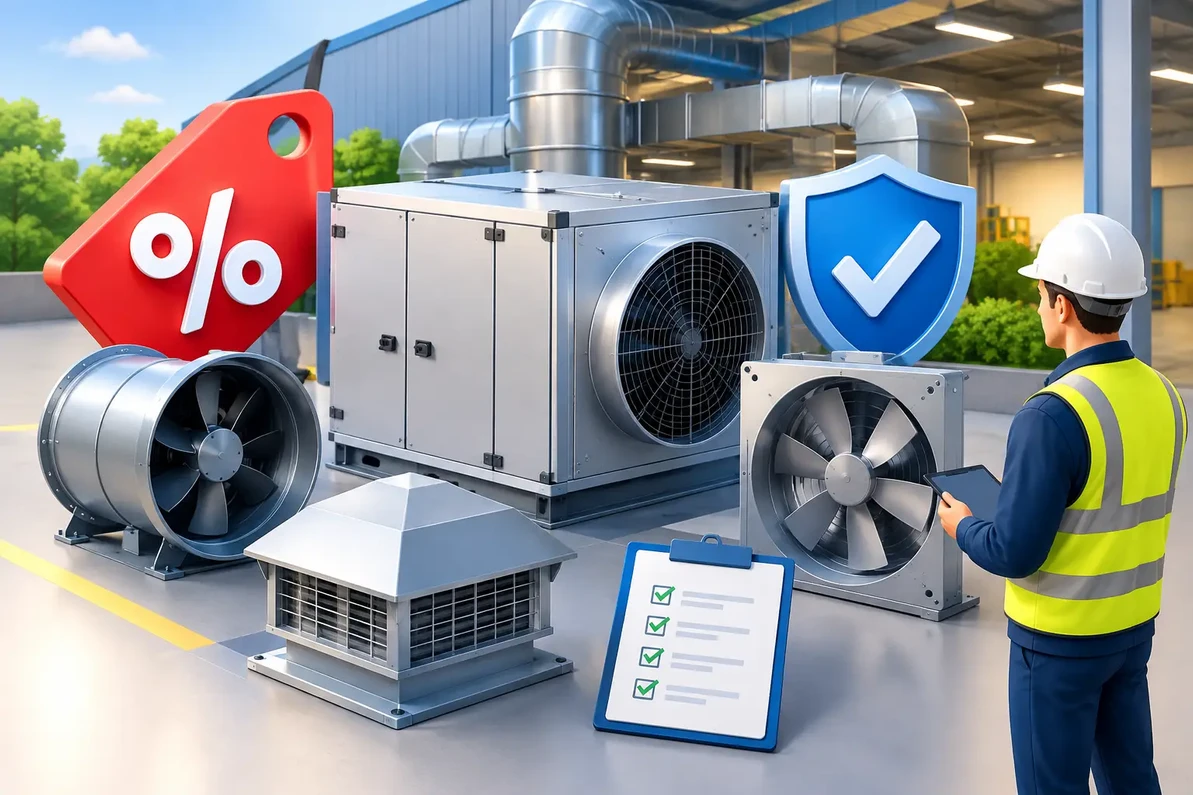
Factory-direct pricing should not mean a buyer is left to solve those variables alone. The useful model is discounted equipment paired with a project evaluation that identifies airflow demand, pressure losses, intake strategy, controls, mounting constraints, and duty cycle before equipment is selected.
What a free project evaluation should examine
A meaningful evaluation begins with the facility, not the product page. Square footage and ceiling height provide a starting point, but they are not enough to size industrial ventilation. The project team needs to understand the thermal and operational conditions that drive ventilation demand.
Air volume, heat load, and air-change targets
For general ventilation, air changes per hour can help establish a preliminary CFM range. For heat removal, the calculation must account for the heat being generated and the allowable temperature rise. Process equipment, motors, lighting, solar gain through the roof, occupancy, and outside-air conditions can materially change the requirement.
An operation that only needs background air movement may be well served by circulating fans, HVLS fans, and targeted exhaust. A space that must expel process heat or maintain equipment inlet temperatures requires a more disciplined exhaust and make-up air calculation. Air movement improves comfort, but it does not remove heat from the building unless the heat has a path out.
Static pressure and system losses
A free evaluation should identify every component that adds resistance. This includes wall shutters, guards, weather hoods, louvers, duct runs, filters, cooling pads, backdraft dampers, and light-deprivation equipment. In high-static applications, a standard propeller fan may not be the right choice. A centrifugal fan, tube axial unit, or a purpose-selected high-pressure exhaust fan may provide more reliable delivered airflow.
This is where cut-sheet data matters. Compare fan curves, motor horsepower, motor enclosure, blade design, amperage, sound level, and performance at the project’s estimated static pressure. A nameplate CFM without a performance point is not enough for a critical application.
Make-up air and pressure balance
Exhaust cannot operate properly without replacement air. If a facility exhausts more air than it can admit, negative pressure rises. Doors become difficult to open, fans lose capacity, unconditioned air enters through uncontrolled leaks, and combustion equipment can be affected.
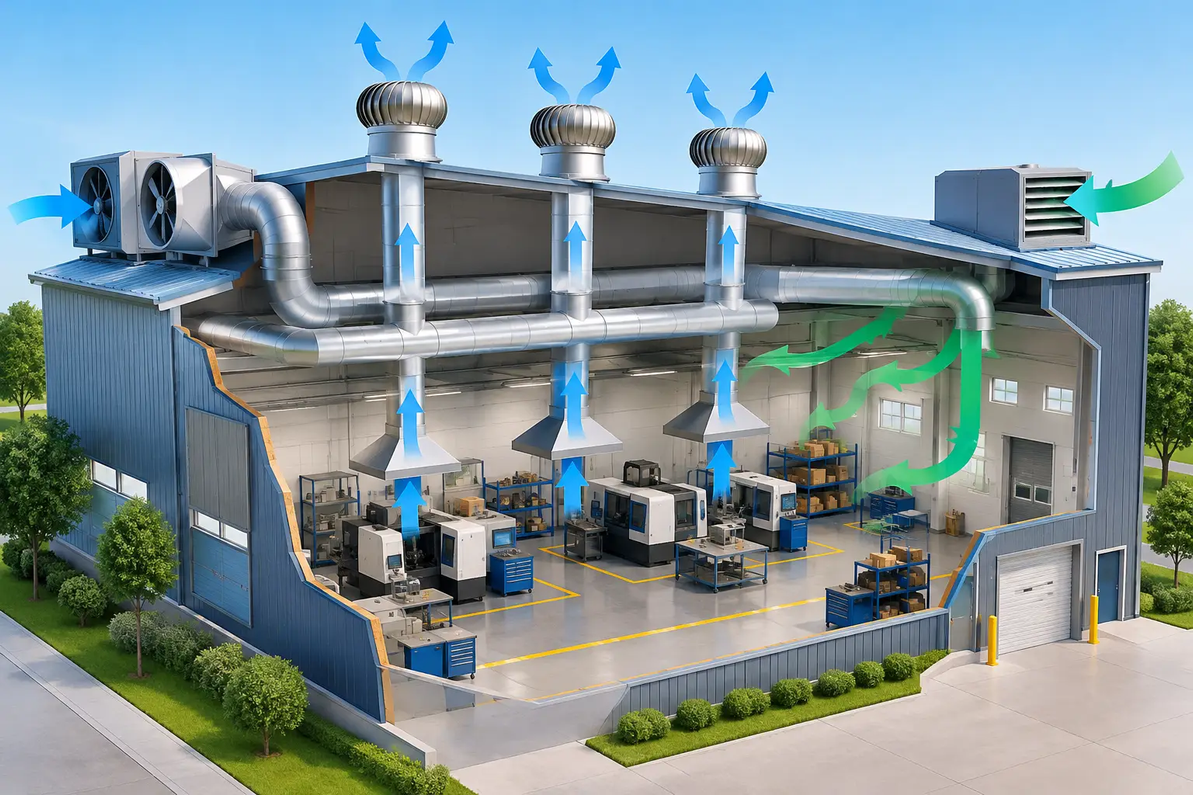
Make-up air may come through properly sized intake louvers, motorized dampers, filtered air units, evaporative systems, or dedicated heated make-up air equipment. The right approach depends on climate, cleanliness requirements, winter operation, and whether incoming air must be tempered. A facility in a cold-weather market may need a different strategy than an open agricultural structure in a warm climate.
Where factory-direct pricing creates real value
Factory-direct ventilation pricing is most valuable when it is combined with equipment matching. It can reduce upfront cost on projects involving multiple exhaust fans, roof-mounted units, HVLS fans, industrial circulation fans, controls, louvers, heaters, and make-up air components. It also gives buyers access to options that may not be available through a generic retail fan assortment.
The trade-off is that specialized equipment must be specified correctly. A lower-priced fan that is difficult to service, incompatible with the electrical supply, or poorly matched to the environment can erase initial savings quickly. For corrosive, dusty, wet, high-temperature, or continuous-duty environments, motor type, coatings, belt versus direct drive, access for maintenance, and component availability deserve review before purchase.
For example, an agricultural barn may prioritize corrosion resistance, washdown durability, and dependable air exchange. A manufacturing plant may need roof exhaust and make-up air coordinated around process zones. A warehouse may benefit from HVLS fans for destratification and worker comfort, paired with exhaust where heat accumulation is the actual issue. Crypto mining and high-density computing facilities may need staged exhaust, variable speed control, containment-aware airflow paths, and temperature-based automation.
There is no single “best industrial fan.” There is only equipment that is suitable for a defined duty.
Controls are part of the ventilation design
A fan operating at full speed around the clock is sometimes necessary, but it is not automatically the most efficient choice. Variable frequency drives, thermostats, humidity controls, pressure sensors, staged fan controls, and building automation interfaces can reduce unnecessary runtime while maintaining target conditions.
Variable speed control is especially useful where heat loads fluctuate. Instead of cycling large fans abruptly on and off, a properly selected VFD can modulate airflow to maintain a temperature or pressure target. However, not every motor and fan arrangement is appropriate for every control method. Motor compatibility, minimum safe fan speed, harmonic considerations, enclosure rating, and control location must be evaluated.
For facilities pursuing LEED or Net Zero goals, ventilation strategy should also consider passive and hybrid options where applicable. The Edmonds ecoPOWER Hybrid Rooftop Ventilator combines wind-driven operation with an EC brushless DC motor for continuous powered ventilation when conditions require it. It is a true hybrid ventilator, not a solar-powered turbine. For the right rooftop application, this approach can support lower energy use while maintaining dependable airflow.
Questions to answer before ordering equipment
Before finalizing a ventilation quote, provide the project details that determine performance: building dimensions, ceiling height, use of the space, equipment heat load, desired indoor temperature, local outdoor design conditions, existing openings, duct layout, power availability, and any filters, louvers, or dampers in the airflow path. Photographs, plans, and existing equipment information can prevent costly assumptions.
Also define what cannot fail. If the application is protecting production, livestock, computer hardware, product quality, or worker conditions, redundancy may be more valuable than selecting one larger fan. If sound limits, roof loading, hazardous materials, weather exposure, or corrosion are concerns, those requirements need to be part of the specification from the beginning.
A free project evaluation does not eliminate every field condition, and it does not replace code review or site-specific engineering requirements where stamped plans are required. It does give the purchasing decision a technical foundation, which is far better than selecting by CFM and price alone.
Factory Fans Direct supports commercial and industrial ventilation projects with factory-direct equipment pricing, ventilation design guidance, and free project evaluation. Contact Mike Miller, VP Engineering, at 888-849-1233 to discuss your facility requirements before equipment is ordered.
The practical next step is simple: document the heat, airflow restrictions, operating schedule, and performance target in your building. Once those facts are clear, the right discounted ventilation package becomes easier to identify, defend, install, and operate.
For commercial and industrial ventilation, cooling, warehouse, or manufacturing projects, contact Mike Miller, VP Engineering at Factory Fans Direct, for a FREE Project Evaluation at 888-849-1233. Bring the dimensions, the heat problem, the equipment list, and the operating constraints. A useful ventilation design begins with what the building is actually asking the system to do.
Factory Fans Direct - Commercial & Industrial Ventilation & Cooling Experts | Contact Mike Miller VP Engineering at Factory Fans Direct for a FREE Project Evaluation 888-849-1233 | Mike@FactoryFansDirect.com
Recent Posts
-

Discounted Quality Industrial Ventilation & Free Project Evaluation
A warehouse with hot loading docks, a manufacturing line producing process heat, and a crypto mining …20th Nov 2026 -
Industrial Exhaust, Make-Up Air & Hybrid Turbine Ventilation
A hot production floor, stagnant warehouse zone, or high-temperature equipment room rarely has a sin …20th Nov 2026 -
Stop Guessing on Airflow: Custom-Engineered Warehouse Cooling & Exhaust
A warehouse that feels 15 degrees hotter at the loading docks than it does near the office is not su …20th Nov 2026