
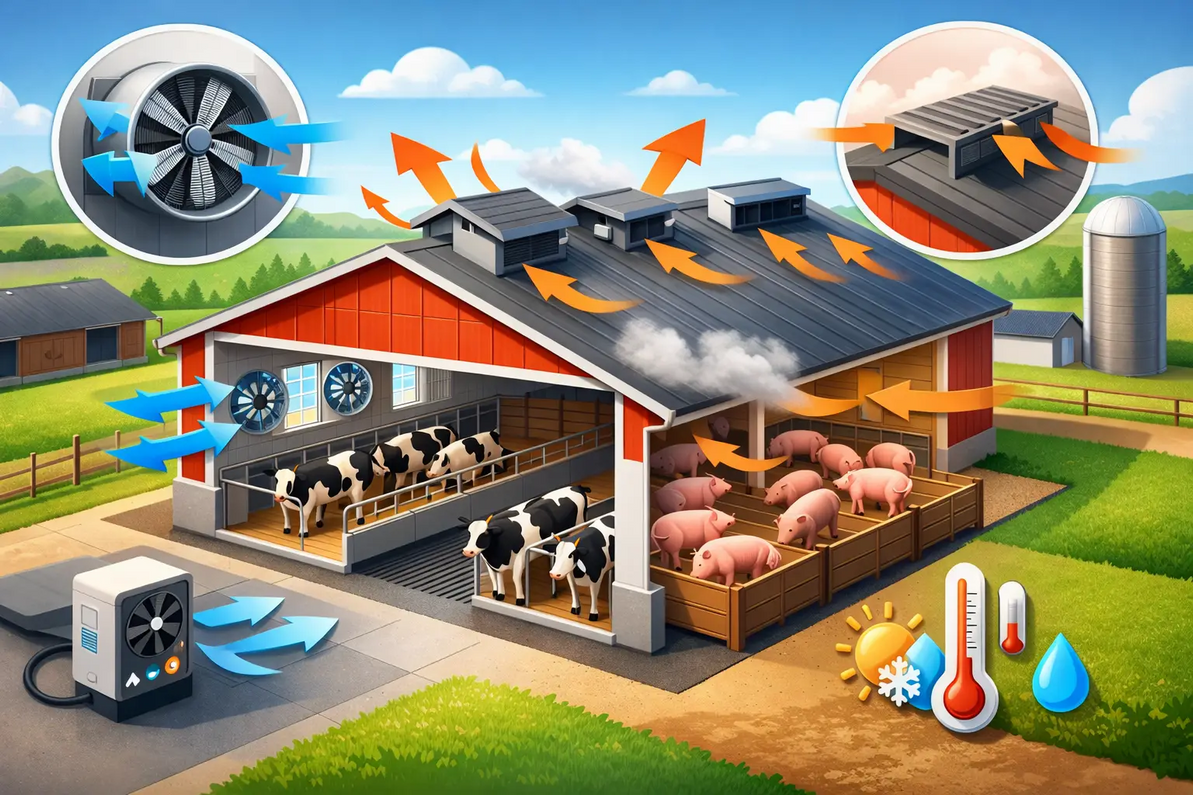
Livestock Ventilation Requirements Explained
A barn that smells sharp by 8 a.m., shows wet bedding before noon, or leaves animals crowding openings by late afternoon already has a ventilation problem. Livestock ventilation requirements are not just about moving air. They are about controlling heat, moisture, ammonia, airborne pathogens, and temperature swings without creating harmful drafts or wasting power.
That is where many projects go sideways. Owners often start with fan diameter or price, when the real question is how much air exchange the building and the animals actually require across changing seasons. Good barn ventilation is a performance calculation first and an equipment decision second.
What livestock ventilation requirements actually mean
In practical terms, livestock ventilation requirements define how much fresh air a building needs, how that air should enter and leave, and how consistently the system performs under different weather and stocking conditions. The target is not maximum airflow at all times. The target is stable animal conditions.
A livestock building has to remove excess heat in warm weather, but it also has to manage humidity and contaminants in cool weather when air exchange rates are lower. If winter ventilation is undersized, moisture accumulates on ceilings, walls, and equipment, bedding stays damp, and respiratory pressure rises. If summer ventilation is undersized, heat stress cuts feed intake, production, and animal comfort fast.
This is why ventilation design has to account for species, building dimensions, insulation levels, ceiling height, manure handling, stocking density, and local climate. A naturally ventilated cattle barn in a dry region will not follow the same design logic as a mechanically ventilated swine or poultry house in a humid climate.
The core factors that drive livestock ventilation requirements
The biggest driver is animal load. More animals mean more body heat, more moisture from respiration, and more waste gases. A barn with high stocking density can overwhelm a fan package that looks adequate on paper if the design did not account for actual occupancy.
The next factor is building use and layout. Open-sided dairy facilities, enclosed calf barns, tunnel-ventilated poultry houses, and curtain-sided hog barns all behave differently. Air has to follow a controlled path. If intake openings are poorly located or exhaust fans are mismatched, air short-circuits and leaves dead zones where heat and moisture collect.
Climate matters just as much. In cold regions, minimum ventilation becomes critical because operators often close buildings too tightly to save heat. In hot and humid regions, high airspeed and steady exchange matter more, especially when evaporative cooling is limited by moisture conditions.
Management style also changes the requirement. Bedding type, washdown frequency, manure storage, and whether doors stay open during loading all affect real-world performance. The same building can need different ventilation settings depending on how it is operated.
Minimum ventilation versus heat removal
One of the most common design mistakes is treating barn ventilation as a single number. In reality, most livestock facilities need at least two operating targets and often three.
Minimum ventilation is used during cold weather or mild conditions. Its job is to remove moisture, ammonia, carbon dioxide, and airborne contaminants while preserving reasonable interior temperature. This is where variable-speed control, staged fans, and properly sized inlets become important. Too much airflow wastes heat. Too little airflow creates wet, unhealthy conditions.
Moderate ventilation handles transitional seasons when the barn needs more exchange than winter minimums but not full summer output. This range is often where control quality matters most because outdoor conditions fluctuate daily.
Maximum ventilation is designed for heat removal and animal cooling. At that point, the system may rely on high-capacity exhaust fans, circulation fans, tunnel airflow, or a combination of mechanical ventilation and natural openings. For many species, especially poultry and swine, air velocity across the animals becomes a critical part of the cooling strategy.
Airflow pattern matters as much as CFM
High fan capacity does not guarantee effective ventilation. Air has to reach the animals, sweep moisture and contaminants from occupied zones, and exit without bypassing problem areas.
In cold weather, inlet design controls whether fresh air mixes with room air before dropping into the animal zone. Poor inlet throw can dump cold air directly onto livestock, causing stress and reducing performance. In warm weather, the goal shifts toward higher direct air movement for sensible cooling.
Barn geometry complicates this. Rafters, pens, feed alleys, curtain walls, and ceiling obstructions can all interrupt airflow. Large fans may create strong movement in one section while leaving stagnant pockets elsewhere. That is why layout, fan spacing, mounting height, and discharge direction are engineering decisions, not accessory choices.
Species-specific needs change the design
Cattle generally tolerate colder temperatures better than poultry or swine, but they still suffer when humidity, ammonia, and stagnant air build up. Dairy barns often benefit from a combination of air exchange and high-volume circulation over stalls, feed lanes, and holding areas. Calves need tighter control because drafts and dampness hit them harder.
Swine operations usually require more controlled mechanical ventilation because pigs are sensitive to both heat stress and poor air quality. Room pressure, inlet management, and staged fan control become more important in these enclosed systems.
Poultry houses often demand the most exact airflow control. Static pressure, tunnel velocity, evaporative cooling performance, and backup ventilation all have direct effects on bird health and feed conversion. Small errors in fan selection or inlet sizing can scale into major production losses.
That is why a generic barn fan recommendation rarely holds up. Livestock ventilation requirements depend on species, age, weight, production stage, and housing type.
Moisture and ammonia are early warning signs
Many owners focus on temperature because it is easy to feel, but moisture and gas buildup usually tell the real story first. Condensation on steel, damp insulation, wet litter, and persistent odor indicate that minimum ventilation is not doing its job.
Ammonia is especially important because it affects both animals and workers. Even when heat looks manageable, elevated ammonia can point to poor exchange at floor level or poor manure-related airflow. This often happens when fan systems are oversized for summer but poorly controlled during cold weather.
A better design balances fan staging, inlet operation, and building tightness so the system can handle low-rate winter ventilation with the same discipline it uses for peak summer output.
Fan sizing, static pressure, and controls
This is where many projects need expert review. Fan performance is not just a free-air CFM number from a catalog. Real barns operate against resistance from shutters, guards, louvers, screens, light traps, pads, and building pressure. As static pressure rises, delivered airflow drops.
That means livestock ventilation requirements should be matched to fan curves, not nameplate assumptions. A fan that looks adequate at one condition may miss target airflow once installed with actual intake restrictions.
Controls matter too. Single-speed fans can work in some applications, but staged systems or variable frequency drives usually provide better control across seasonal loads. If the barn only has on-off ventilation, interior conditions swing harder, and energy use often rises.
For larger or more sensitive facilities, it makes sense to evaluate fan type, motor efficiency, shutter quality, controller logic, and backup power together. A ventilation package is only as strong as its weakest component.
Natural versus mechanical ventilation
Natural ventilation can work very well in the right structure, especially for certain cattle facilities, but it depends heavily on building orientation, ridge opening design, sidewall opening area, and local wind conditions. When those pieces line up, operating cost can be lower and system simplicity can be a real advantage.
The trade-off is control. Natural systems are less predictable during still, humid, or highly variable weather. Mechanical ventilation offers more precise air exchange and is often necessary where animal density is high or air quality tolerance is narrow.
Many barns benefit from a hybrid approach. Natural openings can support mild conditions, while mechanical exhaust and circulation fans take over when environmental loads increase or weather becomes less cooperative.
When to reevaluate your barn
If animals bunch in corners, avoid feeding zones in hot weather, cough more during winter, or show inconsistent performance by location within the building, ventilation deserves a second look. The same applies if utility costs rise while air quality still feels poor.
Facility changes also trigger reevaluation. New curtains, tighter doors, different bedding, added animals, equipment heat, or building expansions can all shift the original design assumptions. What worked five years ago may no longer match the current load.
A proper review usually starts with dimensions, species data, occupancy, climate, and target operating conditions. From there, airflow requirements, intake area, static pressure expectations, circulation needs, and fan selection can be matched as a system. That engineering-first approach is what keeps buyers from overspending on hardware that does not solve the real problem.
At Factory Fans Direct, that is exactly why free project evaluation matters. The right answer is not simply more fan. It is the right airflow strategy for the building, the animals, and the season you are trying to survive. If your barn conditions are inconsistent, uncomfortable, or expensive to manage, that is usually the signal to stop guessing and start designing.
Factory Fans Direct - Commercial & Industrial Ventilation & Cooling Experts | Contact Mike Miller VP Engineering at Factory Fans Direct for a FREE Project Evaluation 888-849-1233 | Mike@FactoryFansDirect.com
Recent Posts
-

AI Smart Buildings Incorporate Edmonds ecoPOWER Hybrid Turbine Ventilation
A building automation system can report rising rooftop temperatures, increasing indoor contaminants, …12th Sep 2026 -
Smart Buildings Architects Recommend Edmonds ecoPOWER Hybrid Ventilation
A rooftop ventilator should not force an all-or-nothing energy decision. Smart Buildings Architects …7th Sep 2026 -
Smart Industrial Buildings Use Edmonds ecoPOWER Hybrid Ventilation
A roof exhaust system can be the difference between a plant that controls heat at the source and one …7th Sep 2026