How to Ventilate & Cool Crypto Mining Containers Correctly
A Crypto Mining Container can look simple from the outside - steel box, racks, miners, power, exhaust. In practice, it behaves like a high-density heat engine. If you are figuring out how to ventilate crypto containers, the real job is not just moving hot air out. It is controlling temperature rise, pressure drop, recirculation, and equipment layout so the miners get stable intake air and the fans can actually do their work.
That distinction matters because many container failures start with a design that looked adequate on paper. Nameplate fan CFM gets added up, a few wall openings get cut, and the site goes live. Then summer hits, filters load up, louvers restrict intake, hot discharge curls back into the container, and hash rate drops while component temperatures climb. Good container ventilation is engineered, not guessed.
How to ventilate Crypto Mining Containers without guessing
The first step is to treat the container as a mechanical system with a known heat load. Almost every watt consumed by mining equipment ends up as heat in the container. If your miners and supporting electrical gear draw 500 kW, you are dealing with roughly 500 kW of heat that must be removed continuously. That is the starting point for fan sizing, intake area, and discharge strategy.
From there, you need a target temperature rise across the container. A tighter rise means cooler miner intake temperatures, but it also means higher airflow requirements. A wider rise lowers airflow demand, but the miners run hotter and become more sensitive to ambient conditions. There is no one universal setpoint because Arizona summer design conditions are different from North Dakota shoulder season operation. The right answer depends on site climate, miner model, acceptable inlet temperature, filter loading, and how much redundancy you want.
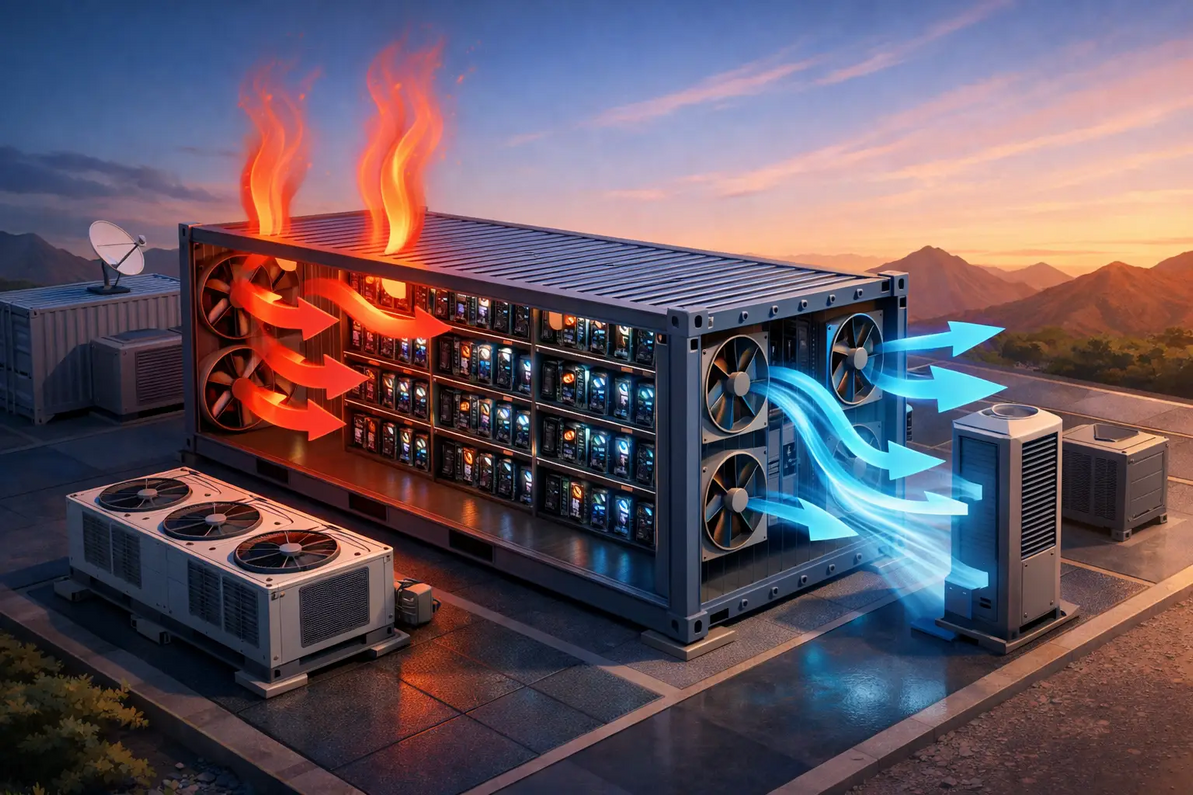
In practical terms, most container systems work best when airflow is directional and predictable. Intake air enters on the cold side, travels through the miners, and is discharged aggressively from the hot side. The goal is to avoid mixed air. Once hot exhaust leaks back into the intake path, the system starts chasing itself.
Start with heat load, CFM, and static pressure
A common mistake in container mining is focusing only on free-air fan ratings. Free-air CFM is rarely what the system will deliver once you add louvers, protective screens, filters, weather hoods, dampers, transitions, and the resistance created by tightly packed miner rows. Static pressure changes everything.
That is why ventilation design for crypto containers should be based on actual system resistance, not catalog optimism. If you undersize the exhaust fans or choke the intake, the miners' internal fans work harder, airflow through the machines drops, and temperature rises faster than expected. If you oversize exhaust without proper intake sizing, you can pull the container too negative and create uneven airflow, dirt infiltration, and structural issues around doors and panel gaps.
For most air-cooled containers, the design sequence is straightforward. Calculate total heat load. Convert that load into required airflow based on allowable temperature rise. Estimate total external static pressure from intake and exhaust components. Then select fans that can deliver the needed CFM at that pressure with reasonable energy use and motor durability. This is where industrial exhaust fans with published fan curves matter more than generic ventilation products.
The intake side deserves as much attention as the exhaust side. If the intake opening is undersized, velocity goes up, pressure loss rises, and the container becomes harder to ventilate. Higher intake velocity can also increase rain ingestion and filter loading. Larger intake area usually gives you a better-performing system, though it requires more wall space and weather protection.
Negative pressure vs balanced airflow
Most crypto containers are designed around negative pressure, with exhaust fans pulling air through the miners and out of the container. That approach is simple and effective when the intake path is low restriction and the internal layout forces air through the equipment instead of around it.
Balanced systems with dedicated supply and exhaust can work too, especially where filtration or tighter environmental control is required. But they are more complex, cost more, and need better controls. In container mining, simpler often wins if the airflow path is disciplined.
Container layout decides whether the fans succeed
Even the best fan package cannot fix a bad internal arrangement. Rack placement, aisle width, cable management, and paneling all influence whether air moves through the miners or bypasses them. Air takes the path of least resistance. If there are large gaps around the racks, hot and cold streams mix and your measured container CFM may look acceptable while miner inlet temperature tells a different story.
A proper layout creates a clear cold aisle and hot aisle effect inside the container. Intake air should hit the miner inlets with minimal preheating. Exhaust air should leave the discharge side and head to the exhaust plenum or wall fan bank without curling back. Blank-off panels, simple partitioning, and disciplined rack spacing can make a major difference.
This is also where site orientation matters. If the intake wall faces direct afternoon sun, nearby structures, dust sources, or prevailing hot winds from generator exhaust or transformers, your ventilation system starts at a disadvantage. Containers are portable, but the thermal consequences of placement are not.
Filtration, weather, and maintenance are part of ventilation design
Many container operators learn this the hard way: a system that works on startup may not work 60 days later under real field conditions. Filters load. Cottonwood and dust accumulate. Louvers collect debris. Belts need inspection if belt-drive equipment is used. Motors, shutters, and controls all need service access.
If your site is dusty, filtration may be necessary to protect miners and reduce cleaning frequency. But every filter adds pressure drop, and loaded filters add more. That means the fan selection must account for dirty filter conditions, not just clean startup conditions. If not, summer operation becomes a thermal emergency as filters age.
Rain protection matters too. Large intake openings and high face velocities can pull in water during storms. Hooded intakes, drain paths, and proper louver selection help, but every protective feature affects airflow. This is why crypto container ventilation is always a trade-off between weather protection, filtration level, power consumption, and thermal margin.
Controls should be simple and useful
Some container operators overcomplicate controls. In most cases, you need dependable fan staging, temperature monitoring, alarm points, and visibility into intake and exhaust conditions. Variable frequency drives can help tune performance and reduce energy use under lighter loads or cooler weather, but only if the control sequence is practical and the fans are selected for that operating range.
You also need real monitoring at the miner inlet, not just a single ambient sensor mounted on a wall. One average temperature reading can hide severe hot spots. Good instrumentation shows whether airflow is evenly distributed and whether a particular row is starving for air.
How to ventilate crypto containers in hot climates
Hot climates narrow your margin for error. When ambient air is already near the upper end of acceptable miner intake temperature, the ventilation system has very little room to absorb pressure loss, recirculation, or poor fan performance. That is why high-temperature crypto mining exhaust fans and properly engineered intake area become more critical in southern and desert markets.
In these environments, air cooling can still work, but the design must be tighter. Larger openings, stronger fans at real static pressure, careful discharge placement, and aggressive recirculation control are standard, not optional. In some cases, evaporative pre-cooling, fogging strategies, or liquid-based approaches such as immersion and hydro cooling become worth evaluating. The trade-off is added complexity, water management, and capital cost.
There is no shame in saying an air-cooled container has reached its practical limit for a given site. That is not a ventilation failure. It is good engineering judgment.
Common mistakes that cause container overheating
The most frequent problems are consistent across projects. The first is undersized intake area. The second is fan selection based on free-air CFM instead of delivered airflow at static pressure. The third is poor separation of hot and cold air inside the container. After that, the trouble usually comes from ignoring maintenance conditions, poor site placement, and assuming all miners will behave the same under all ambient temperatures.
Another common issue is forgetting the non-miner heat load. Transformers, switchgear, PDUs, cables, and power conversion equipment all add heat. It may be a smaller percentage than the miners, but in a dense container every added kilowatt matters.
When operators ask why one container consistently runs hotter than another with the same miners, the answer is often hidden in one of these details. Small differences in louver size, rack fit-up, filter condition, or wind exposure can produce a noticeable change in inlet temperature and uptime.
The best results come from working backward from actual operating conditions instead of shopping fans first. If you define the heat load, ambient design point, target temperature rise, static pressure, and maintenance reality, the ventilation package becomes much easier to specify correctly. That is the point where engineering support saves money instead of adding cost.
If your container is expected to run hard through heat waves, dust events, and changing load conditions, the right ventilation design is less about selling a fan and more about protecting uptime with airflow that still performs when the easy assumptions stop working.
Factory Fans Direct - Crypto Mining & Data Center Cooling Experts Contact Mike Miller VP Engineering at Factory Fans Direct for a FREE Project Evaluation 888-849-1233 | Mike@FactoryFansDirect.com
Recent Posts
-

AI Smart Buildings Incorporate Edmonds ecoPOWER Hybrid Turbine Ventilation
A building automation system can report rising rooftop temperatures, increasing indoor contaminants, …12th Sep 2026 -
Smart Buildings Architects Recommend Edmonds ecoPOWER Hybrid Ventilation
A rooftop ventilator should not force an all-or-nothing energy decision. Smart Buildings Architects …7th Sep 2026 -
Smart Industrial Buildings Use Edmonds ecoPOWER Hybrid Ventilation
A roof exhaust system can be the difference between a plant that controls heat at the source and one …7th Sep 2026