Greenhouse Climate Control Guide
A greenhouse that runs 5 to 10 degrees off target for a few hours can cost more than a bad fan purchase. It can stall growth, invite condensation, stretch plants, and force your heaters and exhaust equipment to fight each other. That is why a greenhouse climate control guide should start with performance, not products. Before you select fans, shutters, heaters, or controllers, you need to know what the structure is doing under load.
What greenhouse climate control really means
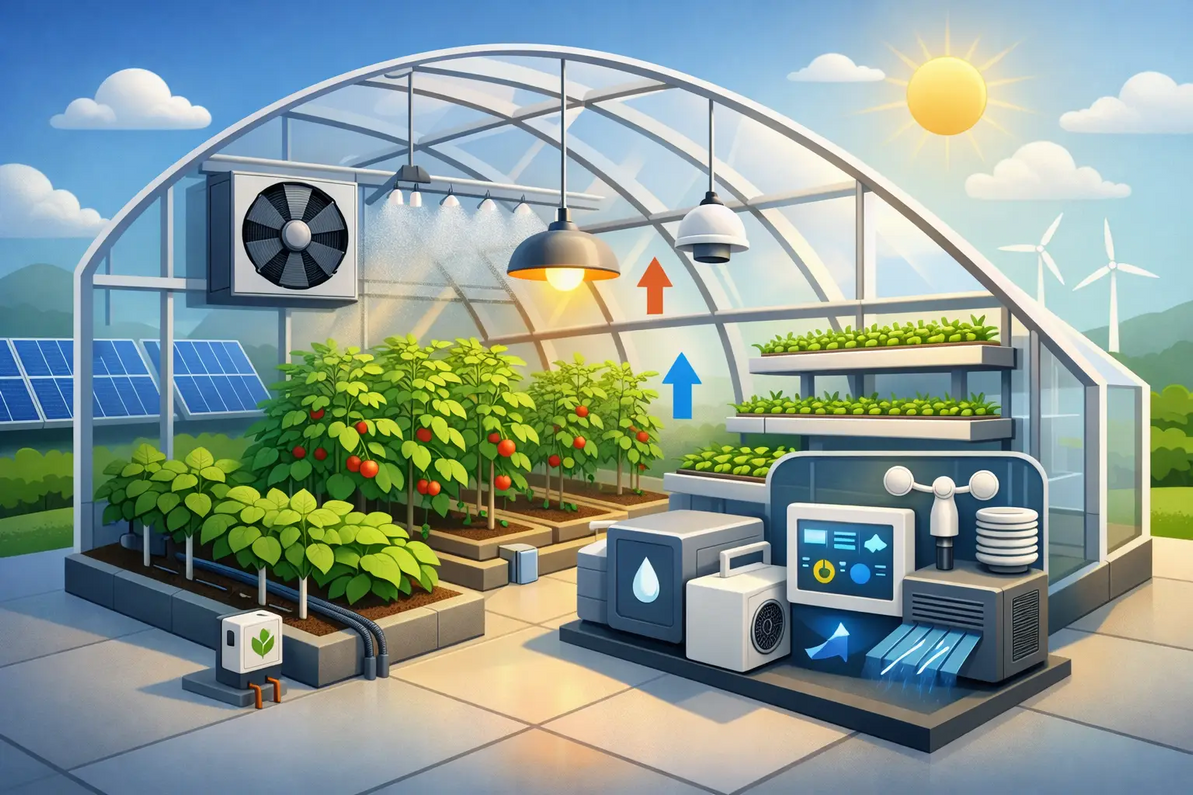
Climate control is not just about cooling a hot house in July. In a working greenhouse, you are managing temperature, humidity, air exchange, air movement, and sometimes pressure relationships at the same time. Those variables shift with season, crop density, irrigation strategy, glazing type, house orientation, solar gain, and outside weather swings.
For most growers, the real challenge is interaction. Add exhaust without enough intake and fan performance drops. Add heat without proper air mixing and you create hot ceilings and cold crop zones. Reduce ventilation to hold temperature and relative humidity climbs fast. The system has to be designed as a package.
That is where many installations go wrong. Equipment gets chosen by rough square footage instead of actual structure dimensions, desired air changes, heat load, and static pressure. A greenhouse is not a warehouse, and a propagation house is not a finishing bay. The control strategy has to match the crop and the building.
Start this greenhouse climate control guide with the load
The first question is simple - what are you trying to remove or maintain? In summer, you are dealing with solar heat gain, plant transpiration, equipment heat, and outside ambient conditions. In winter, you are trying to maintain setpoint while controlling moisture and avoiding cold spots.
A serious greenhouse ventilation design starts with house length, width, sidewall height, peak height, glazing material, internal obstructions, and whether you are naturally ventilated, mechanically ventilated, or using a hybrid setup. Then you look at crop type and density. Dense canopy changes humidity behavior and restricts air movement near the leaf surface. That matters because the sensor may read acceptable room temperature while the crop microclimate is still wrong.
If you are growing ornamentals, leafy greens, hemp, cannabis, or propagation material, your acceptable range may be narrower than in a general agricultural structure. A broad target like 65 to 85 degrees is not enough for equipment selection. You need day targets, night targets, acceptable humidity range, and your maximum allowable recovery time after outside weather shifts.
Ventilation is the backbone of control
Mechanical ventilation usually carries the workload in greenhouses that need predictable air exchange. Exhaust fans pull out heated, humid air while intake shutters or motorized louvers bring in replacement air. The sizing target is typically expressed in CFM, but the real question is whether that CFM is delivered at your operating static pressure, not just in a free air rating.
That distinction matters. Light traps, evaporative pads, insect screens, dirty shutters, and long air paths all add resistance. Once static pressure rises, many fans move less air than buyers expect. On paper, two fans may have similar diameter and motor horsepower. In the field, one may hold performance much better through resistance.
Air exchange alone is not enough. A greenhouse also needs internal air movement. Horizontal airflow fans help destratify the space, break up humidity pockets, and reduce leaf wetness duration. That improves temperature uniformity and supports more stable crop conditions between irrigation cycles. Exhaust handles exchange. Circulation handles uniformity. You usually need both.
Natural ventilation can work very well in the right climate and structure, but it is more weather dependent. Ridge vents, sidewall vents, and roll-up sides can reduce mechanical runtime and energy cost, yet they give you less precision during still, humid, or rapidly changing conditions. For many commercial growers, a hybrid approach makes more sense than relying on one method year-round.
Cooling is not just fan capacity
When outside summer air is too warm to provide direct relief, ventilation by itself reaches its limit. This is where evaporative cooling enters the design. Fan-and-pad systems are common because they can pull large volumes of air through wetted media and reduce incoming air temperature before it crosses the crop.
But pad systems are not plug-and-play. Pad length, pad height, face velocity, water distribution, sump maintenance, and house length all affect results. Overspeed the air through the pad and efficiency drops. Undersize the exhaust and the cooling effect never reaches the far end of the structure. In dry climates, evaporative cooling can be highly effective. In humid regions, the same equipment produces less temperature drop and raises indoor moisture load, which can create downstream disease pressure.
Fogging or misting may also be used in some applications, especially where targeted cooling and humidity control are part of the crop strategy. The trade-off is obvious - what helps temperature may complicate moisture management. That is why the control sequence matters as much as the equipment.
Heating and humidity have to be designed together
A lot of growers treat heating as a winter issue and humidity as a summer issue. In practice, they are linked all year. A tight greenhouse can hold heat well overnight and still develop condensation on surfaces and foliage. Once moisture accumulates, disease pressure rises and uniformity suffers.
Proper heating design means matching BTU output to the structure and to the way air moves through it. Unit heaters, tube heat, and other systems each have strengths depending on house layout and crop. The mistake is assuming installed heat equals delivered crop-zone temperature. Without circulation, warm air pools high and colder, wetter air lingers where plants actually live.
Sometimes the right move is to heat and vent at the same time. That sounds inefficient until you compare it to the cost of chronic condensation, botrytis pressure, or slow morning dry-down. Good greenhouse control is often about controlled compromise, not one-variable optimization.
Controls make or break the system
Even correctly sized equipment can perform poorly under weak controls. Basic thermostats may be enough for a simple hobby house, but commercial operations usually need staged control. You may want first-stage ventilation, second-stage ventilation, evaporative cooling enable, circulation fan scheduling, heating lockouts, and humidity-based triggers.
Sensor placement is a major issue. If a thermostat is mounted in a fast-moving air stream or too close to a heater discharge, your equipment will short cycle or lag behind real crop conditions. Humidity sensing also needs thought. A single sensor in one aisle may not reflect what is happening in corners, under benches, or inside a dense canopy.
Variable frequency drives can improve control in some systems by letting you modulate fan output instead of simply switching full on and off. That can help reduce electrical demand spikes, smooth temperature control, and better match ventilation to changing loads. It is not always necessary, but in larger or more sensitive facilities it can be a strong design choice.
Common sizing mistakes growers make
The biggest error is buying by greenhouse square footage alone. Air volume, structure geometry, intake area, and resistance matter just as much. The second common mistake is neglecting replacement air. Exhaust fans cannot deliver rated CFM if the house cannot bring in enough outside air.
Another issue is mixing incompatible equipment. A powerful exhaust package paired with undersized shutters, poor circulation, or weak controls leaves performance on the table. So does selecting low-cost fans without reviewing the performance curve. If your greenhouse includes pads, screens, or light restriction, fan selection based on free-air numbers can miss the mark badly.
Finally, many operators understate future load. Today it may be a lightly planted bay. Next season it becomes denser, more automated, and hotter because more lights, pumps, or propagation equipment have been added. Design should account for realistic operating conditions, not best-case assumptions.
How to make this greenhouse climate control guide useful in the field
If you are planning a new system or correcting an underperforming one, gather the hard data first. Get your structure dimensions, crop type, glazing details, target setpoints, current equipment list, and photos of intake and exhaust layout. Note whether the space runs too hot, too wet, too stratified, or too inconsistent from end to end.
Then evaluate the system as a whole. Fan count is not the same as delivered ventilation. Heater capacity is not the same as uniform crop-zone heating. Controller features are not the same as a sound control sequence. A proper review should connect CFM, static pressure, intake area, circulation pattern, and temperature-humidity targets into one design.
That is where a technical review pays for itself. Factory Fans Direct works with growers, contractors, and facility operators who need equipment matched to real conditions, not generic fan charts. If your greenhouse has pad resistance, unusual geometry, or a crop that cannot tolerate wide swings, getting the design right before you buy usually costs less than correcting it after install.
The best greenhouse climate control setup is rarely the one with the most equipment. It is the one that holds the target range consistently, with predictable airflow and enough control to adapt when the weather stops cooperating.
Factory Fans Direct - Greenhouse, Cannabis & Hemp Ventilation & Cooling Experts | Contact Mike Miller VP Engineering at Factory Fans Direct for a FREE Project Evaluation 888-849-1233 | Mike@FactoryFansDirect.com
Recent Posts
-

Smart Buildings Architects Recommend Edmonds ecoPOWER Hybrid Ventilation
A rooftop ventilator should not force an all-or-nothing energy decision. Smart Buildings Architects …7th Sep 2026 -
Smart Industrial Buildings Use Edmonds ecoPOWER Hybrid Ventilation
A roof exhaust system can be the difference between a plant that controls heat at the source and one …7th Sep 2026 -
Smart Commercial Buildings Use Edmonds Hybrid Ventilation
A rooftop exhaust fan that only performs when the wind blows is not a complete ventilation strategy. …7th Sep 2026