
Attic Ventilation That Actually Works
A hot second floor in July and frost on the roof deck in January usually point to the same problem: attic ventilation that is missing, undersized, or badly balanced. Homeowners often notice comfort issues first, but contractors and technically minded buyers know the bigger concern is system performance. When air movement through the attic is wrong, you can end up with trapped heat, moisture accumulation, shortened shingle life, and insulation that never performs the way it should.
What attic ventilation is supposed to do
At its core, attic ventilation manages heat and moisture. In summer, solar gain drives attic temperatures well above outdoor ambient conditions. Without enough air exchange, that heat radiates downward into living space, increases HVAC runtime, and puts more stress on roofing materials. In winter, the issue shifts. Warm interior air that escapes into the attic carries moisture, and when that moisture hits cold roof surfaces, condensation can form.
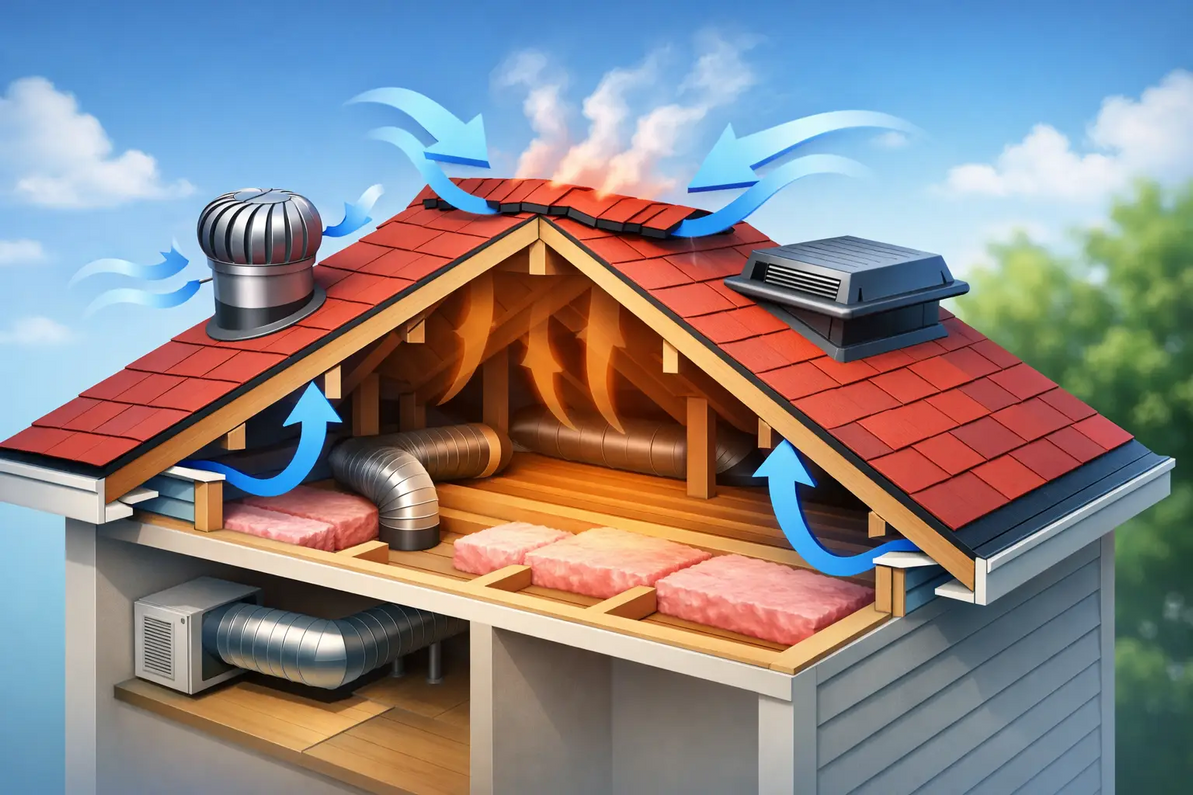
Good attic ventilation helps exhaust hot, humid air and draw in cooler outside air. That sounds simple, but performance depends on the entire assembly, not just one fan or one vent. Intake area, exhaust area, attic volume, roof geometry, insulation depth, duct leakage, and climate all affect results. This is why a fan added to a poor vent layout can solve very little, or sometimes create new problems.
Passive vs powered attic ventilation
Passive attic ventilation relies on natural air movement through intake and exhaust openings. The most common configuration is soffit intake combined with ridge exhaust. As warmer air rises, it exits high on the roof while outside air enters low at the eaves. When the net free vent area is balanced and airflow paths are open, passive systems are low maintenance and effective in many homes.
Powered attic ventilation uses a motorized attic fan, roof-mounted fan, gable fan, or solar attic fan to increase air exchange. These systems can be useful when the attic has complex geometry, inadequate natural draft, dark roofing that drives high heat load, or a design that limits passive vent placement. They can also help in homes where the attic repeatedly reaches extreme temperatures that passive venting does not control well.
The trade-off is that powered ventilation must be selected and installed carefully. An oversized attic fan can pull conditioned air from the house if ceiling penetrations are not sealed well. It can also depressurize the attic and compete with other exhaust devices. For that reason, fan CFM should be matched to the attic space and the available intake vent area. More fan is not automatically better.
Why balanced attic ventilation matters
A balanced system means the attic has adequate low intake and high exhaust. If you install a strong exhaust fan but do not provide enough intake, the fan will still move air, but not in the way you want. It will look for makeup air through recessed lights, wiring penetrations, attic hatches, and other leakage points from the living space below.
That creates two problems. First, you lose conditioned indoor air. Second, you increase the chance of drawing interior moisture into the attic assembly. In technical terms, proper makeup air is a design requirement, not a nice extra.
This is where many attic ventilation projects go sideways. Buyers focus on the fan horsepower, watt draw, or thermostat setting and skip the intake math. For reliable performance, the vent system has to be treated as a complete airflow path.
How to evaluate an attic ventilation system
Start with the basics: attic square footage, roof pitch, existing vent type, and visible signs of heat or moisture distress. Then look at the airflow path. Are soffit vents blocked by insulation? Is there ridge vent installed across the full usable ridge, or only on a short section? Are there old box vents, gable vents, and powered fans all operating together in a way that may short-circuit airflow?
Short-circuiting is common. For example, if a powered gable fan pulls air from a nearby ridge vent instead of from soffit intake, the fan is exchanging air across the top of the attic while leaving lower sections stagnant. On paper, the fan is moving CFM. In practice, the attic is not ventilating evenly.
A proper evaluation also considers climate and use case. In hot Southern markets, heat removal is often the priority. In mixed or cold climates, moisture control can be the bigger concern. In tightly built homes, air sealing and attic ventilation need to be considered together. If the attic floor leaks air badly, ventilation alone will not solve the root issue.
Common attic ventilation mistakes
One of the biggest mistakes is mixing vent types without understanding how they interact. Ridge vents and gable fans can work against each other. Roof louvers installed near powered roof fans can become unintended intake points. More openings do not always mean better airflow.
Another common mistake is underestimating static restrictions. Dirty screens, crushed baffles, insect guards, and blocked soffits can reduce effective intake dramatically. The fan may be rated for a certain CFM in ideal conditions, but field performance changes when airflow resistance increases.
There is also the sizing mistake. Homeowners often buy an attic fan based on price or generic square-foot claims on packaging. Serious performance work requires matching the fan to the attic volume, vent layout, and expected heat load. Motor type, weather exposure, noise level, control strategy, and serviceability matter too, especially in hotter regions where the fan may cycle hard for long periods.
When a powered attic fan makes sense
A powered solution makes sense when passive venting is not enough or not feasible. That includes homes with limited ridge length, complex rooflines, long attic runs, heavy solar gain, or poor natural draft. It can also make sense in retrofit situations where improving comfort on the top floor is a priority and the attic repeatedly runs at extreme temperatures.
The right fan depends on the application. Gable-mounted units can be a good fit when wall access is available and roof penetration is undesirable. Roof-mounted fans are often used when direct vertical exhaust is preferred. Solar-powered attic fans appeal to buyers looking for low operating cost, but they still need proper intake venting and realistic expectations about output during varying sun conditions.
For technically minded homeowners and contractors, the better question is not "Do I need a fan?" It is "What airflow target am I trying to hit, and does the attic support that airflow path?" That is the engineering question behind a successful installation.
Attic ventilation and roof life
Poor attic ventilation can contribute to premature aging of roofing materials, especially in high-heat conditions. Excess attic heat raises the temperature of the roof deck and shingles from below, which can increase thermal stress over time. Manufacturers vary in how they address ventilation in warranty language, but from a building-performance standpoint, heat management is still a valid concern.
Moisture is just as serious. Persistent condensation can stain roof decking, promote mold growth, and reduce insulation effectiveness. By the time visible damage appears, the problem has usually been building for a while. Attic ventilation will not fix roof leaks or major air-sealing defects, but it plays a critical support role in keeping the assembly dry.
Choosing equipment with performance in mind
If you are comparing attic ventilation products, focus on more than advertised coverage area. Look at rated CFM, power consumption, motor quality, housing durability, thermostat or humidistat control options, sound profile, and installation method. For replacement jobs, verify rough opening dimensions and electrical requirements before ordering.
For higher-performance applications, it is worth reviewing cut sheets and installation details instead of relying on broad marketing claims. A fan that performs well in a basic open attic may not be the right choice for a low-slope roof, a heavily compartmentalized attic, or a house with limited soffit intake. This is where engineering guidance can save time and prevent expensive trial and error.
Factory Fans Direct works with buyers who need that level of support, especially when the project calls for more than a one-size-fits-all answer. Residential attic ventilation may seem simple compared to a warehouse or grow facility, but the same rule applies: airflow has to be designed, not guessed.
The best results come from the whole system
The strongest attic ventilation setup is usually the one that fits the house, not the one with the biggest fan. Intake and exhaust have to be balanced. Air sealing has to be taken seriously. Insulation cannot block the airflow path. Controls need to match the climate and operating conditions.
If your attic is running hot, your upstairs rooms are uncomfortable, or you are seeing signs of moisture, treat it as a system problem and not just a fan problem. A little design work up front usually beats replacing components later. When attic ventilation is sized and matched correctly, you get better comfort, better roof performance, and fewer surprises when the weather gets extreme.
Factory Fans Direct - Whole House Fans Experts | Contact Mike Miller at Factory Fans Direct for a FREE Home Evaluation 888-849-1233 and a $50 discount Coupon on the Centric Air Whole House Fans.
Recent Posts
-

Smart Buildings Architects Recommend Edmonds ecoPOWER Hybrid Ventilation
A rooftop ventilator should not force an all-or-nothing energy decision. Smart Buildings Architects …7th Sep 2026 -
Smart Industrial Buildings Use Edmonds ecoPOWER Hybrid Ventilation
A roof exhaust system can be the difference between a plant that controls heat at the source and one …7th Sep 2026 -
Smart Commercial Buildings Use Edmonds Hybrid Ventilation
A rooftop exhaust fan that only performs when the wind blows is not a complete ventilation strategy. …7th Sep 2026