Factory Airflow Upgrade Example That Works
When a production floor runs 10 to 15 degrees hotter than the outdoor ambient, operators feel it first, but the real cost usually shows up elsewhere - quality drift, nuisance shutdowns, and fans that never seem to solve the problem. A good factory airflow upgrade example is not just about adding more exhaust. It is about matching air movement, air exchange, static pressure, and make-up air so the building works as a system.
In manufacturing spaces, airflow problems often get treated like isolated symptoms. One area is hot, so a wall fan gets added. A machine line throws off heat, so a roof exhaust fan goes in. Dust lingers, so someone opens a dock door. Those fixes can help temporarily, but they also create pressure imbalance, short-cycling airflow paths, and dead zones. The better approach is engineering the upgrade around heat load, contaminant source points, building leakage, and the actual production schedule.
A practical factory airflow upgrade example
Consider a 60,000 square foot metal fabrication facility with 24-foot ceilings, multiple welding stations, two laser cutting lines, and a packaging area at the south end of the building. The facility had several complaints at once. Summer indoor temperatures were reaching the low 90s, smoke haze was building near the weld cells during busy shifts, and operators near the center of the floor had almost no noticeable air movement.
The building already had roof exhaust fans and several large wall louvers, but the system had grown in pieces over time. Some fans were oversized for the available intake area. Other sections had intake openings but very little directional airflow to move heat and fumes toward exhaust. The plant team had also installed pedestal fans around workstations, which improved comfort in small pockets but did not solve the building-level ventilation issue.
A measured review showed the main failure was not total fan count. It was poor air path control. The building was pulling replacement air from wherever it could get it, including open dock doors and unintended shell leakage. That created inconsistent pressure and left the hottest zones trapped above production equipment and in the center bays.
What changed in this factory airflow upgrade example
The upgrade started with a basic engineering sequence. First, the facility heat load and contaminant generation were estimated by process area. Next, the existing exhaust capacity was verified against actual fan performance, not just nameplate assumptions. That distinction matters because installed CFM often drops once static pressure, backdraft dampers, dirty guards, and roof cap losses are considered.
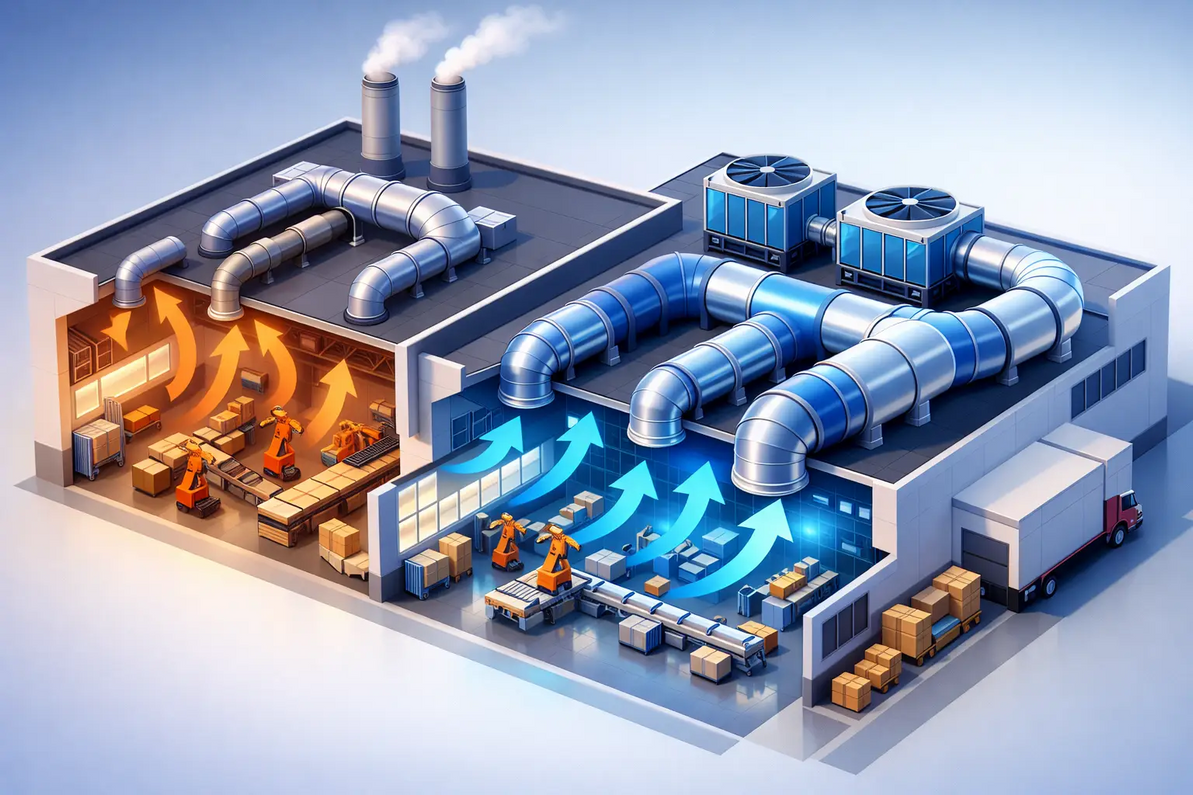
The recommended package included a rebalanced exhaust layout, dedicated make-up air openings, and high-volume destratification fans to break up stagnant hot layers. Instead of relying on random infiltration, the system was adjusted so incoming air entered from controlled wall inlets positioned away from the dirtiest exhaust zones. That gave the building a more predictable sweep pattern across welding, cutting, and assembly areas.
In the hottest process zones, localized exhaust was improved so the central system did not have to do all the work. This is a common miss in factory ventilation. General ventilation helps lower average temperature and improve air exchange, but it should not be expected to capture concentrated heat and fumes right at the source. When source capture and general airflow are paired correctly, the required total airflow can sometimes be lower than a brute-force exhaust-only design.
The project also added variable frequency drive control to selected fans. That gave the plant flexibility to run lower airflow during partial production and increase ventilation during peak shifts. Fixed-speed systems can work well, but where the process load varies, speed control often improves operating cost and helps maintain a better pressure balance across seasons.
Why more exhaust alone often fails
A lot of factory owners ask a fair question: why not just install more roof exhaust fans and move on? The answer is that exhaust without sufficient make-up air turns the building into its own restriction. Fan motors may run, but delivered CFM falls off because the system is starved for replacement air.
That can create several side effects. Exterior doors become harder to open. Air gets drawn in from undesirable areas. Dust and humidity can be pulled from adjacent spaces. In some facilities, negative pressure can even interfere with combustion appliances or process equipment. More fan horsepower does not always mean better ventilation if the intake path is undersized or badly placed.
This is why a factory airflow upgrade example only becomes useful when it includes the full airflow circuit. You need to know where air enters, how it travels through the process area, what resistance it encounters, and where it leaves. If any one of those pieces is ignored, the upgrade may look strong on paper and underperform in the field.
The performance results
After the redesign, the facility reported a measurable drop in average occupied-zone temperature during summer production hours. Conditions still tracked with outdoor weather, which is normal in a non-air-conditioned manufacturing building, but the interior delta was reduced enough to improve worker comfort and process stability. The haze issue near welding was reduced because the airflow pattern no longer allowed contaminants to pool in the middle bays.
The floor also felt different at operator level. That matters more than many people think. Air movement at working height changes perceived comfort even when dry-bulb temperature does not fall dramatically. In industrial buildings, the goal is often not full mechanical cooling. It is to reduce heat stress, remove contaminated air, and keep the building operating within a safer, more productive range.
Energy use did not disappear, of course. The upgraded system used power, and adding controls and better fan selection can raise first cost. But the trade-off favored performance. Instead of running a patchwork of inefficient fans at full tilt with inconsistent results, the facility had a coordinated system matched to the actual operating load.
Where upgrades should start in real factories
The right starting point depends on the building and process. In a welding plant, source capture and smoke control may drive the design. In a packaging or warehouse environment, heat buildup and destratification may be the primary issue. In food, chemical, or specialty production, pressure control and air change rate can be more critical than temperature alone.
That is why airflow upgrades should begin with field data, not assumptions. Facility managers should look at process heat load, existing fan schedules, intake and exhaust free area, ceiling height, machine placement, and whether the problem is seasonal or constant. It also helps to identify whether the complaint is truly ventilation-related. Sometimes the issue is radiant heat from equipment, poor workstation placement, or blocked airflow from racks and partitions.
Static pressure matters here more than many buyers expect. Catalog CFM ratings are only useful when you understand the installed conditions. Filters, hoods, dampers, louvers, and duct transitions all affect performance. If the project includes roof-mount exhaust, wall fans, make-up air units, HVLS fans, or VFD controls, the components need to be matched rather than selected independently.
The best factory airflow upgrade example is site-specific
There is no universal fan package that fixes every manufacturing building. A foundry, plastics plant, machine shop, and assembly warehouse can all have "heat problems," but the ventilation design will differ because the heat source, contaminant profile, occupancy pattern, and building envelope are different.
That is where engineering support changes the outcome. A facility can spend serious money on fans and still miss the target if the airflow path is wrong. On the other hand, a well-designed combination of exhaust, make-up air, destratification, and controls can often solve the problem with fewer surprises during installation and startup. Factory Fans Direct supports these projects with ventilation design guidance, technical review, and product matching for real operating conditions rather than generic rule-of-thumb selling.
If you are evaluating a factory airflow upgrade, treat the building like a system, not a collection of fans. The most effective projects usually start by asking a tougher question than "What fan do I need?" They ask, "What airflow pattern does this process actually require?"
Factory Fans Direct - Commercial & Industrial Ventilation & Cooling Experts | Contact Mike Miller VP Engineering at Factory Fans Direct for a FREE Project Evaluation 888-849-1233 | Mike@FactoryFansDirect.com
Recent Posts
-

AI Smart Buildings Incorporate Edmonds ecoPOWER Hybrid Turbine Ventilation
A building automation system can report rising rooftop temperatures, increasing indoor contaminants, …12th Sep 2026 -
Smart Buildings Architects Recommend Edmonds ecoPOWER Hybrid Ventilation
A rooftop ventilator should not force an all-or-nothing energy decision. Smart Buildings Architects …7th Sep 2026 -
Smart Industrial Buildings Use Edmonds ecoPOWER Hybrid Ventilation
A roof exhaust system can be the difference between a plant that controls heat at the source and one …7th Sep 2026