
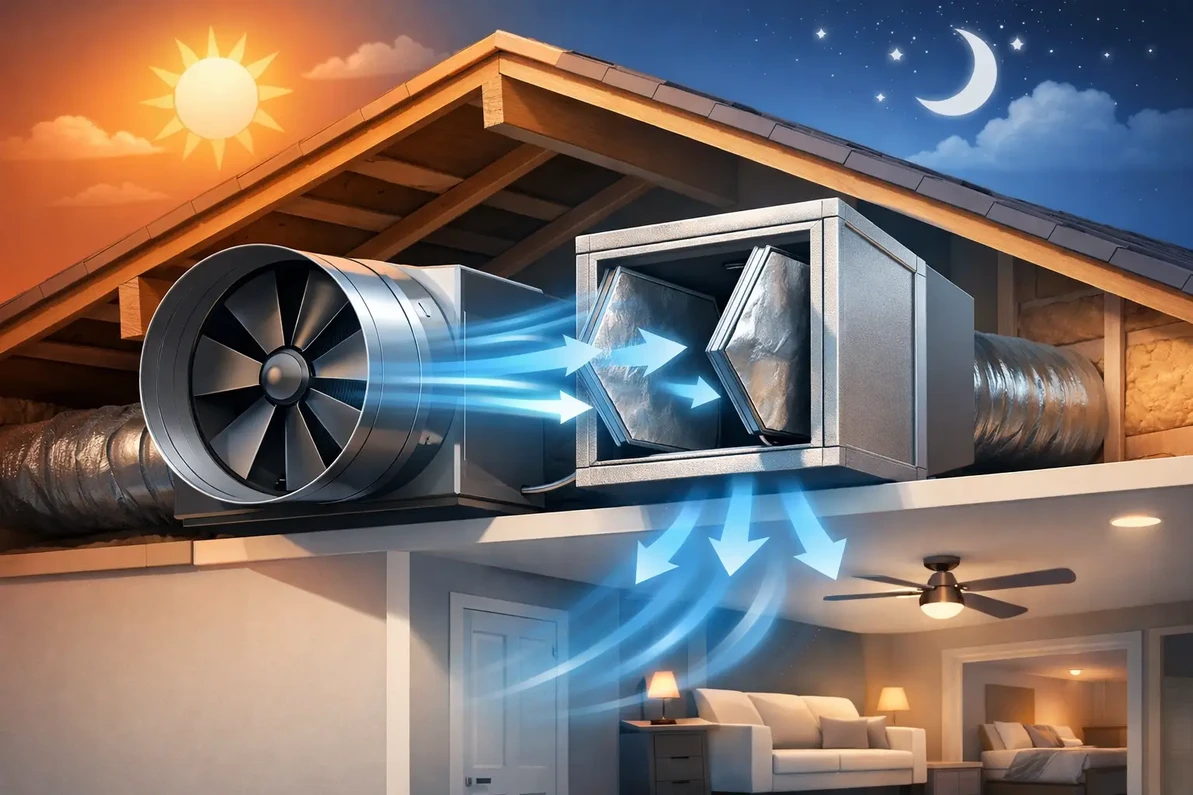
Centric Air Whole House Fans R50 Power Damper
Cold-weather air leakage is the weak point in many whole house fan installations. A fan can move serious CFM in summer, but if the ceiling opening is not sealed properly in winter, you can lose conditioned air and reduce the efficiency of the home envelope. That is exactly where the Centric Air Whole House Fans R50 Power Damper matters. It is designed to give homeowners a much tighter thermal barrier over the fan opening when the system is off, especially in colder climates where standby heat loss becomes a real operating cost.
What the R50 power damper actually does
The R50 power damper is not just a basic shutter. Standard gravity dampers open and close with fan pressure, which is simple and cost effective, but they do not provide the same level of insulation or controlled sealing. The Centric Air R50 power damper uses a motorized insulated damper assembly that opens when the fan runs and closes when the cycle ends.
From a performance standpoint, that matters for two reasons. First, it reduces uncontrolled attic-to-living-space air transfer during the off season. Second, it helps preserve the benefit of installing a premium whole house fan in homes where energy efficiency and envelope control are priorities. If a homeowner is spending more for a quiet, efficient cooling strategy, it makes sense to protect that investment with a better damper system.
Why Centric Air Whole House Fans R50 Power Damper is important in colder climates
In mild climates, a standard insulated door or gravity damper may be acceptable depending on the home and attic configuration. In colder regions, that answer changes. Any opening in the ceiling plane can become a path for heat loss, drafts, and comfort complaints.
The R50 designation points to high insulating value, which is the main reason this option gets attention from homeowners, builders, and contractors trying to balance natural cooling with winter efficiency. It is especially relevant in homes with long heating seasons, high utility costs, or owners who are sensitive to room temperature swings below the fan location.
There is also a practical comfort issue. Homeowners often notice a temperature difference in hallways or upper-floor ceilings where lower-grade dampers are installed. A better-insulated powered damper helps reduce that risk. It will not fix poor air sealing elsewhere in the attic floor, but it can remove one major weak point in the system.
Where it fits in a whole house fan system
A whole house fan is only as good as the system around it. Fan sizing, attic exhaust area, grille placement, and control strategy all affect results. The damper is part of that system, not an afterthought.
If the fan is oversized for the home, noise and pressure issues can show up no matter how good the damper is. If the attic lacks enough net free exhaust area, airflow performance drops and motor load can increase. And if the opening is not well insulated when closed, winter energy penalties can offset some of the savings gained during cooling season.
That is why technically minded buyers should evaluate the damper along with fan CFM, attic ventilation capacity, and climate zone. The R50 power damper makes the most sense when the project goal is not just summer ventilation, but year-round performance.
Installation and application considerations
This is not a one-size-fits-all accessory. The installer needs to confirm compatibility with the selected Centric Air fan model, framing dimensions, electrical requirements, and service access. Powered dampers add complexity compared to passive shutters, so proper installation matters.
Ceiling opening alignment, control wiring, and insulation continuity around the assembly should be handled carefully. A bad install can create air gaps around the perimeter, which undermines the purpose of specifying a high-R-value damper in the first place. In retrofit homes, framing constraints or attic access can also affect whether this option is straightforward or more labor intensive.
For contractors and homeowners, the trade-off is clear. The R50 power damper typically costs more than a basic damper solution, but it can provide better thermal separation, better perceived quality, and fewer winter comfort complaints. In many projects, that added cost is justified. In some milder climates, it may be optional rather than necessary.
Who should consider the R50 power damper
This option is usually a strong fit for homeowners in cold or mixed climates, high-performance homes, energy-conscious retrofits, and buyers who are already selecting a premium Centric Air whole house fan package. It also makes sense when the fan is being installed in a central hallway near bedrooms or frequently occupied spaces where off-season drafts would be more noticeable.
For budget-driven installs in warm regions, a standard insulated damper may be enough. That does not make the R50 power damper unnecessary across the board. It just means the right answer depends on climate, home construction, and performance expectations.
When buyers call for technical guidance, this is one of those specification details that should be discussed early, not after the fan is already selected. Matching the fan and damper to the house is how you avoid callbacks, comfort complaints, and efficiency compromises.
Factory Fans Direct - Whole House Fans Experts | Contact Mike Miller at Factory Fans Direct for a FREE Home Evaluation 888-849-1233 and a $50 discount Coupon and Live Support on the Centric Air Whole House Fans.
Recent Posts
-

AI Smart Buildings Incorporate Edmonds ecoPOWER Hybrid Turbine Ventilation
A building automation system can report rising rooftop temperatures, increasing indoor contaminants, …12th Sep 2026 -
Smart Buildings Architects Recommend Edmonds ecoPOWER Hybrid Ventilation
A rooftop ventilator should not force an all-or-nothing energy decision. Smart Buildings Architects …7th Sep 2026 -
Smart Industrial Buildings Use Edmonds ecoPOWER Hybrid Ventilation
A roof exhaust system can be the difference between a plant that controls heat at the source and one …7th Sep 2026